
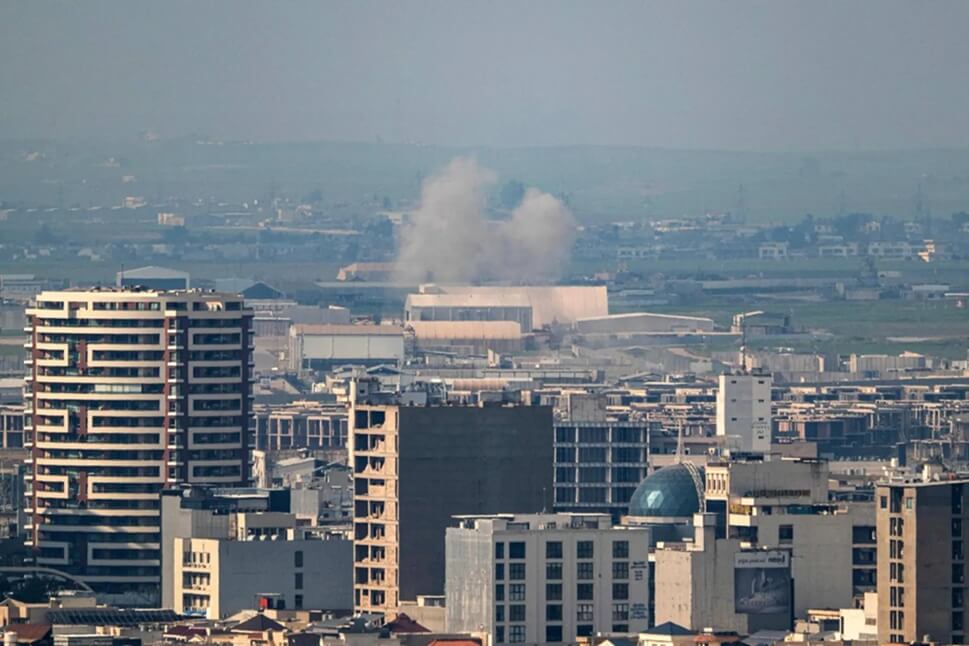
Smoke rises after an explosion near Erbil International Airport in Erbil on March 6, 2026. Photo by: Ozan Kose/AFP
Baghdad (IraqiNews.com) – Iran’s Islamic Revolutionary Guard Corps (IRGC) announced Wednesday that it conducted missile and drone strikes on US military sites in Erbil, pushing the conflict with Washington to Iraqi soil as Tehran continues to assault neighboring nations.
The IRGC claimed that the assault on Erbil, the capital of Iraq’s Kurdistan region, was reprisal for US attacks on Revolutionary Guard targets in Iran the previous night.
The United States Central Command acknowledged that it was executing a fresh wave of attacks on IRGC sites.
Iran claimed that its missiles and drones hit a US maintenance facility and warehouses housing technological equipment in Erbil.
The IRGC also claimed to have attacked the navigation system of a US surveillance balloon and set fire to fuel storage facilities.
There was no quick independent confirmation of the scope of the damage or casualties.
Reports and images circulating from Erbil indicated explosions and flames near US-linked installations, but Iraqi and US officials had not corroborated the IRGC’s allegations at the time of publication.
The incident is especially delicate for Baghdad since Iraq has tried to avoid becoming a battleground in the conflict between Iran and the US.
A direct Iranian assault inside Iraq raises concerns about Iraqi sovereignty at a time when Baghdad is attempting to deepen ties with Saudi Arabia and other Gulf neighbors and attract more regional investment.
Iran’s new reaction has spread far beyond Iraq.
Tehran also attacked US installations in Jordan and Bahrain, according to Reuters, as the renewed conflict stretched to many nations hosting American military personnel. Iran made fresh assertions about attacks on US military personnel in Kuwait.
The strikes exacerbate larger fears among Iran’s neighbors about Tehran’s propensity to exploit their land as part of its conflict with Washington.
During this year’s fight, Gulf nations have already been targeted by Iranian missile and drone assaults, while disruptions in the Strait of Hormuz have hampered regional commerce, oil exports, and trade.
The Erbil attack serves as just another reminder of Iraq’s vulnerability in a battle over which it has little control.
Baghdad has been attempting to strengthen its economic and security ties with Saudi Arabia and other Gulf governments, while also preventing Iranian-aligned armed organizations from using its territory for attacks.
These efforts are becoming more crucial as Iraq pursues Gulf investment in infrastructure, energy, technology, and logistics, as well as to position itself as a commercial bridge between the Gulf, Turkey, and Europe.
The recent US attacks and Iranian reprisal were the most severe escalation in weeks, with fresh conflict driving global oil prices upward.
Baghdad’s immediate issue will be to avoid more assaults on Iraqi land while keeping the US-Iran rivalry—and Iran’s increasingly antagonistic relationship with its neighbors—from jeopardizing Iraq’s own security and developing links with the Gulf.