
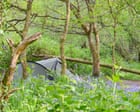
Ancient woodland surrounds the Wray Valley campsite. Photograph: Greydog Images View image in fullscreen Ancient woodland surrounds the Wray Valley campsite. Photograph: Greydog Images Devon holidays I camped in one of Britain’s last remaining rainforests A fragment of temperate rainforest lies on the edge of Dartmoor, and following years of conservation work, its owners have now opened up a sustainable campsite next to this fragile ecosystem
Prefer the Guardian on Google M ist blankets the valley as I wheel my camping gear down the small hill towards a clearing ringed by trees and shrubs. A picnic bench sits at its edge, angled towards the reason why I’m here: one of the last remaining fragments of temperate rainforest in Britain. I’m pitching my tent at Wray Valley Camping, a low-impact site on Dartmoor’s eastern edge between Lustleigh and Moretonhampstead, where I’ll spend five days on one of the site’s “nearly wild” pitches.
Also known as Atlantic woodland, temperate rainforests depend on a rare combination of high humidity, rainfall and consistently mild coastal temperatures where the sea moderates the climate. They once stretched from the western Highlands of Scotland down to Cornwall, covering 20% of the UK , and sheltering rare and delicate lichens and plants. Today more than 95% of our temperate rainforest cover is gone, but Devon’s near-constant dampness and its exposure to the Atlantic make it one of the last strongholds for this rare habitat.
Wray Valley Camping owners Michelle Grist and her partner Kevin Chamberlain have spent seven years restoring this fragile ecosystem while developing the adjacent campsite.
View image in fullscreen Hound Tor is an easy cycle from the campsite. Photograph: Paul Biggins/Alamy “We always intended to run a sustainable campsite from here,” says Michelle, a retired environmental consultant, admitting that neither she nor Kevin (a member of the Dartmoor search and rescue Ashburton team) had ever run one previously. “We did not take it over,” she adds. “We built it from scratch.” Years of camping, both in the UK and abroad, gave them enough experience to know what they liked and what they didn’t. The valley’s topography dictated their designs from the start, Kevin explains – tents only, nothing driven in.
The early years were slow-going: Kevin built a compost toilet by hand before a shower block and other facilities arrived. Running alongside it all was the harder, longer graft of coaxing the temperate rainforest back to life.
“It was actually difficult getting on to the land,” Michelle tells me. “While the drains upland had been cleared, our land was completely flooded.” Michelle and Kevin worked along with several other organisations to restore the woodland, adding 1,200 native plants, 200 metres of new hedgerow and 45 native saplings as well as removing invasive species.
If you’re asking people to make a bit more effort to protect this environment, it tends to attract those who appreciate it Their efforts culminated in February this year, when Wray Valley Camping saw six acres of its 4-hectare (10-acre) estate designated a Devon county wildlife site (CWS) , recognising its importance as one of Dartmoor’s fragile remnants of temperate rainforest and wet woodland. The campsite now offers a unique opportunity to sleep beside this rare ecosystem in one of its four Nearly Wild camping pitches.
A short signposted sustainability trail around the campsite and woodland explains the restoration…