
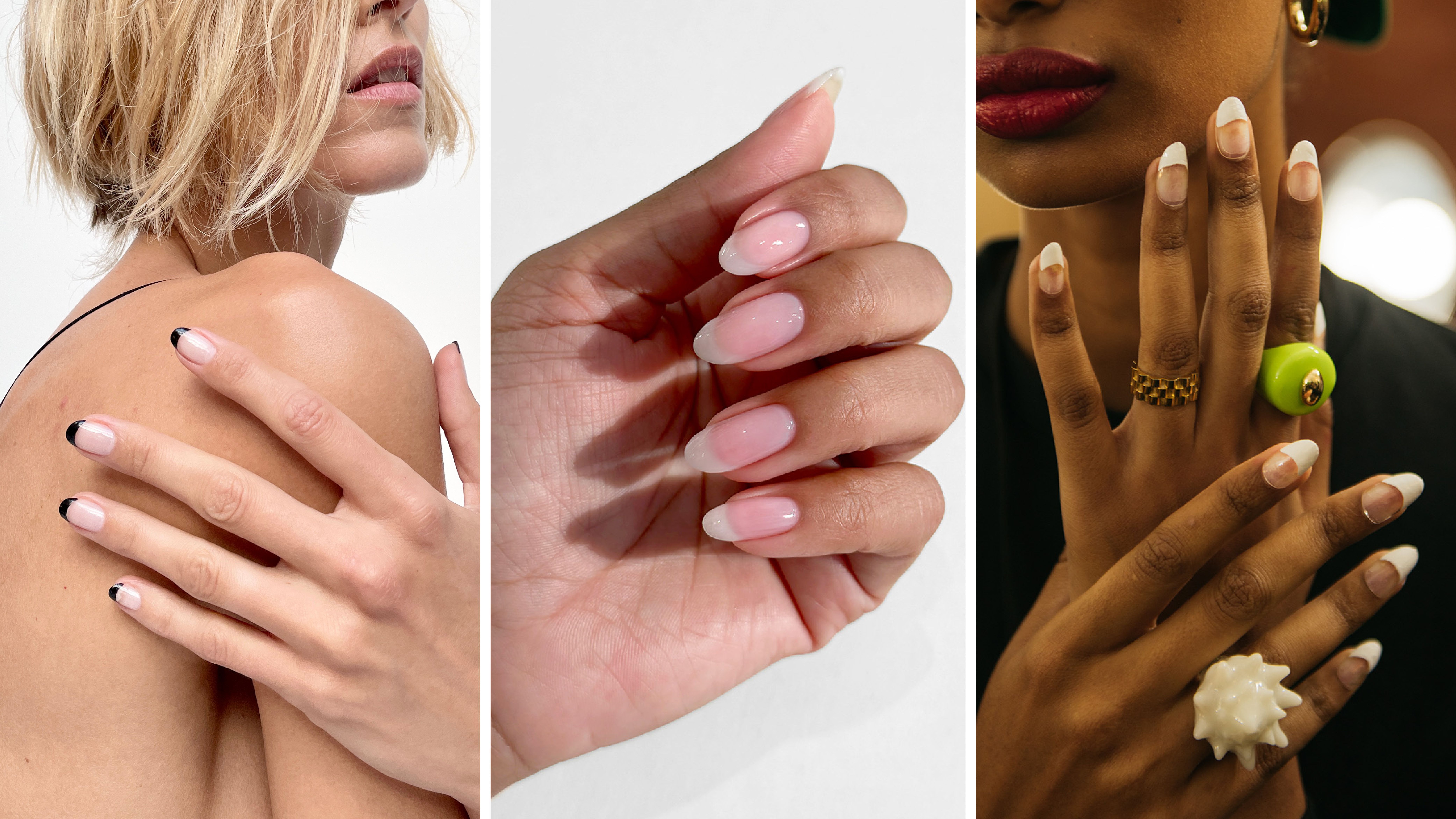
Megan Cencula; Courtesy of JINsoon Save Story Save this story Save Story Save this story I was 13 when my mom dropped me off for my first manicure at my local New Jersey nail salon, sandwiched between a pizza parlor and a Tiger Schulmann’s. My end-of-the-year eighth grade dance was on the horizon, you see, and I wanted to do something tangible to honor my budding womanhood (or, at least, my entrance into high school). The year was 2010, and the most grown-up nail style I could think of was a French manicure , the same one I saw painted on the hands of both glamorous celebrities and fictional characters, like Jennifer Lopez and Elle Woods. The opaque pink base with a bright white polish slashed across the tips was the epitome of femininity, class, and style—until it wasn’t. But more on that later.
The French manicure, in all of its Y2K glory, was introduced to the world pre-millennium. It was 1976 when Jeff Pink, the founder of Orly, is credited with creating it. He’s told the origin story many times before, and he repeated it to me over the phone this past August in honor of the French manicure’s 50th anniversary.
It goes something like this: In the 1970s, Pink owned a beauty supply store that serviced a number of Hollywood studios. He sold beauty products across categories like hair products, makeup, and of course, nail polish to television and movie sets. One day, a director complained that he was spending too much time changing each actress’ nail colors to match their outfits, and asked if Pink could come up with a style that would go with everything. “In the office, I had a white pencil that women used to use to clean underneath the nail, so that gave me the idea to come up with a white nail polish [tip],” Pink says. “At the time, I couldn't get white nail polish because it didn't exist. I had to fight with [a] company to make me one gallon of white polish, and finally they did.”
Jeff Pink, founder of Orly and creator of the French manicure, in 1979.
Pink’s neutral manicure was designed to look like an exaggerated version of the natural nail. Luckily, the director was pleased. “He got so excited and he told me, Jeff, one day you should win an Oscar because you saved the industry so much money,” he says. “I'm still waiting for that.”
In 1976, after his on-screen invention, Pink’s company immediately started producing the style as a kit called the “Natural Nail Look,” et voilà, the French manicure. Although, it would be a few years until it was called the French manicure, and until the look really caught on with the common nail lover.
The turning point came in 1978, when Pink had the opportunity to demonstrate how to achieve his “Natural Nail Look” at Paris Fashion Week, and was suddenly struck with inspiration in the City of Love. “On the way back from Paris to L.A., I said to myself, Jeff, you know what? Natural Nail Look is really kind of cheesy. Maybe you should come up with some other name,” he says. “And then the idea came to me. I just came from Paris. Let's call it French manicure.” And then the French manicure was born.
“[Orly] was really pushing the versatility component, which was important to women of the 1970s,” says Suzanne E. Shapiro , nail historian and author of Nails: The Story of the Modern Manicure . “It was a look that you could wear from the office to your social life that matched any number of changes of clothing would've been hugely appealing at that era.” The style also gained r…