
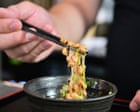
There is evidence that regular consumption of the high-fibre, protein-packed food can boost the immune system, improve digestion and increase bone density. Photograph: Andrew Caballero-Reynolds/AFP/Getty Images View image in fullscreen There is evidence that regular consumption of the high-fibre, protein-packed food can boost the immune system, improve digestion and increase bone density. Photograph: Andrew Caballero-Reynolds/AFP/Getty Images Japanese food and drink It’s a superfood but natto as we know it. Japan’s slimy fermented beans are coming your way Comprised of smelly soya beans held together by strands of mucus, the ancient dish is appearing in health food shops across the world
Justin McCurry in Tokyo Tue 15 Sep 2026 01.54 CEST Last modified on Tue 15 Sep 2026 03.33 CEST Share Prefer the Guardian on Google I t is smelly, slimy and contains bacteria – and a sizeable number of Japanese wouldn’t touch it with a pair of barge pole-length chopsticks. But after centuries as a breakfast food for Japanese diners with nerves of steel, natto is emerging as a global superfood to rival kimchi , kombucha and kefir .
Its exact origins are unknown. Some believe it was introduced to Japan from China by Buddhist monks during the Yayoi period (300BC-AD300), before becoming a staple among rural communities during the Edo period (1603-1868).
A more prosaic explanation is that natto is the accidental byproduct of conflict, based on the legend of Minamoto no Yoshiie, a military commander during the Heian period (794-1185), whose troops discovered that simmered soya beans originally intended for their horses, but which had been left to fester in the heat for days after an enemy sighting, had taken on a viscous, pungent quality. Presumably famished by the demands of battle, they ate them anyway, and liked them enough to offer them to their master, who was similarly impressed.
View image in fullscreen Minamoto no Yoshiie at the boundary to Nakoso, a painting by Suzuki Kiitsu, Japanese painter (1796-1858). Photograph: Culture Club/Bridgeman/Getty Images Whatever their origins, the beans – large, medium and small, or sometimes chopped, hikiwari -style – are finding their way into supermarkets around the world.
Exports are packaged into Styrofoam trays of small paper cups and frozen, their nutritional value unaffected during transit, according to manufacturers.
“We tend to try something new or unusual if we believe it will be good for our health, and that goes for people in the US, Australia and other countries,” said Hidefumi Ito, the president of Natto Kobo (Natto Workshop) Sendaiya , a chain of restaurants where diners can eat as many varieties as they like accompanied by rice, strips of simmered daikon radish and miso soup.
View image in fullscreen A selection of natto on sale at Natto Bar Koganean, a specialist store in Tokyo. Photograph: Justin McCurry/The Guardian Eaten as it is – or with topping ranging from mustard, shredded onion, wasabi and a splash of dashi – natto’s appeal lies in its versatility. It works on toast or as a pizza topping, or mixed with pasta or avocado.
But some Japanese are unconvinced. The dish is still more popular in the country’s eastern and northern regions, where it was used, often in soup, to see households through long, bitterly cold winters, while their counterparts in the west and south have traditionally been more sceptical.
Consumers overseas, though, appear to have overcome any initial resistance to nat…