
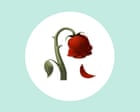
Composite: Guardian Design View image in fullscreen Composite: Guardian Design Emojis The wilting rose emoji: what its rise and fall tells us about gen Alpha It was the fastest-growing emoji in 2025 – but if you’re older than 16, it has probably passed you by. Now, just as twentysomethings are catching up, it’s over
Lucy Knight Tue 15 Sep 2026 06.00 CEST Last modified on Tue 15 Sep 2026 06.01 CEST Share Prefer the Guardian on Google I n the 2025 hit Netflix show Adolescence, DI Luke Bascombe’s 13-year-old son, Adam, has to explain to his father the way his generation use heart emojis. “Red means love, purple: horny, yellow: ‘I’m interested, are you interested?’, pink: ‘I’m interested but not in sex,’ orange: ‘You’re going to be fine,’” he explains. “It all has a meaning. Everything has a meaning.”
And those meanings are constantly evolving. Take the skull (💀), for example, which has come to be used as a reaction for finding something funny – a visual shorthand for the slang phrase: “I’m dead.” Or the wilting rose (🥀) which was, according to Google data analysed by the New York Times , the fastest-growing emoji in terms of popularity in 2025 – and was the 93rd most used. That the previously obscure wilting rose is now in the top 100 emojis is thanks to generation Alpha (those born between 2010 and 2024), who use it in place of the broken heart emoji (💔) to signify sadness, or ironically, to suggest mock-heartbreak.
This use of the wilting rose (also known as wilting/wilted flower or dead rose) is an example of what the American linguist Adam Aleksic refers to as a “forced emoji” – when an emoji has a meaning consciously projected on to it, rather than being used intuitively. He thinks the start of the wilting rose’s popularity among gen Alpha can be traced back to JuggTok, a community of meme accounts on TikTok that focus on ironic humour. In early 2025, videos started to appear stating that the broken heart emoji was becoming overused and “mainstream”, suggesting the wilting rose as an alternative.
“There’s a constant cycle of which emojis are popular,” Aleksic explains. Using the ones that haven’t yet gone mainstream “signals your in-group awareness of which joke is currently popular”. Using emojis “naively” – in other words, the way most over-30s use them, eg a laughing face to express laughter – is a reason for others to make fun of you. “At this point, it’s uncool to even use the skull emoji,” he says.
Read more Forced emojis don’t always work. Aleksic makes a comparison to the the film Mean Girls, in which high schooler Gretchen tries to make “fetch” the new cool slang term, only to be told by the school’s queen bee, Regina George, to “stop trying to make ‘fetch’ happen”. In fact, since the wilting rose’s spike in popularity, some have tried to replace it with the dead battery emoji (🪫) – but it doesn’t seem to have had the same staying power as the wilting rose. That one has probably endured, says Aleksic, because “there is something intuitive about it. The rose was supposed to be a symbol of something good, and then it wilts – there’s a feeling you can express in that.”
But the way we communicate is changing so quickly that emojis in general might be losing their appeal among young people, says Aleksic. “Stickers are becoming more popular overall,” he says, predicting that “there could be a shift away from these preset icons that the apps hand you, and more toward reaction images”.
Whether it’s slang terms, emojis or s…