
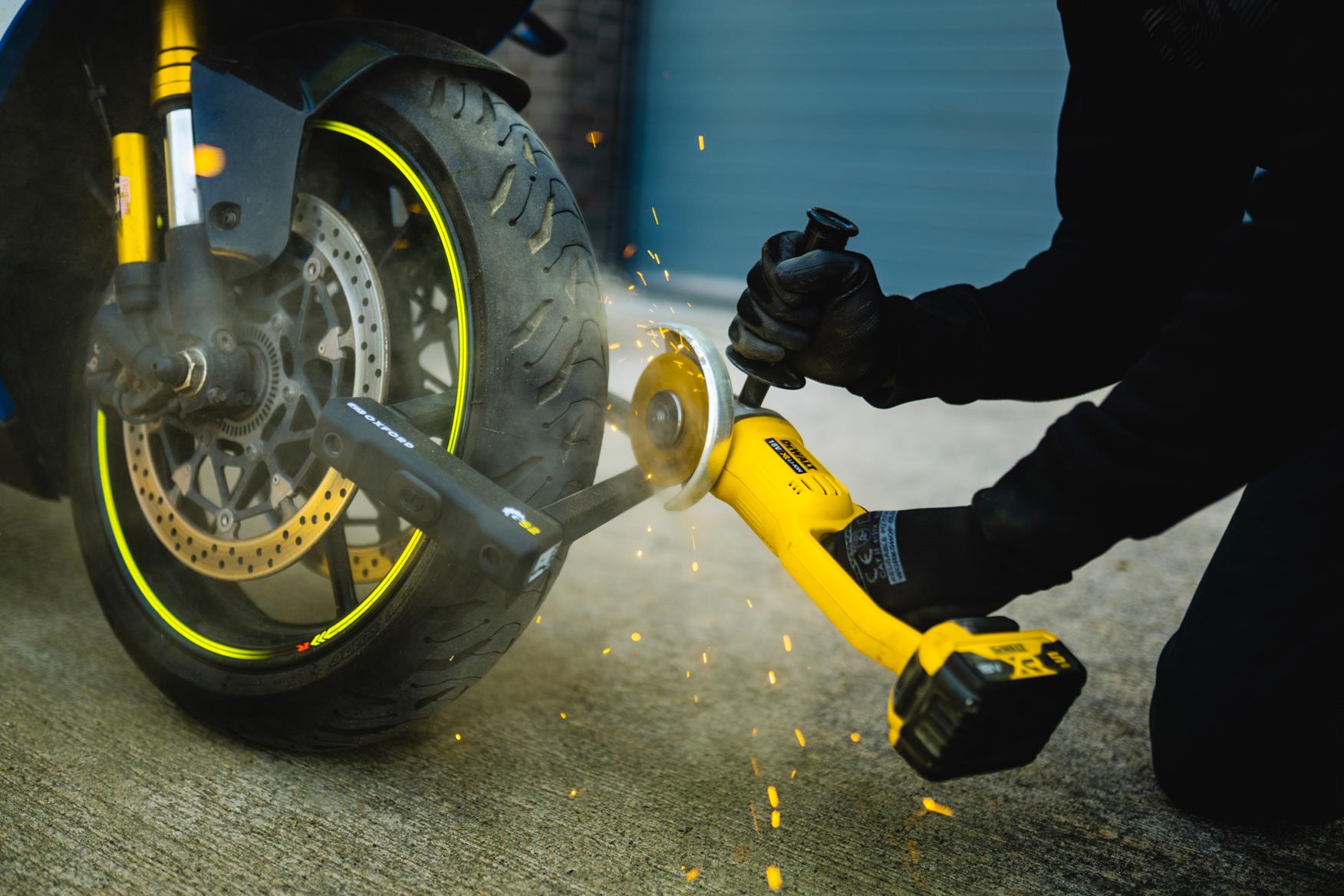
Oxford have unveiled a new pair of D-locks, the Grinder S1 and S2, which the firm say are virtually angle grinder-proof thanks to a silicon carbide coating on the shackle.
Motorcycle security remains a major concern for riders, with thousands of thefts reported every year and the angle grinder now the tool of choice for many thieves. Lock manufacturers have responded with hardened steel cores and various coatings designed to resist grinder attacks while staying portable enough to carry.
Oxford say it would take an average of 10 discs to cut through one side of the 14mm-shackle Grinder S1, rising to 15 discs for the 16mm-shackle Grinder S2.
“A few years ago we started looking at angle grinders as being a serious threat, and we developed our Beast range at that point,” Oxford’s Head of Product Design, Kris Doe, told MCN. “Our Beast range is mechanically resistant to angle grinders just by its design – the dimensions and geometry of it prevent an angle grinder disc from reaching the centre of the pin, which means they are indestructible by angle grinder.”
Despite that, Doe said the market had moved in a different direction. “Marketing from the rest of the world has dictated that consumers want a lock that has a coating, or something that makes it angle grinder-resistant. That’s the route we’ve ended up going down with Grinder. Angle grinders are the biggest attack on all locks – that’s the main tool we’ve seen being used in the UK, and consumers are demanding an angle grinder-proof lock.”
Oxford say they studied the wider market closely before launching their own coated design. “We’ve watched what everyone else is doing in the space, and we’ve tested every lock out there,” Doe said. “We took our time entering the market because we were late to it in the first place.
So we thought, as we’re late to it, we might as well make sure our product is better than everyone else’s. We did a lot of testing, a lot of research, and spent a lot of time with our suppliers and with different institutes testing material options, before concluding we were going to use a silicon carbide coating.”
While Litelok use their own compound called Barronium and Hiplok buy in a flat sheet component called Ferosafe from security materials specialist Tenmat, Oxford have opted for silicon carbide, an extremely hard compound also used in sandpaper and ballistic body armour.
The silicon carbide coating itself is applied in a process similar to anodising. “You place the shackle into a liquid bath, apply an electrode, and the crystals form onto the outside of the shackle,” said Doe. “The way it works against a grinder disc is down to its shape – it’s a multifaceted surface, with lots of flat edges.
“As the rotating blade hits one facet, it gets bounced onto the other, and essentially vibrates the disc. In doing so, you vibrate the disc to death. You’ll see videos of this being tested, and if you test them yourself, you’ll see clouds of dust coming up – that’s just the disc disintegrating.”
Doe said the technology isn’t entirely new to the security world, though Oxford have developed their own application of it. “It’s derived from existing technology, but we’ve developed it ourselves for this application,” he said. “There are others using similar versions of silicon carbide in security.’
The Oxford Grinder S2 costs £219.99, with the S1 costing less at £179.99 for the short and £199.99 for the longer version. This is significantly less than the competition, which Do…