
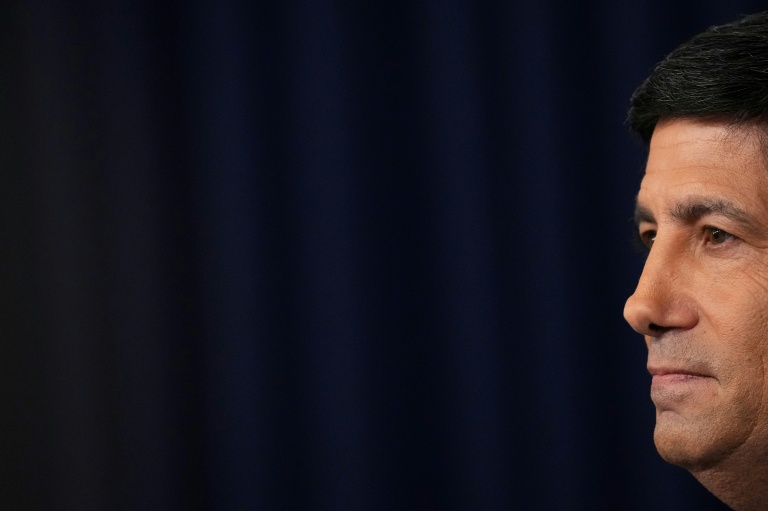
Kevin Warsh’s post-meeting comments were taken as hinting towards more interest rate hikes
Hong Kong – Most equities rose Thursday after the Federal Reserve hiked interest rates for the first time in three years and boss Kevin Warsh sounded a hawkish note that ramped up bets on another increase as officials fight surging inflation.
Investor sentiment was also given a lift by hopes for a pick-up in oil supplies from Saudi Arabia after the country moved to restore some capacity from a pipeline it closed at the weekend following drone attacks.
In a unanimous decision, the Fed lifted borrowing costs for the first time since 2023, defying President Donald Trump’s demand for cuts, as Warsh stressed the need to combat inflation that has been “too high” for “too long”.
“We removed a dose of accommodation so that financial and credit conditions would be more consistent with our ultimate objectives,” Warsh said after the announcement.
“Today’s action starts to show we’re serious about this, and we will deliver on the price stability objective.”
The decision was announced along with a graph showing the vast majority of Fed policymakers saw at least one more was likely necessary before the end of the year.
Traders now see an October hike as being a 50:50.
While Wall Street’s three main indexes ended Wednesday in the red, Asian traders took the 25-basis-point lift more positively, with analysts saying it shored up credibility in the central bank and provided some reassurance over officials’ determination to beat inflation.
Long-term government bond yields — which this week touched two-decade highs — fell as investors pared back their inflation expectations, which at 3.4 percent is currently well above the bank’s two percent target.
“Removing a dose of accommodation is not the language of a central bank that believes it has completed the job,” said Stephen Innes at Quintex Intel.
“It suggests policy was still providing support before Wednesday and may not yet be restrictive after it.
“The hike removed the immediate credibility question. The explanation created a new argument about how much tightening remains.”
And Christian Scherrmann at DWS added: “Overall, we believe the main motivation this time was credibility, given bond market pricing and recent developments in oil markets.”
Still, he added: “Despite his hawkish stance, Fed Chair Warsh’s optimistic outlook on the economy may be music to many ears.”
Equity markets across Asia were mostly higher in early trade.
Tokyo, Seoul, Singapore, Taipei, Wellington and Jakarta all advanced, though Hong Kong and Shanghai dipped.
However, Tai Hui, of JP Morgan Asset Management, warned: “We think the chance of U.S. policy rates returning to above five percent is still limited.
“Nonetheless, a catalyst to extend the equity bull market (lower interest rates) is looking unlikely in the foreseeable future.”
The news angered Trump, who called Warsh a “good man” who had “a hostile board”.
“They’re raising the rates to make Trump do as bad as they can possibly do… So they’re raising that only for political reasons, and that’s a raise against Trump,” he complained.
While the Middle East crisis continues to weigh heavily on sentiment and oil prices above $1…