
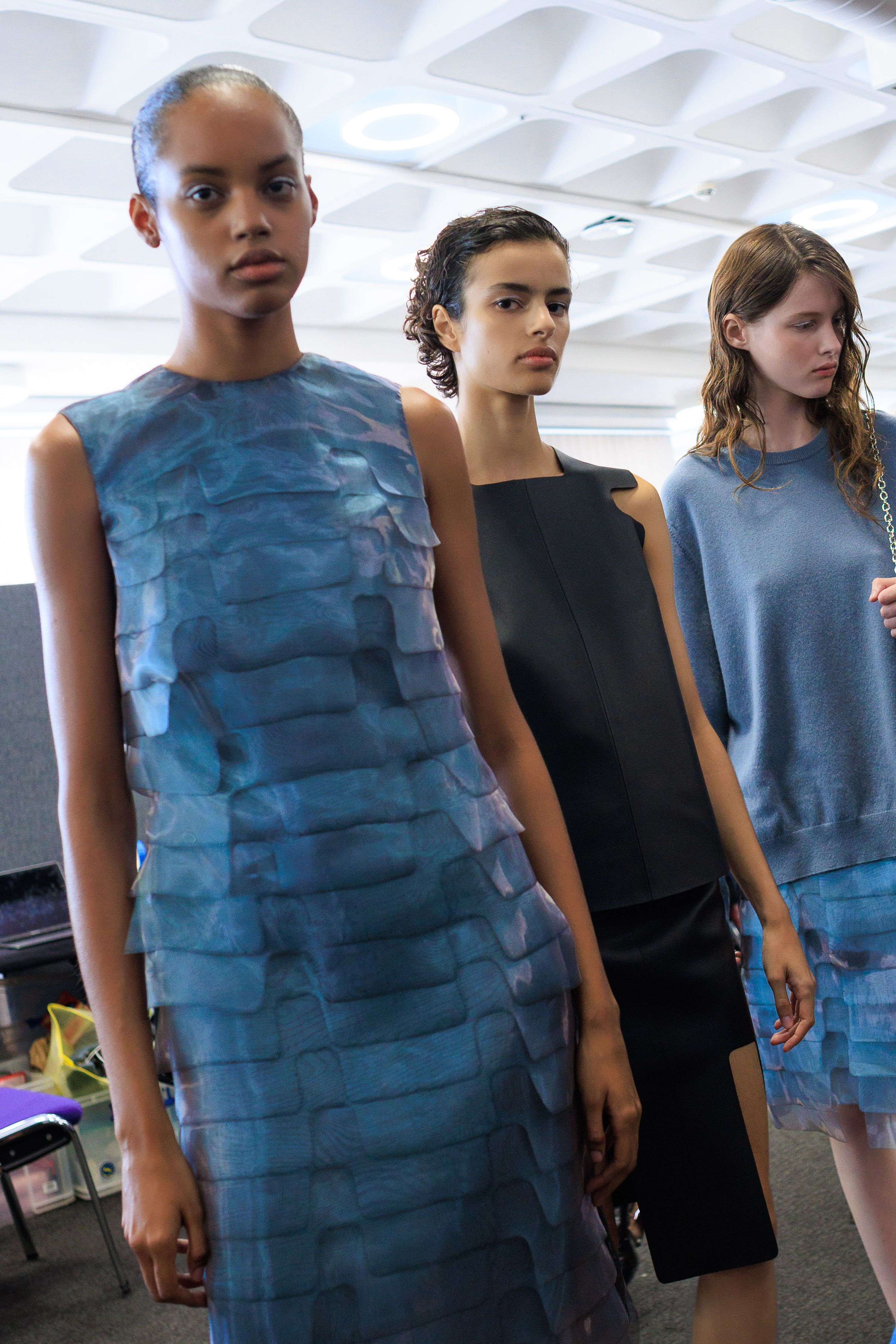
Christopher Kane’s Mulberry debut was the talk of the town. Photo: Acielle/Style Du Monde Save Story Save this story Save Story Save this story London Fashion Week (LFW) Spring/Summer 2027 was a season of milestones and renewed optimism in a city that has struggled to maintain industry pull the past few years. Headlined by a “rather marvelous” Mulberry debut” from Christpher Kane — following the protracted closure of his own label in 2023 — and a more divisive homecoming show from Seán McGirr’s McQueen, the schedule offered strong propositions, with emerging and household names generating buzz among editors, buyers and content creators. (McQueen will remain in London for the foreseeable, per CEO Gianfranco D’Attis .)
Burberry bookended the week with a show that was both parts kooky — featuring offbeat prints and badged designs — and commercially minded, primed with easygoing tailoring, track jackets, and hefty denim. A surprise cameo from rapper Central Cee gave the show a quintessentially British star factor, while the front row was curated to match this Made in Britain sensibility: Jason Statham, Stephen Graham, Kano, and Tems.
Elsewhere on the ground, insiders were energized, reflecting a broader stabilization in the luxury market and a renewed momentum unique to London. In a breakfast conference at the beginning of the week, the British Fashion Council’s (BFC) chair David Pemsel — who will leave his role on September 30 after a decade on the board — gave his swansong speech for the non-profit organization, welcoming in his successor Pavita Cooper and noting fashion’s £67 billion contribution to UK economy. “British fashion travels. It has huge cultural currency, both economically but also on the wider scene,” he said, celebrating the distinct ecosystem that helps young designers thrive. “There are moments where we worry about the economic climate, but creativity is a superpower. Where creativity thrives, I know economics always follows.”
From left to right: Mulberry SS27 and McQueen SS27
The BFC’s CEO, Laura Weir, also gave a notably upbeat speech, highlighting a shift in tactics she and her team have ushered in with the 2030 strategy , which focuses on clarifying the significance of British fashion on a global scale — giving the BFC and designer communities leverage with the UK government, partners, and international investment. The UK government’s Department for Culture, Media and Sport (DCMS) has pledged £3 million for the next three rounds of NewGen — a support program for emerging design talent in London.
Nonetheless, the DCMS does not plan to introduce a tax-free shopping scheme in the UK, despite industry calls for it. “The UK’s fashion industry is a vital part of our creative economy, from textile mills in the Scottish Highlands to independent retailers on the Cornwall coast,” a DCMS spokesperson shared with Vogue Business . “The government is committed to working hand in hand with designers, manufacturers, and retailers to support growth and creativity across the sector.”
Weir’s developing four-year plan could help reposition London as an unmissable pit stop in the global fashion week circuit. And this season, that was already felt. Vogue Business noted a marked presence of international brands and retail powerhouses engaging with the week, not to mention high-profile audiences at the shows. Stars like Alexa Chung, rapper Skepta, actor Joe Locke, and singer Tems were spotted across front rows throughout the week.
Con…