
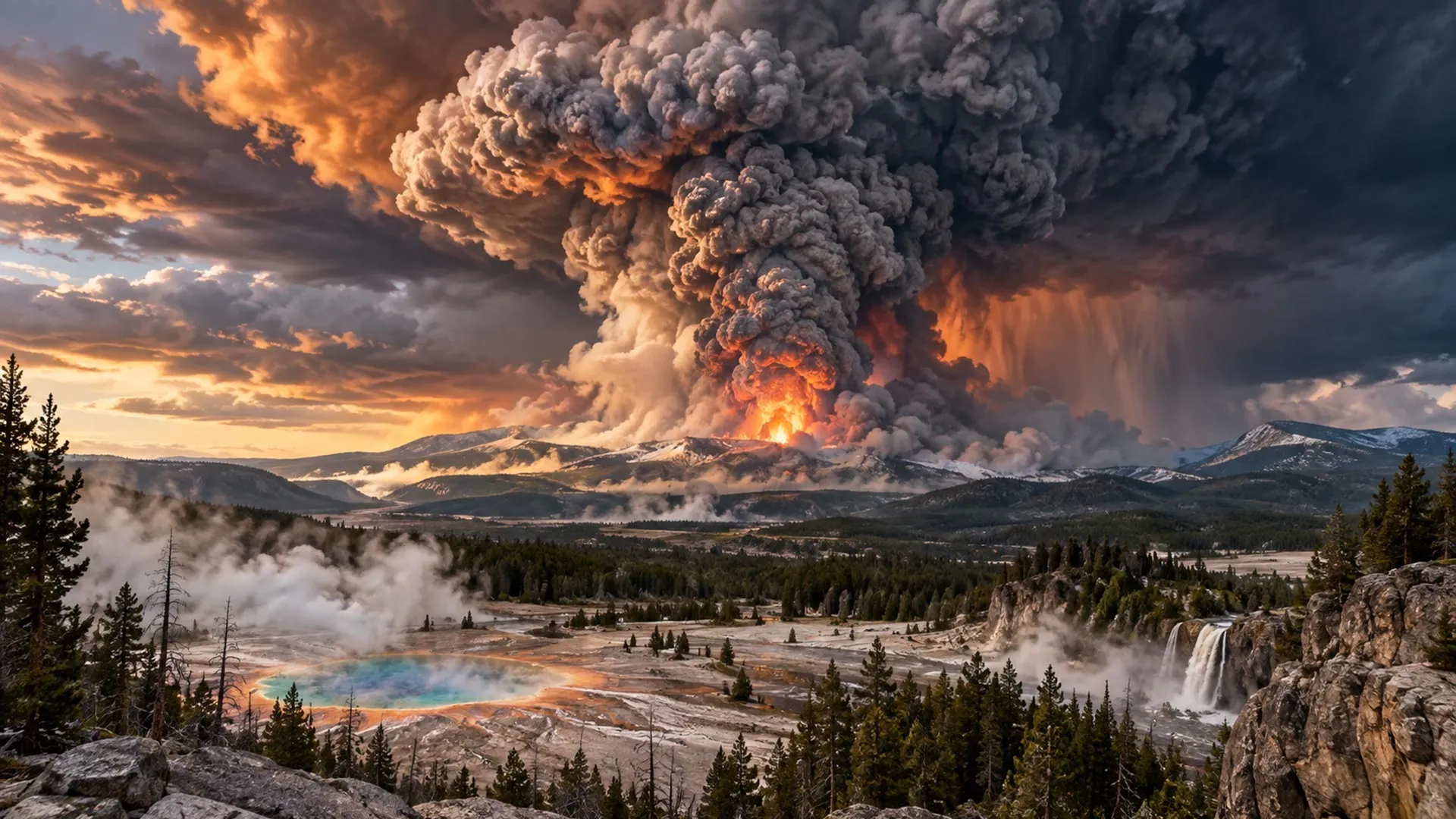
Around 631,000 years ago — a geological blink of an eye — catastrophe unfolded in what is now north-western Wyoming, US. During what is thought to have been a series of immense volcanic eruptions, life within hundreds of kilometers of the blasts was shattered. Ash was dispersed across much of North America and the effects were felt worldwide. This was a super-eruption of the massive volcanic system located in what is now the Yellowstone National Park.
Despite the scale, no known human witnessed the cataclysm . As far as we know, early humans had not yet reached the continent. Across oceans, perhaps early humans did wonder at the hazier skies and unusually vivid sunsets. Volcanic particles circulating in the sky cooled their climate and likely affected their weather patterns and lives. Whether they noted these changes – or connected them to any distant event – is unknowable.
Today, humanity would certainly notice. We already know that a super-eruption on this scale would be a threat civilization as we know it. So what exactly would we experience if Yellowstone erupted? We are experts in disasters and volcanoes and what follows is a thought experiment into what might happen in the worst case scenario. We’ve based our hypothesis on research and by examining how countries have dealt with disasters in recent years.
Shortly after 6am, an analyst at the University of Utah Seismograph Stations sees a series of sharp spikes interrupting the usually quiet wavy lines recorded by Yellowstone’s earthquake monitors. The measurements represent earthquakes detected beneath Yellowstone overnight. The scientist raises an eyebrow and takes a deep breath – these observations don’t fit with Yellowstone’s usual behavior.
People often imagine Yellowstone as a sleeping “supervolcano.” It may sleep, but its geological processes never do. An array of instruments monitors its activity – and any changes in it. A dense network of seismometers records earthquakes in the region. Around the clock, data feeds in from GPS stations, strainmeters (instruments which measure deformations and changes in the shape of the Earth’s crust) and sensors positioned within its active geyser areas. Satellite observations, gas sampling and field surveys add plenty more information.
Scientists look at the number of earthquakes along with their location, depth and size. Earthquake “swarms” warrant particular attention, especially when they appear to be migrating through the crust (Earth’s solid, outermost rocky shell) or becoming progressively shallower. Such patterns can indicate that magma or pressurized hydrothermal fluids (hot, mineral-rich water) is moving upwards.
Our scientist is relieved to discover that most of the unusual tremors are tiny — too weak to have been felt. But together, they form an unusually concentrated swarm. The analyst checks the signals against neighboring seismometers and, more out of curiosity than concern, contacts colleagues at several partner organizations comprising the Yellowstone Volcano Observatory (YVO) in order to follow YVO’s response plan .
They deduce that, overnight, instruments have recorded a tightening cluster of earthquakes beneath Yellowstone’s vast caldera, which is roughly 55–70 kilometers across. Yellowstone experiences thousands of earthquakes each year , and swarms are not unusual. But this one appears to be mi…