
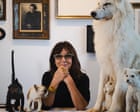
‘I don’t always tell the truth’ … Sophie Calle in her studio in Paris. Photograph: Rasmus Quistgaard / Louisiana Channel View image in fullscreen ‘I don’t always tell the truth’ … Sophie Calle in her studio in Paris. Photograph: Rasmus Quistgaard / Louisiana Channel Sophie Calle Interview ‘Sometimes I do cruel things – and it’s worth it’: the fabulous shameless art of the great Sophie Calle Chloë Ashby The French artist has stalked people, posed as a hotel maid to get into rooms, and filmed her mother’s last breath. Has she any regrets? Non! As a major UK show opens, she recalls her career highs
Prefer the Guardian on Google I ’ve read enough interviews with Sophie Calle to know that the conversation ahead could be tricky. France’s most famous conceptual artist can be a touch evasive. Which is why I’m so surprised by the woman before me, who is friendly and seemingly open, all smiles. She’s wearing big tinted glasses, and behind them I picture her eyes twinkling. Then, 10 minutes in, she tells me she is obsessed with absence. When I ask why, she says: “Why do you live in England? Why are you wearing that sweater? I am not here to do therapy with you.”
She is talking to me from the same Paris apartment she has been living in for almost 50 years. Hanging from the ceiling is a disco ball, and, alongside pictures and books, there are boxes that I imagine are filled with the innermost thoughts and feelings of her subjects. Since the early 1980s, Calle has made a name for herself with art that is at once intimate and detached, morbid and playful, immersing us in the lives of others – and in her own life, too. With a camera and a notebook in hand, she has invited strangers to sleep in her bed, posed as a hotel maid to document the belongings of guests, and called everyone in a lost address book to build a peculiarly tender portrait of its owner. Now, at 72, she is about to open her first big show in the UK for nearly two decades.
I didn’t know what to do with my days. So I followed people to see what they did with theirs “I became an artist to seduce my father,” she tells me, matter of fact. He was a doctor and a collector of pop and conceptual art. She was 26 and “very lost”. He wasn’t happy with how she’d been spending her time, hitch-hiking around the world with no money or sense of purpose. When she returned to Paris and peered at the works on his walls, she thought it might please him if she made art too. “I could not paint,” she says, “but I enjoyed writing, and taking photos seemed possible. I did not know what I was doing or where it was going, but I was confident.”
View image in fullscreen Water therapy … a Turkish man sees the sea for the first time in 2011’s Voir la Mer . Photograph: © Sophie Calle / DACS, London, 2026 Courtesy of the artist and Perrotin Right away, she started following people. “I did not know what to do with my days,” she explains. “So I thought, ‘Let’s see what other people do with theirs.’ Immediately, I liked the feeling of not having to decide; it was both restful and active.” In 1980, she stalked a man she’d met at a party from Paris to Venice, tracing his movements in time-stamped entries and photographing him in his raincoat as he passed through the twisting city streets, unaware of the woman in the blond wig following just a few steps behind.
Her new exhibition, Something Missing ? at Turner Contemporary in Margate, brings together photographs, videos and installations from 1986 to 2024. It is about a…