
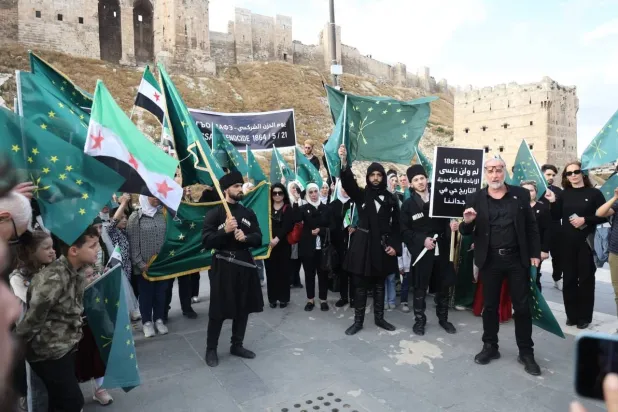
The Circassians of Syria have renewed their rejection of Israeli Prime Minister Benjamin Netanyahu's statements last May, where he described the Druze and Circassians as "brothers in blood and brothers in life." Their leaders in the Syrian Golan stressed to "Asharq Al-Awsat" that they are an integral part of the Syrian society, loyal to the state and its new leadership, and that "he who usurps the land is an enemy."
The villages of Bureika and Beer Ajam, inhabited by a majority of Circassians in Quneitra Governorate in southern Syria and the surrounding villages, are witnessing a severe demographic drain due to repeated Israeli assaults, leading them to become almost empty of their residents, according to media statements from there, last October. The residents attribute this retreat to intensified Israeli military activity, continuous surveillance operations, and restrictions on movement and mobility imposed on the population.
The mukhtar of the two villages, Saif al-Din Jawish, said: "We, the Circassians, live in these two villages in peace, and for months Israel has arrested some of our children; we are tired of wars and want peace and security."
Israel's practices and Netanyahu's words have met with a firm rejection from the Circassian institutions in Syria. The "Circassian Council of Tribes in Syria" issued a statement clearly announcing its total rejection of any attempt to exploit the name of the Circassians or involve them in colonial projects or political propaganda, whether in the past, present, or future.
The presence of Circassians in Syria dates back to the late 19th century, coming through Anatolia and the Balkans from their original homeland in the North Caucasus after the war waged against them by the Tsarist Russia between 1763 and 1864, which resulted in the killing of more than two million of them and the displacement of over 1.8 million.
The Circassians are distributed across most Syrian governorates, especially in Damascus and its countryside, Aleppo, and the Golan Heights. Estimates indicate that their number in the overall governorates ranged before the uprising against the Assad regime in 2011, between 400,000 and 500,000, which has now decreased to 200,000 - 250,000 due to immigration abroad in the past years like the rest of the Syrians.
Among the areas inhabited by the Circassians are 18 towns, villages, and gatherings in the Golan Heights located in the southwest of the country, with an estimated total area of 1860 square kilometers, of which Israel occupied about 1250 square kilometers during the June 1967 War. Like other residents of the plateau, the Circassians were displaced as a result of that war to other areas within Syria.
Under the disengagement agreement signed between Syria and Israel in 1974 after the 1973 War, Syria regained a part of the Golan Heights, including towns and villages inhabited by a majority of Circassians, namely the town of "Beer Ajam" and the villages of "Bureika" and "Al-Qahtaniyah."
A site for United Nations forces overlooking the Israeli bulldozing operations in Beer Ajam (Asharq Al-Awsat)
The mayor of Beer Ajam, Fouad Ibrahim, told "Asharq Al-Awsat" that "the Circassians adhere to their Syrian identity and take pride in belonging to Syria. This has been expressed by the Circassian Tribal Council in Syria, the Circassian Charitable Society in Syria, and the Circassian Advisory Council in Syria, all of which clearly stated their firm rejection of Netanyahu's statements and their pride and esteem in belonging to Syria and the new Syrian state, and working with other sections of the people to build this homeland and preserve its lands and unity."
An Israeli military vehicle infiltrating the town of Saida Al-Hanout in the southern Quneitra countryside in mid-January (Syrian News)
Israel announced since the very first day of the fall of the Assad regime in late 2024, the end of the 1974 agreement, to begin incursions into the towns and villages of the buffer zone in the Syrian side adjacent to the disengagement line. It has established about 10 advanced military bases there. The continuous Israeli incursions to this day have exceeded the buffer zone and affected towns and villages outside of it.
Ibrahim explained that the Beer Ajam municipality sector includes the villages of Ruweihina, Zubaydah, Beer Ajam, and Bureika, and the total area of these villages is about 10,000 dunams, while the length of its western side adjacent to the disengagement line is about 8.5 kilometers.
He explained that the berm built by the occupation inside the Syrian side of the buffer zone and along the western side of those villages is located at a distance varying between 100 and 400 meters approximately from the disengagement line, thus it has cut off 4,000 dunams of land owned by the residents.
As is the case in the towns and villages where the Israeli army incursions occur in the Quneitra and Daraa countrysides, its incursions have had catastrophic implications on all aspects.
The number of inhabitants of the villages of Ruweihina, Zubaydah, Beer Ajam, and Bureika is estimated at about 3,000, over 80 percent of whom work in agriculture and livestock farming.
Israeli soldiers gather near the ceasefire line between Syria and the occupied Golan Heights on December 9, 2024 (Reuters)
Ibrahim clarified that the lands seized are agricultural grazing lands depended upon by livestock breeders, but the occupation now, by preventing the residents from grazing their livestock, has forced them to buy fodder at very high prices; a situation that has reflected negatively on their profits and living conditions.
The consequences of the Israeli incursions have also affected many charitable organizations and associations that, according to Ibrahim, refuse to work in the sector; fearing for their staff and personnel from the continuous incursions and the checkpoints established by its patrols and the inspections of passersby and homes.
Additionally, a large number of families who immigrated to Arab and Western countries during the war; fearing persecution from the fallen regime due to their pro-revolution stances, have not returned after the liberation due to the new security situation.
"City of Peace" in Quneitra Governorate on the edge of the occupied Golan Heights (AFP)
The mayor of the City of Peace in the middle countryside of Quneitra, Mariam Dougoz, emphasized in her interview with "Asharq Al-Awsat" the Circassians' rejection of Netanyahu's words, stating: "This statement is rejected, and our position is clear: he who usurps the land is an enemy."
She added that the suffering experienced by the residents in those villages is "severe," due to their prevention from accessing their agricultural lands or grazing their livestock in the lands.