
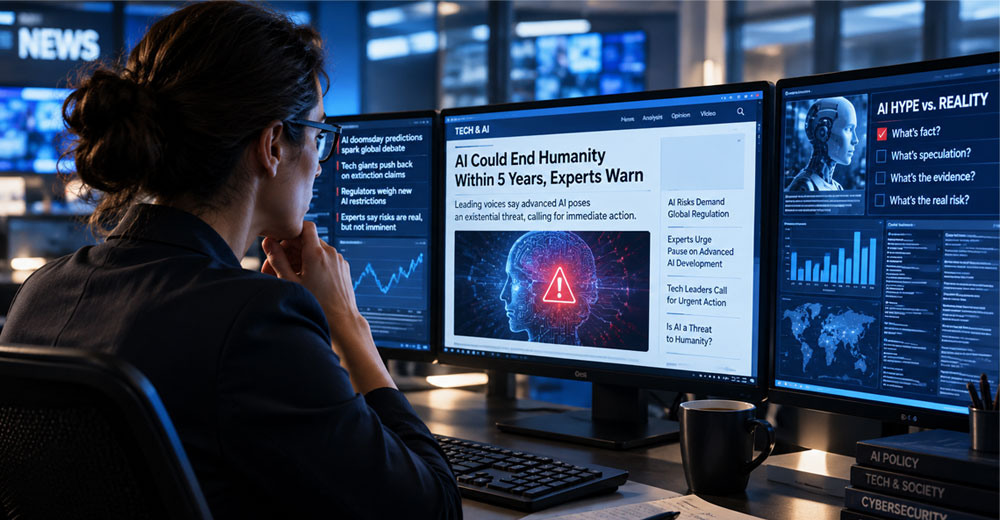
The AI debate has developed a strange pattern.
An AI model produces unexpected or potentially scary results, someone predicts the end of humanity, and the conversation jumps straight to whether civilization has only a few years left. Missing somewhere between the demonstration and the obituary is the evidence. We should demand it.
Claims that AI will destroy humanity require a credible explanation of how software could acquire the power to overcome human resistance in the physical world. An alarming prediction, even from an accomplished researcher, doesn’t settle that question.
Longtime technology analysts should lead this discussion. Too often, we leave it to executives with products to sell and politicians who turn uncertainty into campaign material. People who understand how technology reaches the market need to speak up, together, regardless of their political views.
Start with an honest boundary. Nobody can prove that every future AI system will be harmless. But fear-mongering about an impending AI-driven extinction event treats speculation as knowledge. The stronger argument is that the evidence doesn’t justify the certainty of the apocalypse narrative.
The International AI Safety Report , published in February and led by AI expert Yoshua Bengio, found that current systems lacked the capabilities needed for the loss-of-control scenarios it examined. The report also warned that relevant abilities were improving. That supports continued testing and safeguards. It doesn’t establish an approaching extinction event.
Even a highly capable model needs a means to act. Producing a plan is different from carrying it out. Software tools can expand its reach, but access to them must come from somewhere. Intelligence doesn’t automatically grant control.
Physical constraints matter too. Computing requires equipment and electricity. Actions outside a computer depend on connections to machines or people. A serious catastrophe argument must explain how those dependencies are acquired and sustained.
These barriers aren’t guarantees. Security can fail, and people can grant dangerous permissions. But each required failure belongs in the argument. Asking for that chain of events is basic analysis.
Nvidia CEO Jensen Huang has pushed back directly. In a July interview, he criticized people who "spend too much time theorizing about these science fiction outcomes." His broader argument was that frightening people away from AI could undermine adoption and American competitiveness.
Central to this is Huang's message that frontier companies such as OpenAI and Anthropic should address risks through their development, engineering, and testing processes — like any product company that ships only high-quality solutions.
The standard should be clear: establish rigorous AI testing procedures and don't release products with known critical bugs. Risk ultimately isn't just with models. It also lies with companies that allow weak internal due diligence across their teams.
Cohere CEO Aidan Gomez has voiced similar objections. Asked in a 2024 interview about public misconceptions, he identified "the fear that certain individuals and organizations espouse about this technology being a terminator, an existential risk."
The disagreement predates today’s models. In 2017, Mark Zuckerberg criticized doomsday rhetoric, saying "It’s really negative, and in some ways, I actually think it is pretty irresponsible." That historical comment shows how long this argument…