
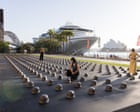
‘People want you to behave, want you to be a nice guy’: Ai Weiwei, whose work Mushrooms is on show outside the Museum of Contemporary Art in Sydney. Photograph: Linda Nylind/The Guardian View image in fullscreen ‘People want you to behave, want you to be a nice guy’: Ai Weiwei, whose work Mushrooms is on show outside the Museum of Contemporary Art in Sydney. Photograph: Linda Nylind/The Guardian Ai Weiwei Ai Weiwei unveils his epic new Australian work: ‘90% of art is just garbage. Real art questions the existing order’ From his farm in Portugal, the acclaimed artist speaks about war, peace, the state of the world – and his 40 metre sculpture Mushrooms, on Sydney Harbour
Prefer the Guardian on Google “I t’s like a film set. Like it’s not real,” the bemused Uber driver says as we pass through a succession of silent rural villages washed with milky sunlight. He’s right: signs of human life are weirdly absent during our windy journey through the Alentejo. I’m making my way to Ai Weiwei’s secluded farm, nestled deep in the Portuguese countryside, where arguably the world’s best known living artist has quietly lived for the last six years.
When I arrive, I am ushered inside a vast cathedral of a building, a replica of Ai’s erstwhile, and controversially demolished , studio in Shanghai. The space is cavernous. It’s gridded by huge wooden columns and its dizzyingly high ceilings are webbed with beams. There is no artwork on the walls, nor are there any obvious signs of production or activity.
Read more “People say, what is this building for? For what? Fuck that. Maybe it’s for nothing,” Ai tells me with a shrug. “It’s empty. And emptiness, people cannot accept.”
Ai has been busy filling other vacant spaces: I’m visiting him to chat about the unveiling of his latest work, Mushrooms, this year’s Neil Balnaves Tallawoladah Lawn Commission outside Sydney’s Museum of Contemporary Art. Characteristically epic, elliptical and urgent, this installation is 40 metres in length, and consists of 500 identical cast iron sculptures of combat helmets on an elevated platform. The title alludes to the visual rhyme between mushroom caps and the shape of the helmets – as well as the fungal associations with decay, death and the fragility of life, brutally exposed by armed conflict.
View image in fullscreen Ai Weiwei’s Mushrooms, outside the Museum of Contemporary Art (MCA) in Sydney on the Tallawoladah Lawn. Photograph: Anna Kucera “Curiosity” and “boredom” generally shape Ai’s creativity, and the origins of this particular commission are “very simple”. In 2015, Ai began work on Human Flow , his documentary on the migrant crisis for which he and his team travelled to 23 countries. The process of producing this film led him to reflect more deeply on the causes of these perilous mass movements across the globe: war – or more specifically, the mechanics and munitions involved in contemporary warfare.
“I studied for two years to understand the military, arsenals, who designs bombs, and how they are used. Then, when Russia threatened Ukraine and Ukraine asked for help from Germany, the German chancellor offered them 5,000 helmets . I laughed,” Ai says. “I thought, wow, that’s interesting. So, at the beginning of the conflict, you can say Germany or Europe did not understand the nature of the war.”
View image in fullscreen Mushrooms consists of 500 identical cast iron sculptures of combat helmets, with the title alluding to fungal associations with decay, death…