
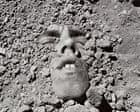
An installation set inside a decaying Georgian terrace … David Wojnarowicz’s Untitled (Face in Dirt). Photograph: Lisa Mitchell/David Wojnarowicz View image in fullscreen An installation set inside a decaying Georgian terrace … David Wojnarowicz’s Untitled (Face in Dirt). Photograph: Lisa Mitchell/David Wojnarowicz Art and design Review ‘I’m carrying rage like a blood-filled egg’: the best of Glasgow International – review From his deathbed photographs of his former lover to a face emerging from dirt, New Yorker David Wojnarowicz is the festival standout, although Renèe Helèna Browne’s film about cows contains multitudes
Prefer the Guardian on Google S etting the mood for this year’s Glasgow International (GI) is a show dedicated to David Wojnarowicz – artist, writer and fixture of the 1980s East Village scene . Including paintings, photographs and video works, it is arranged inside a Georgian terrace house so decayed that you can see through perforations in the building’s fabric. Stoop to peer between crumbling bricks and you’ll see a reproduction of a mural of a cow’s head that Wojnarowicz painted in the New York piers. On the top floor, Wojnarowicz’s deathbed photographs of his former lover Peter Hujar occupy one elegiac wall. Look up. Through the splintered ceiling play fragments of a film unfinished at Wojnarowicz’s death, in 1992, aged 37.
Sometimes the artist’s voice permeates the friable architecture, emanating from the soundtrack to Itsofomo (In the Shadow of Forward Motion) playing on a box TV. “I wake up every morning in this killing machine called America and I’m carrying this rage like a blood-filled egg,” he declaims with spitting fury. The words had specific context – New York during the Aids epidemic – nevertheless Wojnarowicz’s rage at a system that failed to serve or preserve him feels emblematic.
The day after I last visited Glasgow , a vape shop attached to Central station caught fire. Returning, months later, the station’s main entrance is blocked. It is only the latest of the many roads, pavements and buildings in the city now cut off with hoardings, Heras fencing and scaffolding. Among the no-go zones are cultural landmarks including the Charles Rennie Mackintosh-designed School of Art which suffered fires in 2014 and 2018, and the Centre for Contemporary Art, which closed earlier this year. As the fabric of the city becomes progressively inaccessible to its people, Glasgow has acquired a contingent atmosphere, as though not fully committed to its present.
View image in fullscreen Farm life … a still from Renèe Helèna Browne’s film, Flat. Photograph: Renèe Helèna Browne “Every day is a going on until something happens, and then a going on again in this endless difficulty of staying in sync with the world,” intones Renèe Helèna Browne over their film, Flat. Filmed in Donegal, Flat follows Browne’s uncle as he ekes an existence on a tumbledown farm tending cows, constructing a home inside a shed and lecturing her on the solar system. It’s a film about many things: a building materials scandal, masculinity, our place in the universe. But at its base, it’s about struggle and survival. A portrait of life as an endless sequence of catchups, mishaps and repairs.
Tanoa Sasraku ’s Tropical Hardware is a terse and elegant sculptural installation. Wooden cases painted the colours of military camouflage and tropical kitsch carry flak-jackets sculpted from dozens of sheets of newspaper, mottle-tanned with the rays of a UV lamp. Trinkets filled with crude oil spill from office boxes – the tchotchkes of warfare. Like Browne, Sasraku explores aspects of masculinity – starting from the viewpoint of the wife of a soldier serving in the Gulf. The result is a cocktail of bravado, mineral wealth, patriotism and violence, served with a tropical umbrella.
View image in fullscreen A precarious dependence on soil … Rehana Zaman’s Plantation follows seasonal farm workers. Photograph: Rehana Zaman Two intense film installations examine failing social and institutional structures. Rehana Zaman ’s Plantation looks at the labour conditions of migrant and seasonal farm workers in Pakistan and Scotland. Their precarious dependence on soil owned by others is sharply exacerbated by the climate crisis. A catastrophic flood takes place while Zaman is filming in Pakistan. She films families crammed together and living on boats on the muddy water having lost everything.
Across three screens, Naeem Mohaiemen ’s Through a Mirror Darkly pieces together archival footage relating to the shooting of students involved in civil rights and anti-Vietnam war protests at Jackson State College and Kent State University in 1970. Highlighting the relative paucity of archival material – and cultural commemoration – of the black students at Jackson State, it’s a film punctuated with gaps and silences. In a grim foreshadowing (in case more were needed) of our own self-serving leaders, a Vietnamese journalist working in the US obse…