
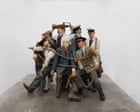
Like extras from an Ealing comedy … Alex Margo Arden’s Accounts. Photograph: Jack Elliot Edwards/© the artist. Arts Council Collection, Southbank Centre London. View image in fullscreen Like extras from an Ealing comedy … Alex Margo Arden’s Accounts. Photograph: Jack Elliot Edwards/© the artist. Arts Council Collection, Southbank Centre London. Art and design No island of strangers: why I’m using art to unite a fractured nation Fear of outsiders is the defining issue of our times. But is it actually our own selves we’re scared of? And could art hold the answers? Here, the British Art Show’s curator reveals why he’s exploring our deepest dreams and nightmares
Prefer the Guardian on Google O ne of the moral low points of Keir Starmer’s tenure at Downing Street was his “island of strangers” speech, with its rhetorical echoes of Enoch Powell and dispiriting description of a nation fractured by difference. After widespread criticism, Starmer recanted his words, if not the sentiment behind them. Yet his choice of language was a reminder of how the idea of the stranger – representing immigration, but also wider, more inchoate anxieties about otherness and difference – holds such a potent place in Britain today.
In fact, from masked anti-migrant protesters on the south coast to xenophobic riots over the summer, from politicians vowing to stop the boats to immigration polling as the No 1 concern among UK voters, it’s probably true to say that fear of the stranger is the totemic issue of our times.
Not long after Starmer’s speech, I was appointed curator of the British Art Show, which opens in Coventry this week. My thoughts have turned increasingly to the notion of the stranger among us as I’ve worked on the exhibition. The show, developed and produced by Hayward Gallery Touring, is the largest and most significant recurring exhibition of contemporary art in the UK.
Founded in 1979, the exhibition takes place every five years, touring across the country to offer a snapshot of the ideas and ambitions of a rising generation of artists born or based in Britain. Previous versions have brought the likes of David Hockney, Bridget Riley and Anish Kapoor to national audiences. This year is the 10th edition and it features a lineup of critically lauded artists including Alvaro Barrington, Lindsey Mendick and recent Turner prize winners Jesse Darling and Jasleen Kaur.
Each new iteration prompts the same question: what does the show say about British art? Or, indeed, about Britain? In the context of the globe-spanning fairs, biennales and mega-galleries that make up today’s contemporary art world, the question is possibly antique. Yet an exhibition tasked with addressing recent developments in art will inevitably reveal something about the country in which that work originates. To talk about British art, then, is also to talk about place and belonging. It is to ask who we are as individuals, as communities and as a nation.
I’ve chosen to give the latest exhibition a subtitle: A Chorus of Strangers. The name is not a reference to Starmer’s speech, but it does gesture back to another much earlier period in British history also characterised by its antipathy to outsiders.
View image in fullscreen Making the Strangers’ Case … an 1897 depiction of Thomas More pleading for compassion at the 1517 May Day riots. Photograph: Print Collector/Getty Images On 30 April 1517, the eve of the annual May Day festival, an angry crowd of more than 1,000 people marched…