
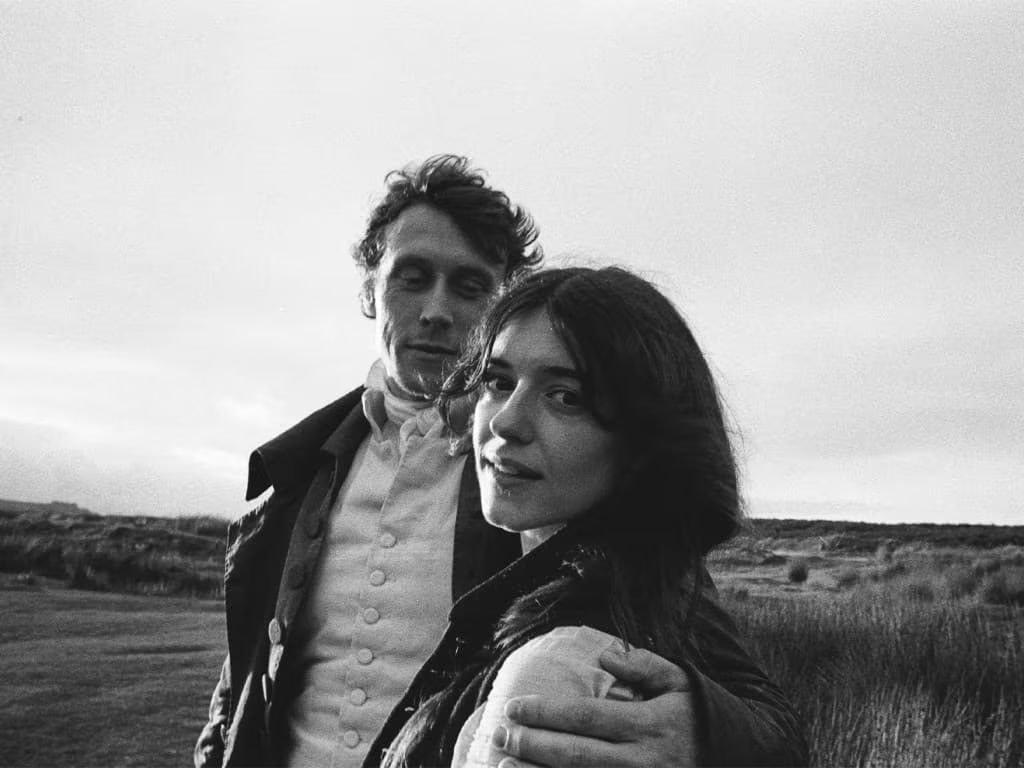
Photo: Esmé Creed-Miles Save Story Save this story Save Story Save this story This story originally appeared in the October 2026 issue of Vogue Australia.
Of all the images Esmé Creed-Miles took on the set of Sense and Sensibility , there is one she loves the most. It depicts star Daisy Edgar-Jones, raven hair swept from her face, looking at Creed-Miles behind her camera. Edgar-Jones is held by actor George MacKay, who gazes at her with such tenderness.
“This should be the poster,” Creed-Miles says definitively. “It could be on the side of a bus.”
It is an image of devotion: between friends and colleagues, and between the characters of the beloved novel by Jane Austen . In this new adaptation, scripted by Diana Reid and released next month, MacKay plays the kind-hearted Edward Ferrars, who loves Elinor Dashwood, played by Edgar-Jones, always sensible and reserved. And she loves her sister Marianne, portrayed by Creed-Miles, a tempest, a romantic, a raw nerve. One morning in August, Creed-Miles looks over her pictures from the film with fondness—and then a critical eye. “There’s one that snuck in the folder, with George, and it’s really overexposed,” she says, brow furrowed. She took countless photographs on set, and countless more that didn’t develop. Creed-Miles remembers a ball sequence where she approached the gathered extras and asked to take their photo. “I was trying to do this silly thing,” she recalls, dragging out her shutter speed so that the flash would sharpen the subject and blur the background into a whirl of bodies.
“I actually lost a lot of images that day,” she admits. “It didn’t really work. But I did get a couple.” One, featuring two dancers locked in reverie, a boom operator visible just behind them, captures something of the scale of a film set and the work of creating these worlds. “I’ve always had an equal interest in the processes going on behind the camera as much as what’s going on in front of the camera,” Creed-Miles says. She takes another look at her photograph of MacKay and Edgar-Jones. It was taken, she recalls, in five minutes at the golden hour at the top of a windy ridge in Dartmoor, England, after a long and “intense” scene from the penultimate sequence of the film. “It’s imperfect. It’s slightly out. As someone who always wants things to be perfect …” She pauses. “I let go of that because it’s a beautiful image.”
Sense and Sensibility , the first novel Austen published, is a tale of two sisters. The eldest is Elinor, holding the family together after the death of their father, who left his daughters with “no dowry to speak of.” Marianne, younger by only a few years, is full of verve and hungry for experience. The original working title was Elinor and Marianne ; although there is a marriage plot, as in all Austen novels, it is secondary to the unshakeable bond of sisterhood. By the end, each has bent towards the other’s temperament, and the final shot of the film is of the sisters, arm in arm. There are forbidden romances, jilted lovers, pregnancies out of wedlock, and pistols at dawn—all involving a man named Willoughby, the prototype for all of Austen’s feckless knaves, played here by a smirking and smackable Frank Dillane. This sensibility is reined in by Austen’s own sense.
The novel—previously adapted by Emma Thompson into a beloved film—ripples with wit, and with the insights of a woman who was herself devoted to her sister. For Austen, the hurdles placed between a pair of lovers are commen…