
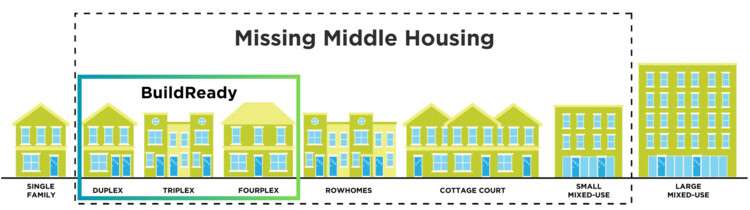
June 11, 2026 June 11, 2026 Home » Competitions » BuildReady Competition for Missing Middle Housing – Cincinnati 2026 About the Competition The City of Cincinnati has launched the BuildReady Competition for Missing Middle Housing, an open call inviting architects, designers, students, developers, and the general public to submit conceptual designs for small multifamily residential buildings. The competition specifically focuses on duplex, triplex, and fourplex residential buildings, a type of housing referred to as 'missing middle housing', situated between single-family detached homes and large apartment complexes.
The competition is the kickoff for the larger BuildReady program, which aims to develop a set of pre-approved housing plans that will be made available for free to any developer or builder in Cincinnati. Pre-approval shortens the permitting cycle by several months, making this type of housing quicker and cheaper to realize. The program is funded by a $2 million federal grant from the U.S. Department of Housing and Urban Development (HUD) and is managed through multiple city departments that include the City Manager’s Office, the Department of Planning and Community Engagement, the Community and Economic Development Department, the Department of Buildings and Inspections, and the Innovation Team.
Participants in the competition are required to submit designs that demonstrate three attributes: contextuality, meaning respect for the character and identity of Cincinnati neighborhoods; affordability, meaning practical designs that keep construction costs manageable for small and medium-sized developers; and scalability, meaning designs that can be implemented efficiently by developers of varying capabilities. The city has indicated its welcome for innovative construction methods such as modular and prefabricated building. The brief includes detailed information about the different architectural styles in Cincinnati neighborhoods, with a particular focus on areas that have a higher concentration of vacant lots suitable for this type of housing.
The competition serves as a vehicle for gathering ideas and community engagement rather than a procurement exercise. Winning and standout designs will be utilized to build an official Request for Proposals (RFP) to be issued by the city in late 2026 to attract pre-approved and viable plans from qualified architectural firms. Thus, the competition begins a longer trajectory leading to actual built outcomes: the BuildReady program commits to supporting the construction of at least two pilot projects using the final approved plans. Those interested in the intersection of urban design policies with housing provision mechanisms find this competition a practical case study of direct relevance.
The competition is open to everyone without restrictions on qualifications, nationality, or age. Applications can be submitted individually or in groups. Basic requirements include:
Two Q&A sessions available for participants:
The competition relies on three separate evaluation bodies instead of a single judging panel:
A total of nine winning designs will be selected: three for each housing type (duplex, triplex, fourplex).
BuildReady is organized by the City of Cincinnati directly through multiple city departments, backed by a $2 million federal grant from HUD, granting it the institutional credibility and financial foundation often lacking in open calls of this nature. However, the evaluation structure notably lacks transparency: the names of professional jury members and community stakeholder panels are not disclosed, making it challenging to assess the depth and independence of professional evaluation. The inclusion of public online voting as an official judging mechanism introduces a populist dimension that conflicts with professional standards such as cost effectiveness and scalability. There are no cash prizes, and the main benefit is the impact of the winning designs on the trajectory of a subsequent RFP and the potential for the concept to be translated into built architecture. This classifies the competition as a tool for public policy engagement rather than a professional design award, and participants must enter with this understanding. For architects and students interested in housing policies, missing middle housing models, and practical mechanisms for municipal pre-approval programs, the competition offers a genuine opportunity to contribute to a documented urban housing initiative. It can be compared to similar housing and urban design competitions on ArchUp.
The BuildReady Competition stands out in the architectural competition landscape for its explicit nature as a political tool. The City of Cincinnati is not seeking a winning design for direct implementation, but rather using the competition to gather ideas, test public trends, and formulate a formal procurement brief to follow. This clarity regarding the role of the competition and its place in the larger trajectory is refreshing and appreciated, even if it means that the immediate reward for participants is impact rather than a commission or cash prize.
The missing middle housing model is one of the most discussed topics in contemporary urban planning in North America. Many U.S. cities are revising their planning regulations to allow for buildings of two to four units in areas that were previously restricted to single-family homes, and the BuildReady program in Cincinnati fits within this broader national discussion, giving the competition political significance that extends beyond the city's borders.
The three-pronged judging structure is designed pragmatically: a professional committee for technical evaluation, a community committee for assessing neighborhood fit, and public voting for broad community engagement. The absence of names from both the professional and community committees is a transparency gap worth noting, even as it aligns with the operational style of many municipal engagement processes.
For students and designers early in their careers, this is a low-risk, high-value educational competition: no fees and no eligibility restrictions, with two Q&A sessions provided, and the brief grounded in real urban scenarios with a documented context for neighborhoods. Thoughtful designs have a real chance to impact what will be built in Cincinnati neighborhoods in the coming years. Student and emerging designer competitions can be checked on ArchUp for more similar opportunities.
From here, the inspiration begins. Delve into architecture, interior design, research, cities, design, and leading projects on A...