
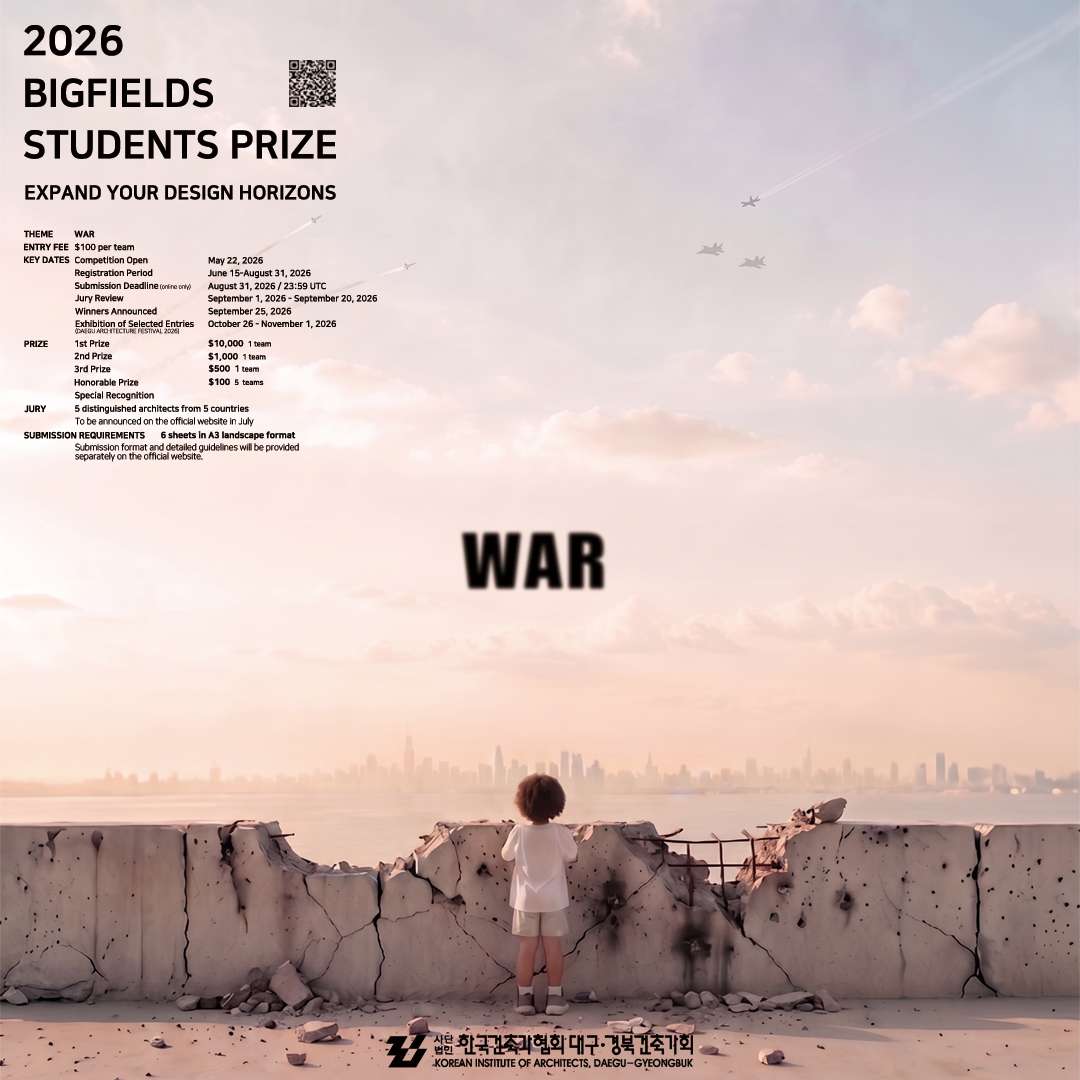
June 12, 2026 June 12, 2026 Home » competitions » BIGFIELDS Student Award 2026 - War Overview of the BIGFIELDS 2026 competition, an international architectural competition aimed at students, organized by the Daegyeong Architects Association based in Daegu, South Korea. The competition revolves around a single core theme: “War”. The organizers frame war not merely as a military event, but as a complex spatial and social condition including urban destruction, displacement, migration, memory interruption, border re-definition, grief, healing, and reconstruction. The competition does not specify a fixed site or functional program; participants have the freedom to define their own context and respond to the theme in their architectural style.
The platform describes its mission to enhance the international architectural discourse under the title “Dalgu-beol”, and includes partners such as the City of Daegu, the Daegu Architects Institute, the Korean Institute of Registered Architects (KIRA), and the Daegu Arts Center.
The competition seeks architectural proposals that engage with “war” as a spatial condition rather than a formal exercise. The organizers explicitly state that they value the spirit of inquiry over polished answers. Accepted types include: memorials, refugee shelters, humanitarian facilities, community rebuilding post-war, protective spaces, archives, educational facilities, projects for site revitalization, urban strategies, and experimental proposals. Each participant must define their location or context, justify it, and clarify its connection to the theme. The brief places particular emphasis on spatial strategy, narrative, expressive power, and cultural interpretation over stunning visual production.
The competition is a platform for conceptual ideas without links to actual implementation or procurement. Its goal is to generate architectural discourse surrounding war as a spatial and human condition, and to provide students worldwide a platform for critical engagement with one of contemporary life’s most pressing themes. Winning and recognized works will be published in an electronic archive. Those interested in the intersection of architecture with conflicts, memory, and human space find a deep intellectual framework in the brief. Conceptual architectural competitions similar to this can be viewed on ArchUp for comparison.
The competition is open to students currently enrolled in bachelor’s or postgraduate programs in architecture and related fields, regardless of nationality or age. Teams of up to five members are allowed. Each individual or team may submit only one project. Those with a direct conflict of interest with jury members are ineligible to participate.
Each project must present its own context and justify its location or spatial condition. The submission must maintain a clear architectural logic and should be framed as an explicit spatial proposal regardless of type or size. Student status must be evidenced upon request.
BIGFIELDS is organized by the Daegyeong Architects Association, a regional professional body based in Daegu, South Korea, consisting of institutional partners including the City of Daegu, KIRA, and the Daegu Arts Center. The platform is newly established with no documented record of previous editions or published winner archives thus far. The jury is the strongest element of transparency in this competition: five appointed members with verifiable professional backgrounds, most notably Khaled Malas, the Syrian architect and professor at Cooper Union, whose heritage and experience have a direct connection to the subject of a competition centered around war, alongside Jo Noero known for his career in socially driven architecture in South Africa. The theme of “war” is intellectually ambitious and truly demanding: the absence of a site and fixed program places the entire burden of conceptual and contextual foundation on the participant. The application fee of $100 is relatively high for a student competition without a documented record, and the considerable gap between the first prize of $10,000 and the second prize of $1,000 is striking. The main benefit for the majority of participants will be in the development of their portfolios and presence through the electronic archive. For students interested in the role of architecture competitions in addressing conflict, displacement, and post-war recovery, the brief offers a serious and genuine intellectual challenge.
BIGFIELDS is a new platform in the international student architecture competition scene. The Daegyeong Architects Association has an institutional presence in South Korea, but the platform itself does not yet have a documented record of previous editions or published results or announcements of winners. This is a consideration for students to take into account before investing $100 and considerable design effort in a competition in its first edition.
The theme of “war” is one of the most serious and pressing topics to appear in an architectural student competition brief in recent years. The decision not to specify a location or program is consistently aligned with the nature of the theme, as war is not a location-specific phenomenon in the way that most architectural briefs are, but it places upon participants the burden of constructing their contextual argument from scratch. This will favor students who have a solid theoretical background and an ability to define a cohesive spatial problem themselves.
The jury is characterized by genuine geographical and professional diversity. The presence of Khaled Malas as a Syrian architect and educator at Cooper Union carries particular weight in light of the competition's theme, while Jo Noero's career in socially critical architecture in South Africa adds depth to the jury beyond mere formal evaluation.
The prize structure deserves careful scrutiny. The gap between the first prize of $10,000 and the second prize of $1,000 is tenfold, which is a sharp and unusual decline even by competition standards. The honorary prize of $100 for each team effectively refunds the entry fee for five additional teams. Participants should enter with realistic expectations: the most likely outcome for the majority of submissions is inclusion in the electronic archive rather than winning a prize.