
June 11, 2026 June 11, 2026 Home » Cities » Breaking through Urban Density and Disassembling Boundaries in the Śhālā Twam Project Breaking through Urban Density and Disassembling Boundaries begins the spatial experience in this architectural composition from the moment of transition from the dense urban fabric to a space that breathes independently. The idea here does not rely on building an isolated refuge, but on re-forming a private piece of land to become a spatial and social extension of the neighborhood. When the visitor crosses the threshold of the project, they experience a gradual dissolution of the solid boundaries between what is public and what is private; where the spaces for artisanal clothing production intertwine with platforms for cultural gathering and areas for physical practice in a continuous kinetic sequence. This functional merging creates a natural human flow within the space, uninterrupted by solid barriers, enhancing the sense of community belonging within an informal spatial framework.
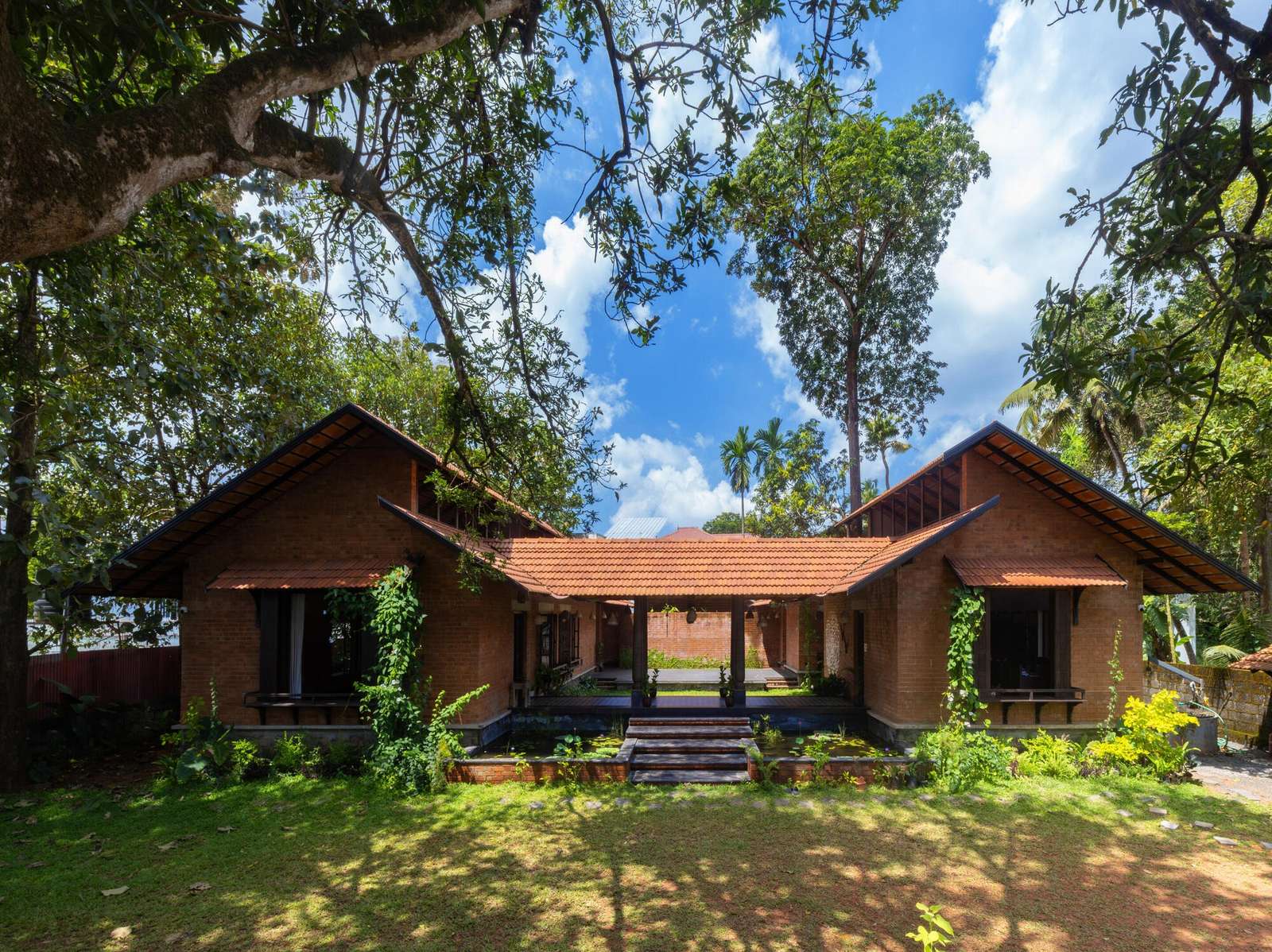
Instead of imposing a strict engineering that erases the site's features, the built mass revolves around its original environment, using the two standing mango trees as a structural and conceptual foundation for architectural development. The first tree plays the role of a visual and vital guide after its direct integration within the building's shell, imposing a continuous interaction between the natural airflow and the shadows seeping through the leaves to create changing patterns on the surfaces of the interior spaces. Conversely, the composition employs the larger tree to form a living climatic canopy over the open theater in the heart of the project. This treatment generates a scenography that shifts with the sun's path throughout the day, granting users a sense of psychological and physical containment, merging the traditional divisions between architecture as a solid mass and nature as a flexible void.
The human experience moves within this space through flexible transitional paths, where shaded terraces and semi-open corridors act as the intermediary linking the various functions of the building. Instead of a strict separation between the yoga hall and the organic clothing unit, these architectural transitions in the urban context allow for an incidental overlap of activities throughout the day, granting the space user a sense of visual and kinetic freedom. The passerby here experiences agile transformations in lighting and natural ventilation while navigating between closed and open spaces; supporting spaces, such as changing rooms and temporary accommodation, integrate with the theater's backstage without disrupting the privacy of use, providing the design a flexible language that evolves and shapes with the daily spontaneous movement of neighbors and children.
The critical scenography of the project is embodied in its central pivot point, which is the open theater that occupies the heart of the composition, shaded by the large mango tree. This space does not isolate as a decorative element, but acts as an open civic space that achieves a geographical and social extension for the neighborhood in an urban environment lacking public spaces. Under this botanical canopy, the space user interacts directly with nature and climate, where the airflow and shadow paths direct individuals' behaviors, transforming what was previously a closed residential plot into an interactive democratic platform. This spatial openness provides a psychological effect that evokes comfort and connectivity, exploring how private architecture can shed its constraints to serve collective urban life.
The architectural structure transcends its physical role to serve as a spatial framework supporting social justice and sustainable livelihoods within the urban environment. By shaping socially open spaces, the interior and exterior design provides a flexible environment for women-led initiatives and crafts, where the movement of handiwork and skill-sharing blends with the daily community flow. This spatial dynamism breaks the traditional isolation of production spaces, allowing users and visitors to experience a shared visual and kinetic experience that enhances small entrepreneurship and makes architecture a tangible empowerment tool that integrates with the human fabric of the neighborhood.
The building's response to the climate is manifested in a clear materiality that relies on honesty in material use and resource economy, moving away from complex technological excess. Exposed clay bricks and tiled roofs provide a rich material visual experience, enhancing the stable psychological impact on the space user and imparting a sense of belonging and rooting in the place. Breathable surfaces and open shaded terraces guide airflow paths and reduce heat gain, creating a comfortable thermal environment that relies entirely on natural ventilation. This employment of building materials, integrated with conserving existing trees for local climate stability, poses an alternative model for urban development that transforms small architectural interventions into a shared cultural and environmental scene.
The project characterizes the accelerating urban density within cities by proposing small interventions as decentralized social and environmental nodes. By restructuring private land into a flexible, climate-responsive public meeting point, the architectural project exploits local building materials and vegetation to dissolve solid parcel boundaries, crafting civil infrastructure as a communal and local element rather than as a large governmental project. Nevertheless, this micro-utopian approach carries a romantic gap that overlooks the dynamics of the real estate market; for reliance on individual altruism to compensate for municipal failures limits the potential for expansion and replication. Without systematic institutional integration, these local patterns may be exploited as cultural privileges that indirectly raise the value of surrounding lands, turning the shared space into an unintended catalyst for spatial commodification.