
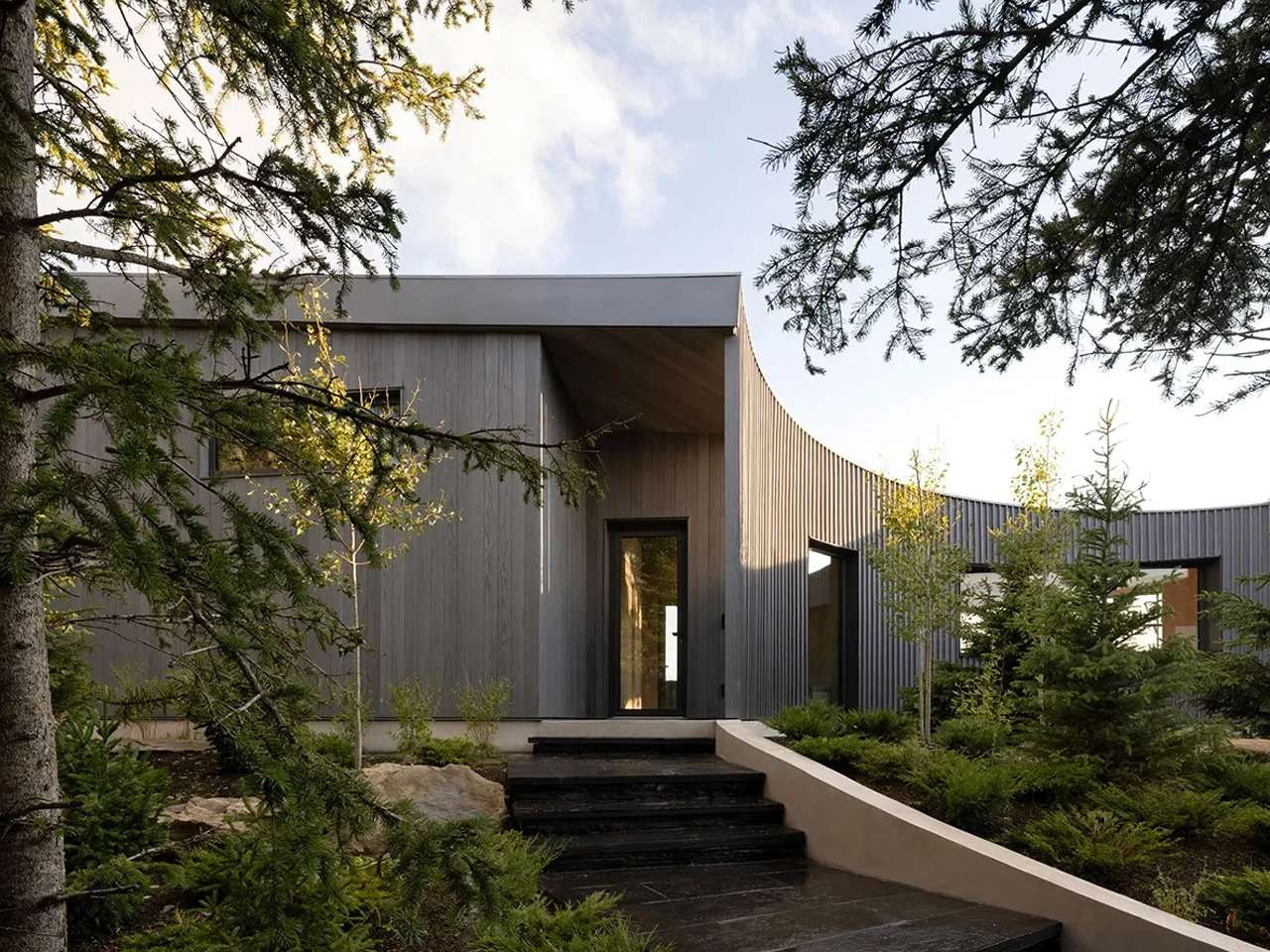
June 11, 2026 June 11, 2026 Home » Architecture » Architectural design exploring spatial duality in Cut Out House and mountain context. Spatial duality and site responsiveness allow the user to move within the structure through two levels of visual and kinetic perception; where the experience of entering begins from relatively intimate and enclosed spaces, directing the gaze depth-wise toward the details of the dense surrounding forests, providing a sense of introspection and stability. This experience gradually changes when transitioning towards the shared spaces, which dramatically and unexpectedly open to the vast visual expanse of the Canadian Rocky Mountains. This studied movement between enclosure and openness reflects the primary purpose of the building as a family vacation home, balancing the need for privacy with the desire to merge with the natural horizon.
The mass abandons formal clatter to leave it to natural influences to shape the space; the geographical orientation manipulates sun paths to cast shifting shadows across the interior surfaces throughout the day. These shadows intersect with the geometric masses of the house, creating a material contrast that stimulates the senses and makes traversing the corridors a lively experience that varies with the time. Similarly, the movement of air and the light seeping through the studied openings enhance the psychological and physical effect of the materials used, deepening the occupant's connection to their surrounding environment without artifice.
The butterfly roof functions as a crucial engineering tool to organize movement and direct visual perception within the space, where its sloping levels tilt in opposing directions to serve a double function; they mimic the slope of the external mountain terrain on one hand and control the viewing angles from inside towards the horizon on the other. In areas where the roof line rises, the communal living spaces gain vertical extension opening onto panoramic views, providing the user with a sense of freedom and connection to the vast geographical expanse. Conversely, the roof lowers in areas oriented towards tree density, retreating the bedrooms into quiet, protected corners that enhance the feeling of isolation and psychological stability.
The sculptural structure of the building is shaped through a strategy of “carving” from the whole mass, where the sculpted voids and openings create a sculptural character that relies as much on the absence of material as it does on its presence. This alternation between solid mass and removed void generates a vibrant interaction with light, as shadows penetrate these architectural folds to reveal a calm design language that avoids structural complexity. This treatment allows the building to occupy its mountain site with confidence and clear simplicity, neither fully submitting to the natural scene nor competing visually with it, endowing the experience of traversing the space with material and visual balance.
The grey acacia wood cladding grants the exterior facades a color and material continuity that gradually dissolves into the natural context, as this choice interacts with the weathering factors to age over time and visually blend with the surrounding rock and vegetation formations. This experience is completed from distant distances across nearby water bodies, where the butterfly roof stands out as a visual and dynamic marker influenced by the changing light throughout the day, giving the mass a suggestion of continuous movement despite its structural stillness. This material and formal symmetry helps in reducing the visual impact of the building, transforming it into a natural extension of the land rather than an alien body to it.
The design acts as a precise visual tool to reshape the relationship between the interior space and the mountain scenery, where windows and architectural openings become considered intersection points that avoid any imbalance with the surroundings. The building does not strive to compete with the Rockies or impose a dominant presence, but rather aligns itself with their terrain and reshapes its mass around their guiding lines, turning the experience of movement and waiting inside into a continuous act of organized and directed seeing. This approach reflects a design language that investigates how the architectural mass interacts with its critical environmental context, turning the structure from mere family refuge into a spatial mediator connecting humans to their high mountainous environment.
The Cut Out House project by Young Projects presents a tactical statement that counters the loud and exaggerated visual form that dominates highland architecture. By adopting a block-based methodology grounded in carving and subtraction and utilizing a dynamic butterfly roof, it transforms the negative space design into a balancing force, replacing traditional residential display with a calm and responsive envelope that interacts with the Rockies as a critical infrastructural and environmental partner rather than just a scenic backdrop.
Yet, this poetic retreat towards material silence entails an obvious elite romanticism; for the reduction of sculptural and architectural strategies into recreational aesthetics overlooks how luxury residential facilities rarely alter the reality of regulatory maps or dense urban expansion trends. True contextual integration requires replicable structural solutions, while this bespoke, costly intervention remains an isolated exceptional case that employs capital to simulate architectural modesty.