
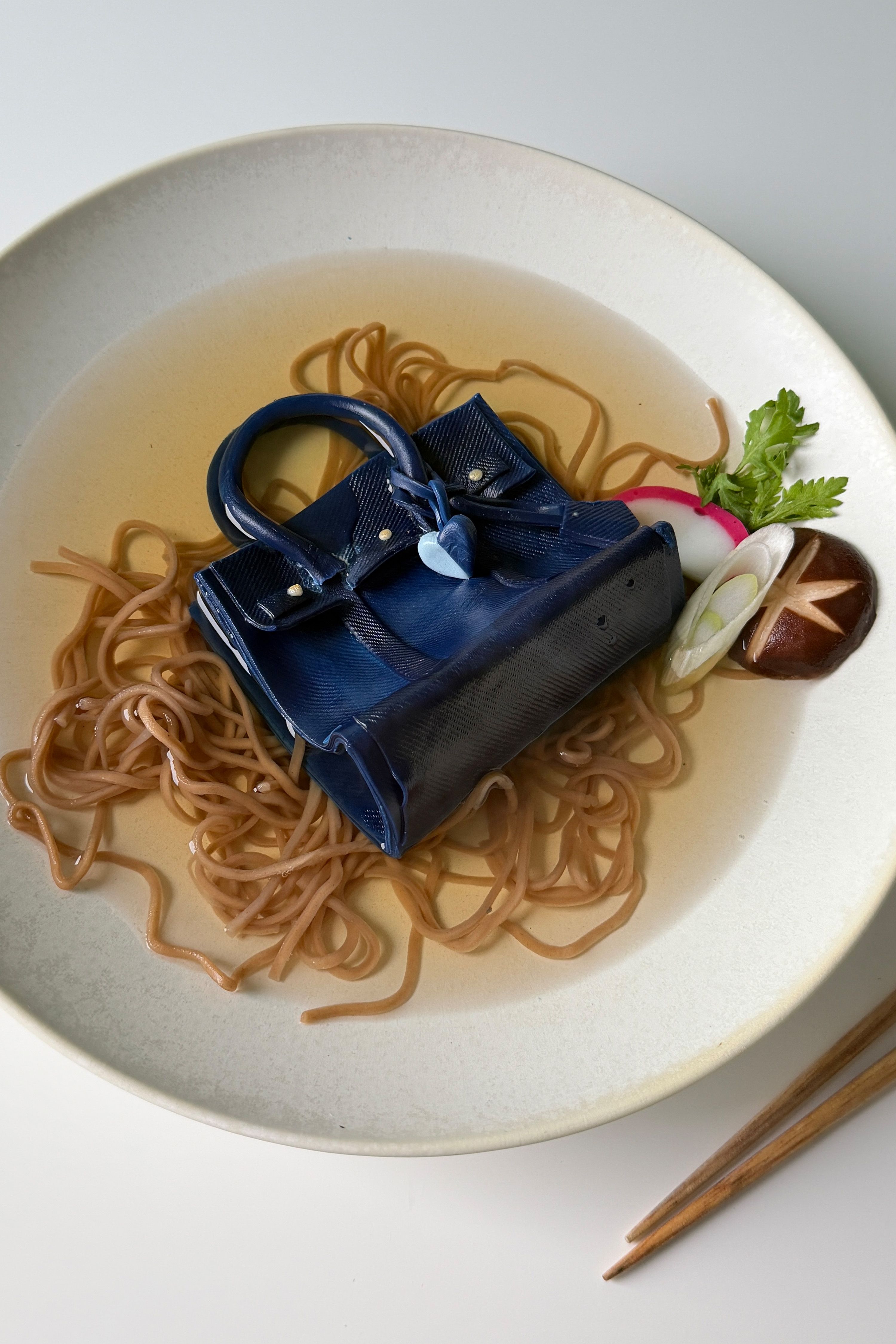
The Korean artist Min Kyung-jin, who goes by the online handle Sibatable, has created edible creations for brands including Gap. Photo: Courtesy of Sibatable Save Story Save this story Save Story Save this story In August, American clothing brand Abercrombie & Fitch posted a Reel on Instagram showing several pairs of denim pants being lined up and folded next to one another. But this wasn’t simply another day at the shop. These realistic, detailed jeans were no larger than the palm of one’s hand and, in fact, crafted entirely out of pasta.
The Reel has been viewed more than five million times, significantly surpassing other videos shared on the platform by the brand. Followers responded enthusiastically to the culinary craft. “What’s wrong babe? You haven’t touched your fettujeane,” joked one user, whose wordplay went on to be liked 15,486 times. Many others complimented Abercrombie for its creativity.
The edible art is the handiwork of the Korean artist Min Kyung-jin, who turns everyday food and ingredients into whimsical, miniature sculptures. Min — who goes by the online moniker @Sibatable (an amalgamation of Shiba Inu, her dog’s breed, and “table”) — studied culinary arts at university and spent a year in the US, but eventually returned to Korea where she got married and had children. As her children got older, she sought a daily creative challenge. “I realized how many different ways food could be transformed by baking, melting, setting or cutting it,” she says. And so, Min began making edible creations and sharing them on Instagram in February 2022.
She is among a recent wave of artists that luxury and fashion brands have been collaborating with, in a bid to demonstrate their commitments to human artistry. It’s an approach that brand consultant Miranda Shanahan has coined “effort signaling”. For many, the concept of making things by hand indicates time, skill and therefore value — a message that high-end brands have become eager to associate with, Shanahan says.
Sibatable’s whimsical creations, made from food, for Coach (left) and Ugg (right).
Indeed, as a rising number of shoppers question whether luxury is still worth its high price , with some believing that luxury goods were generally better made in the past , before industry executives became focused on mass production and corporate profits, some brands have been investing heavily into campaigns that promote the human touch behind their products .
Growing investment in human artists also comes as debate around artificial intelligence and how luxury brands should be using the technology intensifies. When brands including Prada and Gucci released wildly surreal campaigns featuring entirely AI-generated images , the public response was polarized. Some viewers applauded luxury’s willingness to experiment with AI and break new creative ground, while others criticized the synthetic imagery for lacking depth, highlighting concerns around the replacement of traditional creative skills like photography.
“As it becomes harder for brands to defend their price points, people are choosing these painstaking crafts,” where the labor is evident in the outcome, says Shanahan. “The more you can show the length of time to produce anything is now the biggest signifier of value.”
Brands of all sizes are collaborating with highly skilled, slow craft creatives. Hermès, which has a long history of collaborating with artists, recently commissioned illustrator Stuart Patience, artist Sarah Mar…