
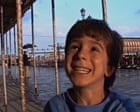
Adrian as a boy in Venice, as seen in Remake. Photograph: Giant Squid Films View image in fullscreen Adrian as a boy in Venice, as seen in Remake. Photograph: Giant Squid Films Film Interview ‘I look at the footage to convince myself that you were alive’: how Ross McElwee made a film about unimaginable loss, grief and guilt Xan Brooks When his son died aged 27, the director could barely bring himself to watch his old clips of the boy. When at last he did, it was the genesis of an extraordinary project
Fri 2 Oct 2026 09.00 CEST Share Prefer the Guardian on Google I t feels crass to compliment Ross McElwee on his latest documentary, Remake, because it is not the picture he would ever have chosen to make. It is instead a grief-struck tour de force: a magnificent film about film-making and its real-world repercussions.
McElwee is a film-maker who HAS spun home movies into art, framing himself and his friends and his son, Adrian. The director used to film Adrian for a few minutes each month. He tracked the boy from infancy to adulthood, trying to catch the significant turns of his life. When tragedy struck, it back-shadowed the footage. Maybe every home movie is a ghost story at heart. McElwee filmed Adrian because he loved him, but now fears he might have hurt him. So he sifts through the material in search of clues, addressing his son as though he were still in the room. “I look at the footage to convince myself that you were alive,” he says. “But also to convince myself that you’re gone.”
The plan, he explains, was for a completely different film. A Hollywood producer wanted to shoot a fictionalised version of his 1986 documentary Sherman’s March . McElwee decided to follow the process – to make a new documentary about adapting an old documentary. That might be funny, he thought. But events overtook him. Adrian’s mental health was deteriorating. He became addicted to opioids. He died from a fentanyl overdose at the age of 27, in the bathroom of McElwee’s Boston home.
“Everything immediately ground to a halt,” the director recalls. “My son was gone. I was devastated. And compared to everything I was facing, the film seemed banal and frivolous.” He took a year to regroup and plotted a new course.
A more traditional film-maker would have junked the original idea. McElwee has audaciously chosen to preserve it, so that the remake plays as a kind of absurd counterbeat to the anguish of Adrian’s death. The film would have been too depressing otherwise, he says. “And in a sense I’m remaking my life by picking up the camera again. I’m reconstructing the life of my son from the scraps and pieces that had ended up being filmed.”
Adrian, we learn, was gung-ho for a Hollywood version of Sherman’s March. Remake shows him discussing the project at length. He feels that his dad should be making more mainstream movies. He says, “Why not just do some big blockbuster hit?”
View image in fullscreen Charleen Swansea at McDonald’s, as seen in Sherman’s March. Photograph: Little Field Films After seeing Remake, I rewatch Sherman’s March. It’s a joyous, insightful, free-ranging affair; a film that delights in taking the road less travelled. McElwee is ostensibly making a civil war documentary, but he keeps being set up with various “nice southern girls”. In one scene, Charleen Swansea – his voluble former English teacher – demands that he turn off his camera before a big date. “This isn’t art,” she roars. “This is life!”
The success of Sherman’s March ma…