
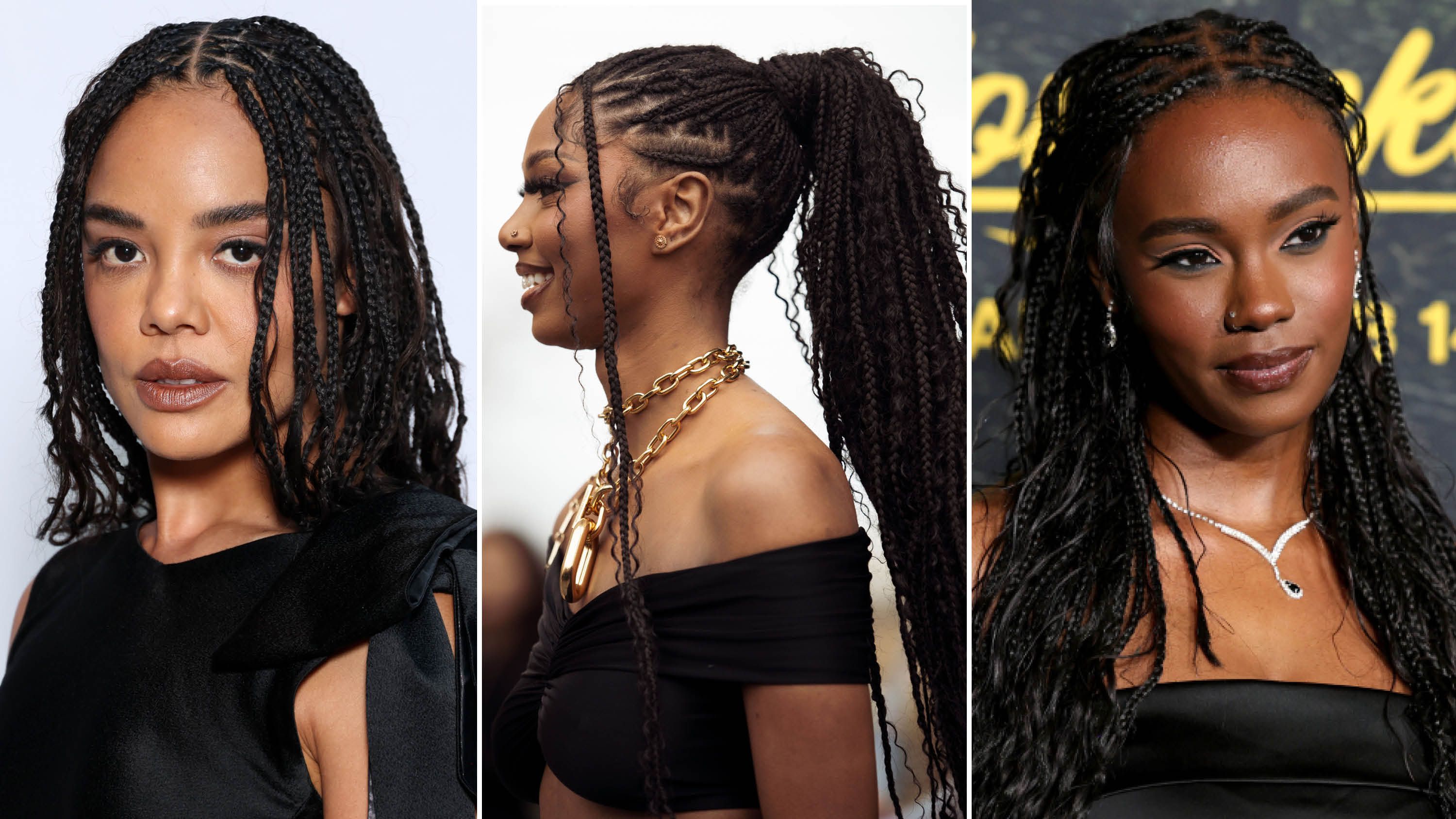
Photos: Getty Images Save Story Save this story Save Story Save this story Have you ever learned the name of a hairstyle and immediately thought, Yep, that makes perfect sense? That was my exact reaction to goddess braids. The flowing, curl-accented plaits look like they should be worn by a deity—one that’s fed succulent fruits as she gazes down from the heavens. Fortunately for us mere mortals, goddess braids are very much an earthly delight.
Before we go any further, what exactly are goddess braids? Well, it depends on who you ask. Unlike cornrows or two-strand twists, which have clear, specific definitions, goddess braids are more nebulous. “The terms ‘goddess braids’ and ‘ boho braids ’ are often used interchangeably, and their meanings can vary between braiders,” says Jess Rutana , a London-based braider.
Photo: Getty Images Photo: Getty Images While both goddess braids and boho braids are knotless styles with loose human or synthetic curls braided into some or all of the plaits, the amount of loose hair and where it’s placed is usually what’s up for debate. To Susy Oludele , a braider based in New York City, “goddess braids take only a few curls. The braid stays defined and the finish is clean,” while boho braids use a lot of hair. “The curls [in boho braids] carry the whole style, and you get that bold, textured look.”
Rutana has the opposite take. At her salon, Zuri Hair Studio, “goddess braids contain significantly more loose human hair, creating a fuller finish where the braids are less visible,” she says. See what I mean?
Photo: Getty Images Photo: Getty Images Regardless of curl count and placement, one thing just about everyone can agree on is that goddess braids are really having a moment. “It’s because they offer versatility, longevity, and a little more dimension than traditional knotless braids,” says Shanna St. Cyr Alexander , a New York-based braider.
The knotless installation provides lower tension than the thick Poetic Justice –era plaits that dominated the ’90s and were attached to the root with knots . There’s “less weight, less pressure on the scalp, [and] less tension on the edges,” says Oludele. “We’ve all watched what heavy styles do to a hairline over time, and women are done with it.” Meanwhile, the loose curls add fullness and provide some visual movement. Simply put, “Goddess braids give you a full, beautiful look without your head hurting for three days after you leave the chair,” says Oludele.
As with any braiding service, your “ natural hair gets cleansed, deep-conditioned , and stretched or blow-dried first,” says Oludele. Then, your braider will feed in the braiding hair and loose curls; again, the amount really depends on your desired finish. ”The curly pieces go in while you are braiding, worked into the braid as you go,” says Oludele. “Depending on the braider and the desired finish, synthetic hair, human hair, or a combination of both may be used,” says Rutana.
To ballpark it, “goddess braids run $300 to $500,” says Oludele. It depends on the market rate where you live and the type of hair your braider uses. If you use only synthetic hair, says braider Ariana Greene , you can expect to pay less. To avoid surprises at the register, Oludele suggests asking your braider if hair is included in the initial quote before you even sit in the chair: “That’s where people get caught.”
Oludele says to oil your scalp two to three times a week and to wash your hair every two to three weeks with diluted…