
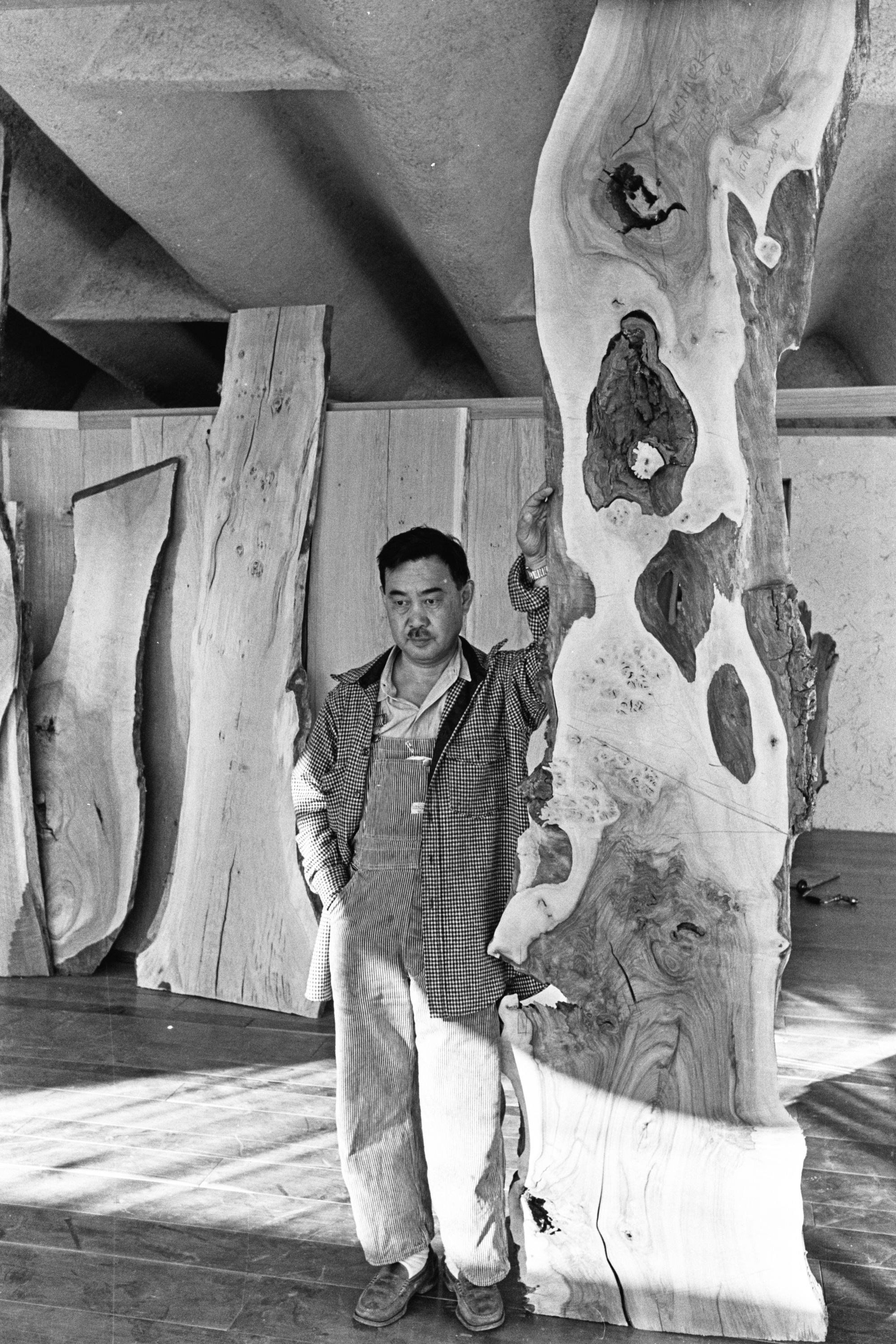
Architect and furniture maker George Nakashima at his workshop in New Hope, Pennsylvania, 1959. Photo: Getty Images Save Story Save this story Save Story Save this story Ruth Asawa ’s wire-knitted sculptures are, like Isamu Noguchi’s wood and paper lamps, among the most iconic American designs—adored, occasionally knocked off, and associated with a postwar aesthetic that is streamlined and concise but at the same time almost sensuous in terms of material. The pieces, whether made of wire or even stone, manage to breathe.
“Noguchi to Asawa: Designing Postwar America,” a new show at the Barnes Foundation in Philadelphia, makes the point that the experiences of Asawa and Noguchi as prisoners in World War II internment camps weren’t just parenthetical to these designs, but central—and that the violence of internment, and its lingering effects, may be in your living room. “Few consider or register,” writes Anne Anlin Cheng, a professor of English at Princeton, in the show’s catalogue, “the complex and scarred racial-ethnic histories behind the makers of these objects.”
Ruth Asawa, Untitled (S.168, Hanging Single-Lobed, Three Layers of Spheres) , c. 1952. Private collection.
The show, which is part of the Barnes’s year-long consideration of the 250th anniversary of the United States, explores the work of Asawa and Noguchi, as well as four other artists: the architect and furniture designer George Nakashima; the sculptor Leo Amino; the graphic designer S. Neil Fujita; and the fiber artist and weaver Kay Sekimachi. Noguchi, Nakashima, and Amino were adults on February 19, 1942, when President Roosevelt signed Executive Order 9066, which forced Japanese American families to quickly abandon or destroy their property and board trains to the holding centers. Asawa and Sekimachi entered the camps amid post-Pearl Harbor anti-Japanese hysteria when they were teenagers.
While the tent camps were being hurriedly built, military guards moved families to temporary “relocation centers”—a desperate experience that American history tends to downplay. Asawa and her family, for instance, were forcibly relocated to the Santa Anita racetrack in Arcadia, California, where they lived in two horse stalls. Often, Cheng writes, “the Asian American subject is praised for her reticence, for not ‘whining,’ for not utilizing her victimhood, for pulling herself up by the bootstraps—a rhetoric and cultivation of resilience that often results in silencing Asian American injuries.” In a 1948 letter to her husband, Asawa wrote: “We have all suffered intolerance innocently. I no longer want to nurse such wounds; I now want to wrap fingers cut by aluminum shavings, and hands scratched by wire; only these things produce tolerable pains. You will have to look at me on streetcars or bus[es] when you hear someone shout ‘dirty Jap.’”
Leo Amino, Unyielding Defiant , 1940. Private collection, Memphis, Tennessee.
In the first section of the show, called “Prelude/Incarceration,” the layout and feel (designed by Stephanie Goto) nod to the claustrophobic impact of the stark camp buildings themselves: a long narrow wall covered in black mimics the cheap tar paper that lined the camps’ barracks—what amounted to elongated, wind-leaking shacks. (As an adult, the poet Mitsuye Yamada remembered inmates in Minidoka, the camp in Idaho, using mess hall butter knives to stuff cracks in the walls with newspapers and rags, writing: “But the Idaho dust/ persistent and seeping,/ found us crouched…