
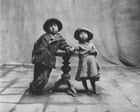
Extractive images … Irving Penn’s Cuzco Children, 1948. Photograph: © Irving Penn, Condé Nast Pinault Collection View image in fullscreen Extractive images … Irving Penn’s Cuzco Children, 1948. Photograph: © Irving Penn, Condé Nast Pinault Collection Photography Review Remember Me review – narrow view of two photographic centuries is like a history of food in three ham sarnies Bourse de Commerce, Paris There are 700 works from François Pinault’s collection on display – more than half of them by Irving Penn – but it’s a blinkered selection and annoyingly didactic
Prefer the Guardian on Google ‘B eware … of assuming the sterile attitude of the spectator, for life is not a spectacle” scream the words of Aimé Césaire – writ large and bold by Barbara Kruger, in a giant installation, The History of Tears, that fills Bourse de Commerce’s spectacular Rotunda. Kruger’s angry, menacing, viscerally charged work – words as images, and large-scale video clips of people seething with self-hate – is a thrilling setup for Remember Me, an exhibition that promises a take on 200 years of photography through 700 works by more than 70 artists drawn from the collection of the French billionaire François Pinault. That excitement quickly dissipates as the exhibition moves on.
This is the biggest photography show ever held at the Bourse de Commerce. Remember Me has two main problems: first, it tries to say too much with too few artists. For a start, nearly 450 of the 700 or so works are by Irving Penn . It leans heavily on classical, conventional approaches, styles and familiar names, and that creates a very obvious skew in the perception of what photography is, does, and how it is presented.
View image in fullscreen Like waves … Remember Me The organisation makes no real sense. There are two main spaces, in addition to Kruger’s installation, dedicated exclusively to one artist. Penn is one of them. The installation looks undeniably beautiful: following the curving Ando architecture, the works have been hung like waves, expanding in undulating lines across the walls, without chronology or theme, flowing freely into the space. However, when you look closely at the works themselves, this configuration becomes very problematic. There are a large number of colonial-style portraits taken in a temporary tent studio by Penn when he travelled in Cameroon and Benin. Many of the pictures depict men and women in traditional tribal dress, and were taken as a commission for Vogue. These nations were actively negotiating independence from France at that time. When you compare them with portraits by Malick Sidibé or Seydou Keïta of the same time, they look even more like anthropological, ethnographic, extractive images by a westerner who couldn’t even communicate with his subjects.
“Primitive subjects respond more to tone than to obscure words,” Penn stated of how he directed the people who appear in these photographs. To me, that says everything about his perspective on African bodies and culture. Then you notice the rest of it: the glamorous white women who appear as pristine models of passive beauty, while all the men are mediocre-looking and wear suits. Still lifes are woven through – presumably to undo the idea of hierarchy between subjects. So, a man who looks at a vase or a plate of fruit the same way he looks at people. The camera has been instrumental in colonialism, and in cultural extraction and appropriation – including in the fashion industry, of which Penn w…