
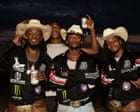
For several years, Chloe Kerleroux has been photographing African American cowboy communities in the southern US. Her work has mainly focused on trail rides: large gatherings where horses, music, dancing, family and community life come together. This year, she explored rodeo culture including at the Bill Pickett invitational in Atlanta
Prefer the Guardian on Google T he image of the cowboy widely portrayed in westerns and popular culture has long been almost exclusively white. Yet Black cowboys hold an important place in the history of the American west. After the civil war and the abolition of slavery, many African Americans found work on ranches and on the great cattle drives westward. By the late 19th century, historians estimate about one in four cowboys were Black.
Among the Black figures who shaped this history was Bill Pickett . Born in Texas in 1870, he became one of the most celebrated Black cowboys and rodeo performers of his time, known in particular for popularising bulldogging, which would eventually give rise to modern steer wrestling.
View image in fullscreen After the national anthem, Josh, a member of the Outlaws Most Wanted, rides around the arena to a pounding hip-hop track as his teammates cheer him on at the Bill Pickett invitational rodeo in Conyers, near Atlanta , Georgia, on 2 August 2026
View image in fullscreen Members of the Outlaws Most Wanted joke and playfully challenge other riders, some of whom have travelled long distances to compete, backstage at the rodeo
His name was chosen by the promoter Lu Vason when he created the Bill Pickett invitational rodeo. In 1977, Vason attended Cheyenne frontier days and was struck by the absence of Black cowboys in the arena. His research led him to the Black American West Museum in Denver, where he discovered the story of Pickett and the history of African Americans in the American west. In 1984, he created a rodeo designed to give Black cowboys and cowgirls a platform and bring greater visibility to this heritage.
More than 40 years later, that mission remains at the heart of the Bill Pickett invitational rodeo. Part sporting competition, part spectacle and part space for passing on history and culture, its 2026 tour crosses the US from February to October, with stops including Memphis, Atlanta, Oakland and Los Angeles.
This year, I decided to join the tour in Atlanta.
View image in fullscreen A family on horseback waits to enter the arena at therodeo, reflecting the intergenerational nature of a cowboy culture passed down through families. 1 August 2026
While there, I met for the first time a contact I had been speaking with before my trip. He runs Diamondcut Ranch, where he works with and trains horses, and around which a wider community of riders has formed. It was there that I met the Outlaws Most Wanted, a team of “bronc riders” competing at the Bill Pickett.
The organisers allowed me behind the barriers on the condition that I stayed with them. I found myself in the space just behind the arena, where the riders wait for their turn and prepare their equipment.
Music is everywhere. The riders joke around, encourage one another and build each other up. The energy and adrenaline rise as their turn approaches, until each rider has to move away from that collective excitement and focus on the few seconds waiting for him in the arena.
View image in fullscreen Rachied Robins, AKA Django, a member of the Outlaws Most Wanted bronc-riding team, who became my mai…