
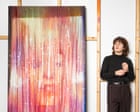
‘An enduring act of devotion’ … Louise Giovanelli at her studio in Manchester. Photograph: Linda Nylind/The Guardian View image in fullscreen ‘An enduring act of devotion’ … Louise Giovanelli at her studio in Manchester. Photograph: Linda Nylind/The Guardian Frieze art fair Pine cones, glitter and a hip-hop head for sale: red-hot artists reveal their Frieze stunners As the sprawling art jamboree hits London, eight of the most exciting exhibiting artists share what their work means to them – and who they hope will buy it
Interviews by Alex Needham Mon 12 Oct 2026 06.00 CEST Last modified on Mon 12 Oct 2026 10.28 CEST Share Prefer the Guardian on Google F irst held in 2003, the Frieze art fair is a giant art supermarket that descends on Regent’s Park, London, every October. Some detest it for its blatant commercialism, others relish it as the opportunity to see a mind-boggling amount of contemporary art in one enormous tent. Here, eight British-based artists of the moment talk through what they’re showing.
How would you describe what you do? I make sculpture. I work a lot with metal, fabrics, quite a collection of materials to make landscapes of figures that grow intuitively.
What’s the highlight of your career so far? My exhibition at Hepworth Wakefield – getting major support in such an incredible institution.
View image in fullscreen ‘I call them gesture works’ … Kira Freije at her studio. Photograph: Linda Nylind/The Guardian Name two favourite artists, one dead and one living. Dead: Marisa Merz or Paul Thek . Both had an attitude of freedom of making. Living: Liliane Lijn or Donna Huddleston , who I know quite well. I love them and I think they’re amazing.
Tell me about the sculpture we’ve photographed you with. I call them gesture works. They’re wall-based, but they allude to a crowd. They’re cast in aluminium and bronze and one of them has a piece of fabric.
Where do you think you’ll be in 20 years? Oh God, I can’t imagine. Hopefully still alive and excited with what I’m making.
How would you describe what you do? I’m a figurative painter, but I also work across sculpture and installation. I’m self-taught, so my work has been described as outsider art. I’ll make work drawn from nursery rhymes and ethnographic texts.
What made you want to become an artist? My mum came to the UK in the 80s from rural Bangladesh and we lived in a series of dilapidated houses. She was a textile worker so she made curtains for the house. My sister would salvage wood and make furniture, so I was immersed in organic homemaking.
View image in fullscreen ‘Outsider art’ … Mohammed Z Rahman with his crate and fish pictures. Photograph: Linda Nylind/The Guardian What’s the highlight of your career so far? Going to the Venice Biennale earlier this year. In light of the death of Koyo [Kouoh , who died while curating the show in which Rahman participated], the artists really came together.
Name two favourite artists, one dead and one living. Maybe it’s a cliche, but I really like Frida Kahlo . I think she did what I’m trying to do in the sense of hitting a balance between social realism, being political, speaking to the current social conditions and introducing a world of fantasy and mythology and dreams. And I really like the work of Toyin Ojih Odutola who had the Barbican Curve commission in London a few years ago. The storytelling and world building of that show was amazing. It’s a guiding star in terms of the direction I want to take my practice.
T…