
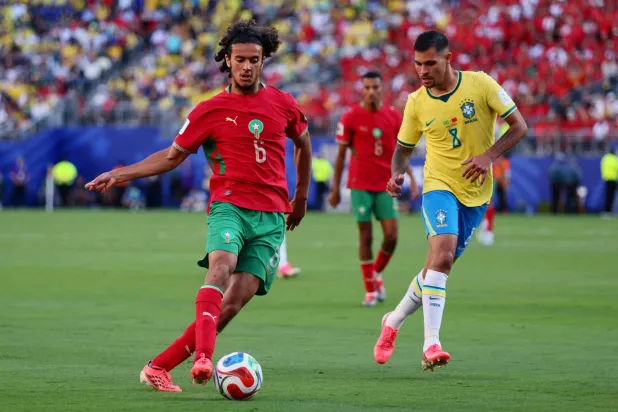
The 1-1 draw between Morocco and Brazil in their World Cup 2026 opener wasn't just a balanced result between two top-tier teams, but revealed an important truth that the Moroccan team possesses all the capabilities to be one of the strongest competitors for the title, having imposed its personality on the match and being the better side for long periods against one of the most decorated teams in history.
Although Brazil managed to escape with a point thanks to an individual moment from Vinicius Junior, the match highlighted evident issues in their midfield, while a talented Moroccan generation led by the young Ayoub Bouaadi emerged, as reported by the British newspaper 'The Telegraph'.
Ayoub Bouaadi during the Brazil match (Reuters)
What concerned Brazil the most was the lackluster performance of pivots Casemiro and Bruno Guimaraes. In the first half, the midfield appeared unable to match the speed and energy of the Moroccan players, giving the 'Atlas Lions' a clear advantage in possession and movement between lines.
Casemiro particularly struggled under the pressure of the Moroccan players, appearing far from his known level, and received a yellow card after a late tackle on Nile El Aynaoui, reflecting his physical struggles in the warm conditions of the match.
With spaces widening in front of the Brazilian defense, Morocco managed to create 12 shots in the first half compared to only six for Brazil, prompting coach Carlo Ancelotti to substitute Casemiro at halftime for Fabinho.
Despite Brazil's relative improvement after the substitution, the team failed to impose its dominance, with defender Gabriel Magalhaes appearing frazzled, confirming ongoing structural issues in the midfield.
In contrast, Brazil had an exceptional weapon in Vinicius Junior, who scored the equalizer with a superb individual effort after a swift run down the left side and a powerful shot that rattled the Moroccan net.
The Real Madrid winger proved once again to be the most capable player of making a difference for the Brazilian national team, especially in light of the apparent lack of collective harmony within the squad.
With him turning twenty-five and entering the best years of his career, Brazil's hopes of breaking their long drought of a World Cup title seem more tied to his ability to create decisive moments than to a fully integrated collective system.
However, the player who stole the spotlight was Moroccan Ayoub Bouaadi. The 18-year-old midfielder delivered an impressive showing that confirmed his standing as one of the top rising talents in Europe.
Bouaadi controlled the rhythm of play in midfield, ending the match with 60 successful passes and 86 touches, the highest figures among all Moroccan players, and succeeded in three successful dribbles that showcased his great confidence under pressure.
Bouaadi had recently made his international decision to represent Morocco despite having played previously for French youth teams, providing his country with a new qualitative addition ahead of the tournament.
The Lille player is attracting interest from several top European clubs, including Arsenal and Paris Saint-Germain, and this match is likely to raise his value even more.
What Morocco showed wasn't a surprise to observers. The national team ranks seventh in the world, just one spot behind Brazil, and is the only African team to achieve a perfect record in the World Cup qualifying.
Alongside Bouaadi's standout performance, full-backs Achraf Hakimi and Noussair Mazraoui also shone with balanced offensive and defensive displays, while Ismail Sabri opened the scoring with a superb goal from a distinctive technical touch.
This follows an exceptional season for Sabri with PSV Eindhoven, where he scored 19 goals and assisted nine others, amid reports linking him to a transfer to Bayern Munich this summer.
With such a wealth of technical talent and a clear collective organization, Morocco has proven itself to be more than just a team capable of surprising the top contenders as they did in the Qatar World Cup but a side with the real means to compete with the strongest national teams in the 2026 World Cup.