
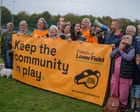
The Friends of Lower Field protesting against the sale of playing fields in Totnes, South Devon. Photograph: Jim Wileman/The Guardian View image in fullscreen The Friends of Lower Field protesting against the sale of playing fields in Totnes, South Devon. Photograph: Jim Wileman/The Guardian Devon ‘We’re not playing games’: Parents launch playground protests to fight school field sell-off School looking to sell piece of open land beloved by people in Devon town to fund refurbishments
Steven Morris Sat 17 Oct 2026 15.00 CEST Last modified on Sat 17 Oct 2026 15.07 CEST Share Prefer the Guardian on Google On Saturdays throughout autumn, residents of Totnes have met at a field on the banks of the River Dart to play ballgames, fly kites or simply sit on the grass and chat.
But it hasn’t just been about having fun – this has been a “play protest” aimed at trying to save a beloved piece of open land in the historic Devon market town.
The local comprehensive, King Edward VI Community College (KEVICC) , has been given the go-ahead by the UK government to sell the 1.5-hectare plot – Lower Field – and it is likely houses will be built on it.
School leaders say they desperately need funds to revamp neglected buildings but campaigners claim the sell-off is an example of land that has been used by communities for decades being whisked away – a modern “enclosure” of public space.
View image in fullscreen Anna Ali said there was ‘hidden impoverishment’ in the area. Photograph: Jim Wileman/The Guardian “It’s devastating,” said Becca Robinson, who uses the field for women’s and girls’ fitness classes. “I’m trying to get women and girls to be more active and to get outdoors. The great thing about the field is it’s an open space, so it feels safe. It really worries me that, if we lost it, fewer women and girls will exercise.
“It’s also a spot people go just to do their own thing rather than take part in structured sport. You can just make an ad hoc decision to go and play a game or just to sit and read.”
Earlier this year, the anti-poverty charity Trussell published research revealing almost half of UK residents (45%) had lost access to at least one community space – such as a park, social club, library or post office – since 2023.
Danielle McIlven, who has been organising games of rounders on the field, attended the school and said Lower Field had been part of her life for years. “It’s about the unstructured play that can take place there. In the summer you see swarms of teenagers playing there or heading down to the river.”
Anna Ali, the organiser of a women’s football “kickabout” and a member of the campaign group Friends of Lower Field , said the town had a reputation for being middle class and affluent. “But there is quite a lot of hidden impoverishment. Public green spaces are vital. I was speaking to a woman who brings her grandchildren here. They can’t afford to join sports clubs, so kicking a ball around on the field is a lifeline.”
Lewis Winks, a leading member of the Right to Roam group, said Lower Field had been shared by the school and the wider Totnes community since it was gifted by the Elmhirst family, known for progressive farming, forestry and educational projects on the nearby Dartington Estate , about a century ago.
View image in fullscreen Campaigner Lewis Winks said Lower Field had been shared by the school and community for about a century. Photograph: Jim Wileman/The Guardian A key issue the Friends group is digging into…