
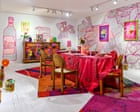
La salle à manger (The Dining Room) by Roxane Mbanga. Photograph: (c) Studio Vanssay View image in fullscreen La salle à manger (The Dining Room) by Roxane Mbanga. Photograph: (c) Studio Vanssay Art ‘If the lion does not tell its story, the hunter will’: a century of thrilling Cameroonian art Key players in the country’s art history feature in a hefty new tome that covers everything from royal-carvers to bronze-smiths to work inspired by a horrific video smuggled out of a torture chamber
Eromo Egbejule in Abidjan Tue 20 Oct 2026 14.00 CEST Last modified on Tue 20 Oct 2026 14.02 CEST Share Prefer the Guardian on Google One Sunday last year, the Cameroonian-Guadeloupean-French artist Roxane Mbanga was relaxing in bed when she received a message that made her sit up. It was about working on an art history project.
Growing up in Paris, she had been a regular at Maasai Mara, the now defunct restaurant owned by her father, where Africans in the diaspora, including the artists whom he helped organise exhibitions, convened to eat and chat. Thus the concept of a book, attempting for the first time to comprehensively compile and document key players in Cameroon’s vast visual art history, made obvious sense to her.
“It’s a magical reconnaissance, being recognised by my peers and being in the same book as people I look up to,” says the 30-year-old artist. “This idea of creating spaces, as with the book, is incredibly important because it allows us to build from there and leave traces for people that will come after. I really lacked that growing up … spaces like books, podcasts or whatever, where I could really see people that resemble me, that do things similar to me.”
View image in fullscreen The first African woman to curate the Venice Biennale … Koyo Kouoh. Photograph: Marco Longari/AFP/Getty Images She is one of 180 artists who appear in Ô Cameroon! , a 424-page volume that launches at the 1-54 Contemporary African Art Fair in London in October, with planned stops in Côte d’Ivoire’s Abidjan, Paris and the Cameroonian cities of Douala and Yaoundé. Posthumous additions include the painter-sculptor Koko Komégné , who died three weeks after submitting his contribution to the book, and the first African woman to curate the Venice Biennale, Koyo Kouoh who died of cancer last year.
The book was curated and conceived by Cameroonian national Ozong Agborsangaya-Fiteu, an Abidjan-based collector and development finance executive. During her travels, she kept encountering artists from her homeland of different generations and in different places, and realised that there was also no single archive or directory to find out more about them.
“There was a sense of absence or loss … I became increasingly conscious that if we did not document these artists’ works, some could just simply disappear,” she says. “At some point, my own curiosity became a feeling of urgent responsibility. I began to feel that if we did not gather these histories right away, we might lose them for ever.”
In 1919 , a year after Germany was defeated in the first world war, its former colony of Kamerun was split into two unequal halves between the French and British. Despite the profound transformation – and as European colonial administrators looted thousands of artefacts from the country – societies of artists continued their intellectual and cultural work underground. Royal carvers and bronze-smiths in the ancient walled city of Foumban, for example, thrived under the reign of Su…