
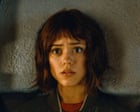
Misreading social cues, crashing the family car … Jenna Ortega as artificial friend Klara. Photograph: Sony Pictures Entertainment View image in fullscreen Misreading social cues, crashing the family car … Jenna Ortega as artificial friend Klara. Photograph: Sony Pictures Entertainment Film Interview ‘I’d consider replacing one of my children’: Taika Waititi on robot kids, his cheese-o-meter and Klara and the Sun Xan Brooks The director has turned Kazuo Ishiguro’s acclaimed novel about an ailing adolescent and her glitchy robot friend into a thought-provoking film. What do the pair think this story says about tech, love and grief?
Thu 22 Oct 2026 06.00 CEST Share Prefer the Guardian on Google I n the wings of the London film festival, a group of young influencers are discussing their personal highlights. Klara and the Sun, says one, and her colleagues agree. It’s not just that the film is still so fresh in their memory, or that they have gathered today to meet its creators and stars. Klara is funny and moving; it’s their festival favourite so far. I relay this exchange to Taika Waititi , the film’s director, who is sipping bottled water in a room down the hall. His gaze widens. He almost chokes. “Thank God!” he exclaims with just a bit too much heat.
Everybody has a perfect film, just as everybody has a perfect friend, and they vary because everybody is different. In the film, sick 14-year-old Josie loves her discontinued robot doll Klara, whereas most kids her age opt for brighter, shinier models. And the young influencers love Klara and the Sun – Waititi’s adaptation of Kazuo Ishiguro’s acclaimed novel – while most older critics vehemently, violently disagree . All of which shows that there’s no accounting for taste, that people are confounding, and that our hearts and our brains are not always in sync. That keeps life interesting. It’s partly what the film is about. “The emotions that we give very simple labels to are really complex,” says Ishiguro, who is seated alongside the director. “The thing we call love, for example, is incredibly noisy and multifaceted. Nobody knows what the hell love is.”
I can't make a Schindler's List. That's not in my wheelhouse For what it’s worth, I loved Ishiguro’s distinctively spare and poignant source novel and am less convinced by Waititi’s screen version, which is certainly noisy. Jenna Ortega stars as Klara, the perky solar-powered AI who plays soulmate to adolescent Josie (Mia Tharia), at a remote country house. She’s a warm splash of sunshine in an otherwise frosty environment, a fish out of water in a tragicomic sci-fi caper. But there is a glitch in the matrix; the component parts don’t align. Waititi adds sugar and caffeine, pratfalls and one-liners. Klara misreads social cues and steers the family car off the road. She fears she’ll be shipped back to the factory and melted down for scrap.
View image in fullscreen ‘In another version of this movie, Klara could be a murder-bot’ … Mia Tharia as Josie with Ortega as her artificial friend. Photograph: Matt Grace/Sony Pictures Entertainment Perhaps the perfect friend is independent, self-directed. Ishiguro has seen several of his Nobel prize-winning books – The Remains of the Day, Never Let Me Go, A Pale View of Hills – adapted for the screen. He feels that the best films break away and that the worst are too faithful. “Sometimes it’s not just loyalty but laziness,” he says. “You can’t just have the text there in front of you. You need to use…