
June 15, 2026 June 15, 2026 Home » News » David Hockney and the Representation of Architectural Space The British artist David Hockney employed the strict geometry of mid-century modern architecture to define spatial logic in his most famous works. After moving to California in the 1960s, Hockney embraced the formal language of modernist wings, characterized by horizontal planes, expansive glass facades, and the integration of indoor and outdoor environments. His paintings serve as architectural documents that capture the stillness of built forms against the fluidity of light and water.
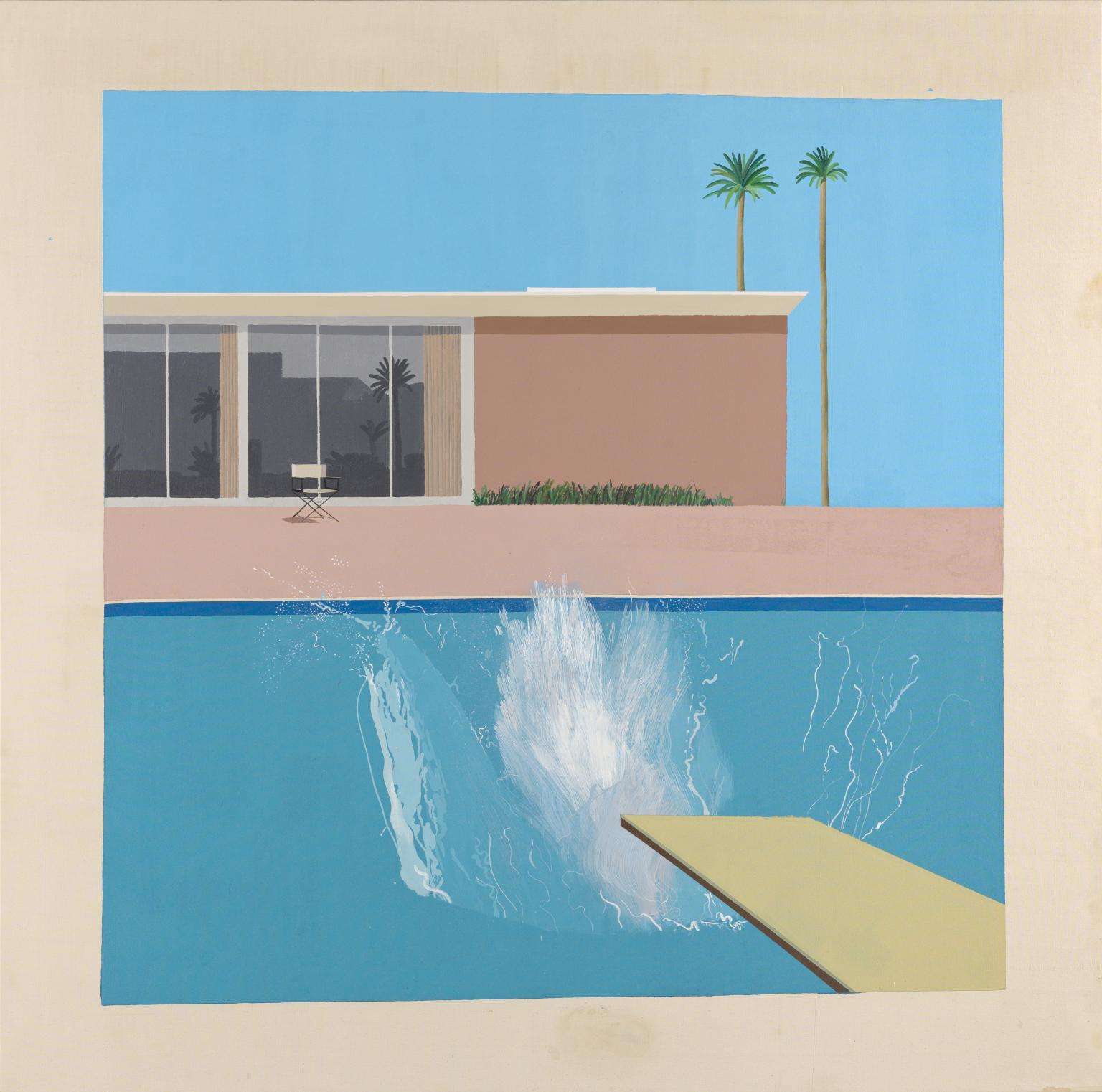
The painting "A Bigger Splash" from 1967 highlights the precision of Euclidean geometry within a residential environment. The composition features a wing with a flat roof and sliding glass doors that create a rigid grid of vertical and horizontal lines. This architectural stillness contrasts sharply with the chaotic movement of water. The built environment stands as a silent, permanent witness to a transient human event, affirming the stable nature of modernist design.
In the painting "Beverly Hills Housewife" from 1966, Hockney explored the concept of transparency through a floor-to-ceiling glass façade. These architectural boundaries act as a visual extension of the living space rather than a barrier. The artist dissolved the distinctions between the closed room and the outdoor patio by placing the character on a tiled balcony framed by slender metal columns. The resulting spatial condition creates the illusion of an open-air living room, reflecting the fundamental principles of Californian modernism.
The internal logic of the painting "Mr. and Mrs. Clark and Percy" (1970–1971) relies on the technique of backlighting (contre-jour). The architectural opening here, represented by open French doors with metal screens, acts as a primary source of light and organizer of space. This opening divides the room into defined areas of light and shadow. Hockney’s simple interior design and the blank surfaces of the walls convey the psychological distance, as the physical space between the figures reflects their emotional state.
The pool in the painting "Portrait of an Artist" serves as a transparent architectural object. The sharp curved edge of the pool creates a deep perspective that directs the viewer's eye toward a distant mountain range. This technical strategy links the precise geometry of the built pool with the irregular forms of the surrounding landscape. The pool becomes an organized intervention that connects human engineering with the organic environment.
Hockney challenged traditional architectural representation in his painting "Large Interior, Los Angeles" (1988) by employing reverse perspective. Instead of adhering to the single-point perspective that emerged during the Renaissance, the lines in this painting expand towards the viewer. This technique dismantles the internal volume, creating a dynamic sense of movement within the room. This shift in perspective transforms the viewer from a passive observer to an active participant within the spatial field.
The architectural elements in these works, such as pools, windows, and structural columns, transcend their functional roles to become psychological and environmental frames. Hockney has proved that space consists of more than just physical dimensions; it integrates color, light, and human interaction. His continual focus on natural light and the relationship between individuals and physical surfaces provides insights into the design of vibrant, light-filled environments.
Project team: David Hockney (Artist). Location: California and London.
Project notes: This analysis covers major works from 1966 to 1988, focusing on the influences of mid-century modern architecture and spatial deconstruction.