
Almost any auto dealership lot or commuter parking structure today presents a sea of monochrome boredom. White, black, silver, and fifty variations of gray dominate the view. For enthusiasts who see a vehicle as an extension of their personality rather than a mere appliance, factory color palettes can be deeply frustrating.
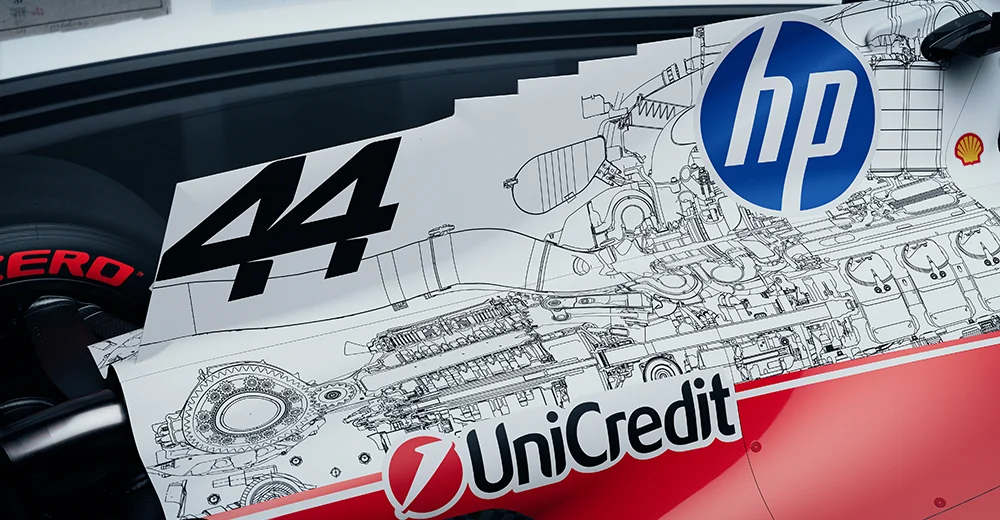
HP and Scuderia Ferrari HP recently detailed their collaboration on a special racing design for the 2026 United States Grand Prix at Circuit of The Americas in Austin, Texas. The project suggests possibilities for how consumer vehicles could be finished and customized.
Ferrari applied its blueprint-inspired graphics to the SF-26 Formula 1 cars using HP Latex printing and vehicle-wrapping expertise. HP Z Workstations supported the design and engineering workflows. A separate display car uses invisible blue ink adapted for the HP Indigo 200K Digital Press to reveal hidden graphics under ultraviolet light.
What interests me is where this could lead beyond the racetrack. Combined with HP's 3D printing technologies, a similar approach could give car buyers more control over both the shape and finish of customized parts — and give automakers another way to offer something beyond the standard paint chart.
Last week, I had my Audi RS e-tron GT performance wrapped in deep purple paint protection film (PPF). I wanted a lighter, more distinctive shade, but couldn't find it in the available films. That experience made digitally printed custom finishes particularly appealing — especially if they could eventually deliver the color I wanted with the protection I chose PPF to provide.
Let's discuss what this could mean for car buyers, automakers, and dealers. Then I'll close with my product of the week, an HP laptop aimed at AI developers.
For everyday car buyers, the appeal starts with the cost and complexity of offering more factory colors.
An automotive paint shop requires substantial equipment, energy, and emissions controls. Pretreatment, electrocoating, primers, basecoats, and clearcoats involve multiple processing stages, spray systems, and curing ovens.
Adding colors can complicate paint handling, production scheduling, and quality control. Automakers must weigh those costs against demand, which helps explain the appeal of a limited palette of broadly popular colors.
Bespoke programs such as Audi exclusive and Porsche's Paint to Sample offer alternatives, but customization can be expensive. Porsche distinguishes between an established selection of Paint to Sample colors and Paint to Sample Plus, which involves evaluating a customer's proposed shade.
Choosing a color outside the standard palette can mean a substantial surcharge, and paying more doesn't guarantee the factory can accommodate the request.
From a dealer's perspective, custom colors can also be a financial gamble. If a buyer orders a car in bold purple or vibrant green and then backs out, the dealer must find another customer who wants that particular combination of vehicle, equipment, and color.
The shade that made the car irresistible to one buyer may narrow its appeal to everyone else. A removable finish offers a different proposition: change the color for the next customer rather than wait for someone who loves the existing one.
When factory customization is too expensive or unavailable, aftermarket wrapping sounds like the ideal workaround: buy a black or silver car, then wrap it in the color the owner actually wants.
That separates the factory…