
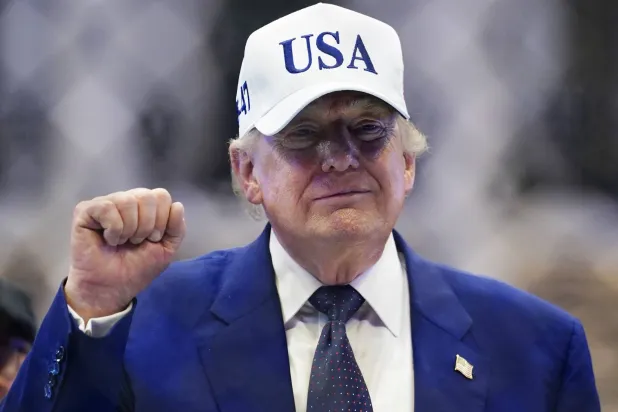
Reactions to U.S. President Donald Trump's announcement of a memorandum of understanding with Iran ranged from cautious welcome to concerns about details and implementation mechanisms.
The memorandum, which is supposed to be officially signed on Friday in Geneva, aims to halt the fighting and reopen the Strait of Hormuz, paving the way for subsequent negotiations regarding the Iranian nuclear program, lifting sanctions, and releasing frozen Iranian assets.
Analysts and experts indicated that the understanding is a temporary framework, and not a comprehensive nuclear agreement like the 2015 deal. It includes, according to the American narrative, the immediate and fee-free opening of the Strait of Hormuz, in exchange for lifting the U.S. naval blockade and removing mines within 30 days.
However, they pointed out discrepancies in the narratives; Tehran speaks of 'Iranian arrangements' and potential measures in the strait, while Trump emphasizes 'free flow' of oil to markets.
The memorandum also leaves open questions about implementation mechanisms, timelines, and the release of $25 billion of frozen Iranian funds.
Supporters of U.S. President Donald Trump promoted the agreement to end the war with Iran as a strategic victory for him, with congratulatory remarks coming from within his administration and among Republican allies. Secretary of State Marco Rubio linked the announcement of the agreement to Trump's 80th birthday, writing on the platform X: 'America is lucky to have a leader with remarkable courage, extraordinary strength, unparalleled humor, and unmatched love for country.'
Trump during the 'State of the Union' address before 'Congress' on February 24, four days before the onset of war on Iran (AFP)
Several Republicans used social media to praise Trump, calling him the 'deal maker.' Republican Congressman Robert Aderholt stated that the upcoming agreement with Iran would impose restrictions on Tehran's nuclear program that exceed what was stipulated in the 2015 'Joint Comprehensive Plan of Action.' He wrote on X: 'Unlike the agreement reached under the Obama administration, this agreement will not allow Iran to continue enriching uranium and stockpiling materials necessary to make a nuclear weapon.'
Republican Senator Lindsey Graham, a close ally of Trump, welcomed the memorandum of understanding with Iran, particularly concerning the assurance of keeping the Strait of Hormuz open, pledging to closely monitor subsequent negotiations regarding the Iranian nuclear program. However, despite the welcome, he expressed concern in a post on X, stating that Iran's view of the agreement seems different from what the American negotiating team is announcing.
Graham stressed that, under U.S. law, any nuclear agreement with Iran must be sent to 'Congress' for review and a vote, expressing his anticipation of viewing the final wording of the agreement.
Democratic criticisms began even before the official announcement of the agreement. Senator Jack Reed, a Democrat from Rhode Island and the highest-ranking Democrat on the Senate Armed Services Committee, told Fox News that the U.S. would achieve less under this agreement than the Obama administration did in the 2015 agreement, which constrained the Iranian nuclear program in exchange for easing sanctions.
Reed noted that the war waged by President Donald Trump cost billions of dollars, led to the deaths of 14 American soldiers, and injured hundreds while causing global economic disruption. He added: 'Essentially, we are now getting less than what was available for the nuclear agreement from which Trump withdrew,' pointing out that the U.S. president wanted to give himself a 'birthday gift' through the agreement that coincided with his turning 80.
Meanwhile, Democratic Congressman Seth Moulton, a member of the House Armed Services Committee, criticized the proposed terms of the agreement, describing them as Trump's 'surrender document.'
Moulton told reporters: 'The Trump administration has already spent $100 billion of taxpayers' money on this war, and 14 Americans were killed, and in the end, we get an agreement that only reopens a strait that was already open before he started the war? How is that considered a victory?'
Ships in the Strait of Hormuz as seen from Musandam Governorate in Oman... June 14, 2026 (Reuters)
The Democratic House Minority Leader, Hakeem Jeffries, told NBC that he wants to see the terms of the agreement if it is reached, but stressed that the war itself was 'reckless' and 'catastrophic.' He added that Trump's withdrawal from the Iranian nuclear deal made Tehran 'stronger,' while Americans became 'less safe' under his leadership.
Gregory Meeks, the leading Democrat on the House Foreign Affairs Committee, stated that Trump’s 'war of choice' was 'wrong and damaging to American interests,' but he welcomed a return to the diplomatic path, calling for more clarity regarding any agreement.
In a statement, Meeks said: 'The American people deserve more than vague announcements or political maneuvering. They deserve security and clear answers and confidence that this administration will not repeat the failures that led us to this costly and unauthorized war.'
Former U.S. Ambassador to Israel, Dan Shapiro, who worked on the Iran file in the Biden administration, stated that Tehran 'knows well how to stall in these negotiations and try to extract gradual concessions.' He added, in a post on the platform X, that it is unlikely that a final agreement will be reached, and even if it happens, 'it will be worse than what could have been achieved through diplomacy before the war broke out.'
Shapiro noted that ensuring the Strait of Hormuz remains open represents the most significant outcome of the agreement, but he pointed out that Iran has managed to turn the strait into a 'real and powerful leverage point.'