
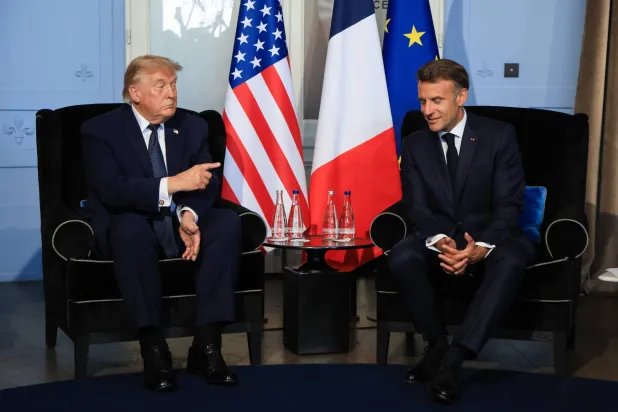
U.S. President Donald Trump stated during a joint press conference with French President Emmanuel Macron that the Strait of Hormuz "will open fully on Friday," adding that he may participate in the signing of the memorandum of understanding with Iran "or may not participate."
Trump confirmed that Iran "will not have a nuclear weapon," expressing hope that the relationship with Tehran is "good." He added that the most important thing at this stage is that "oil prices are falling and stock prices are rising."
Trump also stated that Washington "will consider whether it can fix the situation in Lebanon," referring to the ongoing tension associated with Israeli operations and Hezbollah.
For his part, Macron described the agreement with Iran as "a very important step," stating it will lead to the reopening of the Strait of Hormuz. He added that the French military is ready to help secure navigation in the strait, pending U.S. approval of the French offer.
A senior U.S. official said at a press briefing that the United States and Iran signed a memorandum of understanding to end the war and reopen the Strait of Hormuz, explaining that Trump and Vice President JD Vance signed the document on the U.S. side, while it was signed by Iranian Parliament Speaker Mohammad Baqer Qalibaf on the Iranian side.
The official added that Washington understands that Qalibaf is authorized by the Iranian leader to sign and negotiate, noting that the details of the agreement will be published within a day or two, and that technical discussions will begin later this week.
The official stated that the agreement calls for the immediate opening of the Strait of Hormuz and the lifting of the U.S. blockade on Iran, expecting that traffic in the strait will see a significant increase starting now. He added that the memorandum of understanding explicitly states that the Strait of Hormuz will remain open without fees for a period of sixty days, and that Washington expects free passage in the strait to also be part of the final agreement.
The official emphasized that the lifting of the freeze on Iranian funds and the easing of sanctions are "linked to performance," explaining that easing sanctions is not tied to one specific behavior, but to "Iran's proper conduct." He stated that Washington wants to see Iran take "verifiable and irreversible steps."
He clarified that the United States is ready to release frozen funds and ease sanctions, and may offer "some small initiatives" initially, but linked any broader steps to Tehran's commitment to the terms of the agreement.
The official stated that Israel will have the right to defend itself against Hezbollah attacks, asserting that Israel's withdrawal from Lebanon is not a condition for completing the agreement with Iran.
He added that Washington intends to maintain the current status of U.S. military forces during the next phase of negotiations with Iran, noting that the agreement calls for considering reducing forces when reaching a final agreement.
In this context, U.S. Vice President JD Vance said that signing the memorandum of understanding with Iran will not lead to the release of any frozen Iranian funds, explaining that the framework agreement was signed electronically on Sunday, and its text will be published during this week.
Vance added: "No funds have been released, and that won't change," stressing that Iran will not receive funds unless it takes documented steps to rid itself of its stock of highly enriched uranium. He stated that Washington may lift sanctions if it observes Iranian actions in this direction, but it will not allow Tehran to receive funds "to rebuild its nuclear program" if it does not comply with the required verification regime.
In another interview, Vance said that Washington expects the Strait of Hormuz to remain open in the long term without tolls, but he acknowledged that "very important details" still need to be resolved during the technical negotiations.
He added that Iranian Foreign Minister Abbas Araghchi and Parliament Speaker Mohammad Baqer Qalibaf will represent Tehran at the signing ceremony scheduled for Friday in Switzerland, without revealing who will represent the United States.