
At a time when the Lebanese are awaiting any details that may emerge from the memorandum of understanding between the United States and its potential implications for their country, David Schenker, who served as Assistant Secretary of State for Near Eastern Affairs during President Donald Trump's first term, questioned whether the Lebanese state would remain caught between the hammer of Israel, which continues its military pressures, and the anvil of Hezbollah, which has refused to disarm so far.
For him, the central question is not whether the current war will end soon, but whether Lebanon has become ready and capable of addressing the deeper problem of having an armed organization operating outside state authority.
Schenker argued, in an interview with Asharq Al-Awsat, that the war should not be viewed as an isolated military confrontation but as part of a broader struggle involving Iran, Hezbollah, Israel, and the future of the Lebanese state itself. He initially pointed to Iran's efforts to tie Lebanon's fate to the tensions and negotiations between Tehran and Washington, stating that "Iran seeks to make Lebanon part of broader negotiations" related to the Strait of Hormuz, the Iranian nuclear program, and regional security arrangements.
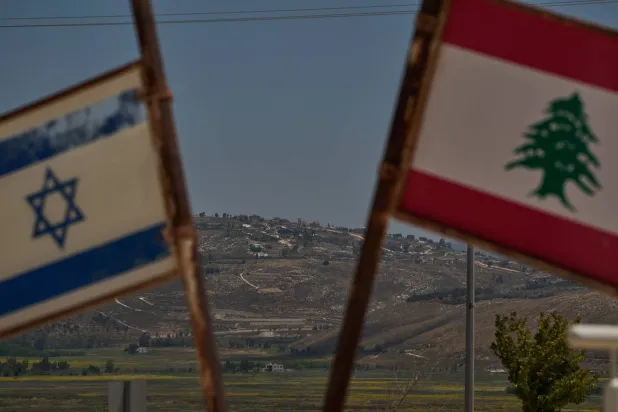
A group of hardline Jews looks from Israel towards southern Lebanon (Reuters)
Schenker predicted that Washington would encourage Israel to exercise restraint without compelling it to a complete ceasefire and to prevent its operations against Hezbollah. He stated: "Restrictions may be imposed on Israel, particularly concerning Beirut, but Israel will not withdraw from Lebanon because of this agreement, and it will continue to target (Hezbollah), which may ultimately benefit from it, adding: 'Once again, Iran intervenes in Lebanese sovereignty. It makes decisions that affect Lebanon and protects (Hezbollah) by giving it a chance to rebuild its ranks.'
Schenker appeared pessimistic about the party, which "will not agree to negotiate with the Lebanese government regarding the surrender of its weapon" because "Iran wants (Hezbollah) to continue, and it is accountable to it," which "keeps Lebanon caught in a strategic impasse."
Smoke rises after an Israeli airstrike in southern Lebanon (EPA)
Regarding what are called the "model areas" to be established in southern Lebanon under the recent agreement between Lebanese and Israeli negotiators mediated by the Americans, Schenker questioned whether the Lebanese army was "capable of controlling those areas", adding that "ultimately, (Hezbollah) will try to return. At that point, the Lebanese state will have to decide whether it is ready to repel it." He considered that "the biggest challenge facing Lebanon lies in a state that lacks the capacity - or perhaps the will - to impose its authority throughout the country." He emphasized that "the solution lies in building Lebanon as a state," because "the strength of (Hezbollah) is not merely the result of Iranian support, but also a consequence of decades of state weakness," noting that "the state is absent, not only in the south but in other areas of the country as well."
Despite the above, Schenker acknowledged the dilemma facing Lebanese leaders; any attempt to confront Hezbollah warns of political instability, perhaps even civil strife. However, refusing to confront Hezbollah condemns part of the country to what he described as a state of permanent war. He stated: "If they fear civil war, and thus are unwilling to challenge (Hezbollah), then part of Lebanon will remain in continuous conflict."
Two Lebanese soldiers near a site targeted by Israeli shelling in southern Beirut suburb (EPA)
He also rejected one of the common arguments in Lebanon for not disarming Hezbollah, which is that the Lebanese army simply lacks the necessary resources, reminding that "the United States has provided Lebanon with about three billion dollars since 2005." He said: "This is not a problem of capabilities as much as it is a problem of political will."
While many Lebanese still hope that the agreement between the United States and Iran will contribute to solving the problem of Hezbollah, Schenker warned that "current American-Iranian talks focus heavily on the Iranian nuclear program rather than Tehran's support for regional armed groups."
He added that "when President Trump first made his demands, they included ending support for proxies. But that is not the focus of these negotiations today." He viewed that the only radical change that would alter the equation would be a radical shift within Iran itself, but he sees no evidence that such a change is near.
Despite the grim outlook, Schenker expressed support for the ongoing direct talks between Lebanon and Israel, emphasizing that practical issues, such as border demarcation, security arrangements, and de-escalation mechanisms, remain addressable even if the major disputes remain unresolved. He found it not surprising that peace talks would focus heavily on the withdrawal of Hezbollah from southern Lebanon rather than Israel's withdrawal. He noted that Lebanese officials themselves have long recognized the interconnectedness of the two issues.