
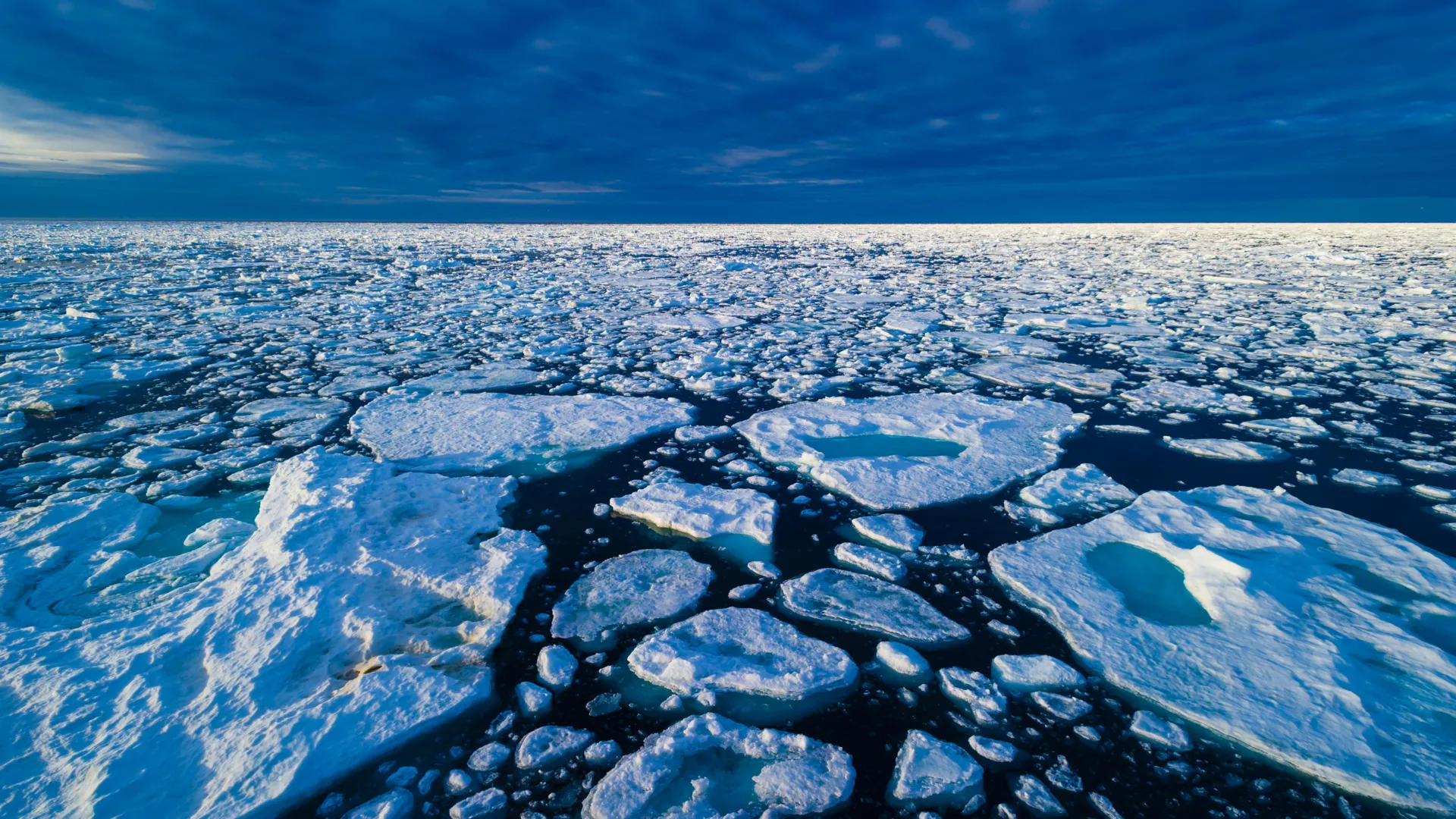
The Arctic could lose roughly one million square kilometers more winter sea ice than scientists previously predicted, according to new research that draws on evidence from a warmer Arctic 6,000 years ago. By using ancient climate records to refine modern computer models, researchers have produced more reliable estimates of how much ice may disappear in the coming decades.
The findings, published in Nature Geoscience , could also have important consequences for winter weather in the United Kingdom and other parts of Europe.
Much of the attention surrounding Arctic ice loss has focused on the dramatic retreat of summer sea ice. Winter ice, however, has received considerably less scrutiny, even though climate models show their greatest disagreements when predicting how much ice will cover the Arctic during the colder months.
Why Arctic Winter Sea Ice Matters for Global Weather
Winter sea ice influences weather far beyond the Arctic by controlling how much heat and moisture escape from the ocean into the atmosphere. Declining ice cover has been associated with colder winters and increased snowfall in the United Kingdom, northern Europe, and North America.
Recent observations have also highlighted the Arctic's changing conditions. In March 2025, winter sea ice reached the lowest annual maximum extent recorded since modern monitoring began. The Arctic matched that record again in 2026.
To improve predictions of future ice loss, scientists at the University of Cambridge and Mexico's Centro de Investigación en Matematicas (CIMAT) turned to evidence preserved beneath the Arctic Ocean.
The team assembled the largest database of its kind containing a chemical marker produced by algae that live within sea ice. The evidence came from sediment cores deposited during the mid-Holocene, approximately 6,000 years ago, when small changes in Earth's orbit helped create a warmer Arctic with less extensive ice cover.
These ancient conditions offered a valuable opportunity to investigate how Arctic sea ice responds to warming and to test whether today's climate models accurately represent that response.
Ancient Ocean Sediments Reveal What Climate Models Missed
The researchers examined concentrations of a biomarker known as IP25, which is produced by algae associated with sea ice. They combined these measurements with other chemical markers left behind by organisms living in open water, allowing them to reconstruct Arctic ice conditions thousands of years in the past.
Next, they compared those reconstructions with simulations generated by 27 climate models for the same ancient period.
Using a statistical method called Bayesian weighting, the researchers assigned greater importance to models that more closely matched the historical evidence. Models that performed less accurately received less influence over the final predictions.
Because the underlying physical processes controlling sea ice remain consistent across different climate conditions, the team could apply these same weights to simulations of both the recent past and the future.
The comparison revealed a significant problem: collectively, the climate models predicted more winter sea ice than the ancient evidence supported.
"When we apply the model weights to historical simulations, we completely eliminated the positive bias," said lead author Crystal Fu, from Cambridge's Scott Polar Research Institute. "The future projections similarly end up being lower than previous estimates, b…