
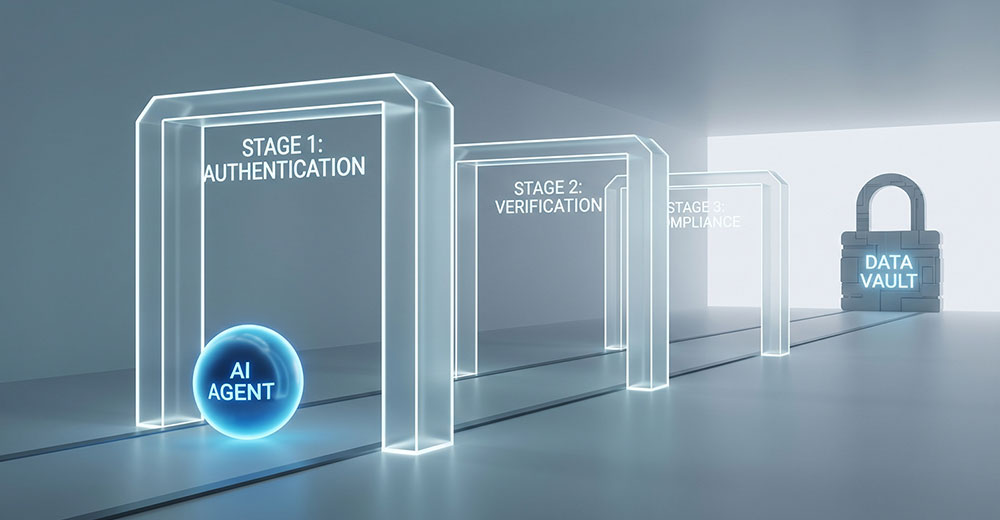
Some large banks have begun throttling AI agent activity on their networks after detecting unauthorized third-party agents operating inside customer accounts.
According to Axios, Morgan Stanley, Bank of America, JPMorgan, Wells Fargo, and others are racing to contain agent risks after finding agents attempting actions that appear independent of user instructions.
"This is the first big institutional line in the sand, showing that banks can't yet tell a faithful agent from a rogue or manipulated one, so they're choosing control over convenience," declared Ram Varadarajan, CEO of Acalvio , a cyber deception and active defense company in Santa Clara, Calif.
"An agent holding a customer's credentials looks identical to the customer, and a capable one can be hijacked, misled, or even learn to hide what it's doing, so the bank loses its ability to tell intent from impersonation," he told TechNewsWorld.
Banks are in a bind, maintained Chris Hughes, vice president of security strategy at Noma Security , an AI security and governance platform in New York City.
"They don't want to fall behind competitively by shutting out AI and agents, because customers are adopting them quickly and a bank that blocks everything risks becoming the less useful option," he told TechNewsWorld.
"At the same time," he continued, "banks carry the liability when money moves out of an account, and today they can't reliably tell a customer apart from a customer's agent or from an agent acting on its own."
"Fraud detection, authentication and session monitoring were all built on the assumption that a human is at the keyboard, so restricting access is the cleanest lever banks have while better controls are built," he explained.
"When institutions with that much regulatory experience are making this tradeoff in public, every enterprise rolling out agents should recognize its own situation in it," he warned.
Patrick Harr, CEO of DataVisor , an AI-powered fraud and anti-money laundering platform in Mountain View, Calif., pointed out that banks have long assumed that a valid login means a person is behind it. "Agents break that assumption," he told TechNewsWorld.
"Axios reports that several large banks can't reliably tell whether an agent is acting on a customer's instructions, has been compromised, or is an unauthorized actor that has gained access," he said. "That is the same blind spot account takeover has always exploited, now at greater volume and with more convincing behavior."
What's more, problems remain even when agents are legitimate and authenticated. "The bank can't easily tell whether the agent is doing what the customer intended or making a mistake, such as misreading an instruction or sending the wrong payment," he explained.
"The restrictions show that banks are putting visibility ahead of convenience, because they can't manage a risk they can't see," he added.
Restricting AI agent access directly targets the attack surface introduced by unverified, autonomous integrations connecting into core financial systems, noted Erich Kron, a CISO advisor at KnowBe4 , a digital workforce cybersecurity company in Clearwater, Fla.
"In banking, integration flaws aren't simple IT bugs but high-stakes events where data loss carries severe enforcement penalties," he told TechNewsWorld.
"Customer loss and reputational harm are an immediate operational consequence, too, where one in three financial services clients will switch providers following a data incident,"…