
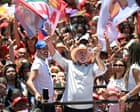
Luiz Inácio Lula da Silva takes a snapshot during a campaign motorcade in Ceilândia, Distrito Federal, Brazil on 9 October. Photograph: Evaristo Sa/AFP/Getty Images View image in fullscreen Luiz Inácio Lula da Silva takes a snapshot during a campaign motorcade in Ceilândia, Distrito Federal, Brazil on 9 October. Photograph: Evaristo Sa/AFP/Getty Images Brazil The secret behind Lula’s win in Brazil may be an ‘army’ – of social media creators There are many explanations for the incumbent president’s win over Flávio Bolsonaro, but analysts – and he – point to reinvention of his social media use
Tiago Rogero in Brasília Sat 31 Oct 2026 14.37 CET Last modified on Sat 31 Oct 2026 14.39 CET Share Prefer the Guardian on Google Four days before his stunning electoral comeback, Luiz Inácio Lula da Silva , Brazil’s president, got his first smartphone.
Lula, who turned 81 last Tuesday, had long said he wanted to avoid an endless stream of calls during his rare moments off, and he began his presidential campaign by sticking to an old habit: using aides’ phones – only when necessary.
Then he suffered an unexpected first-round defeat to the far-right senator Flávio Bolsonaro, who had neither his father Jair Bolsonaro’s charisma nor much of a record as a two–decade legislator – and Lula realised he had lost both in the ballot box and in the digital arena.
The veteran leftist, who contested his first election more than 40 years ago, overhauled his digital strategy, began recording selfie-style videos – and went on to beat Bolsonaro by more than 4.4m votes.
There are many explanations for how he managed to boost turnout and win over other candidates’ voters. Some analysts point to an organic student mobilisation that held mass protests across Brazil, others to a package of government benefits Lula approved at the last minute in a transparent attempt to use government spending to curry favour with the electorate.
But many analysts, and the president himself, point to the incumbent’s reinvention of his social media use as a key reason for his victory.
View image in fullscreen Luiz Inácio Lula da Silva delivers a speech at La Moneda Palace, in Santiago Chile, on 21 July 2025. Photograph: Cristobal Basaure Araya/Sopa Images/LightRocket/Getty Images Interestingly, neither Lula’s campaign created nor ran what was ultimately the driving force behind the shift: a WhatsApp group called “Lula’s Army”.
In the days leading up to the vote, its nearly 11 million followers – up from just 60,000 after the first round – received daily “missions” to try to win over voters and make pro-Lula content perform well on social media.
Leading the “army” was the man Lula praised in his victory speech as “our general”, whose role was “raising the morale of our troops every day”: 42-year-old congressman André Janones.
“I have no doubt that Lula’s army determined the outcome of the election,” Janones said, saying that he is not modest “because modesty sometimes comes very close to hypocrisy. I know how much bigger I came out of this election.”
In his view, the contest had three main fronts. The first was candidate versus candidate, “and on that Lula was winning by a mile because he had much more experience”. The second was mobilisation on the streets, “and we were bringing many more people out to the protests”.
But the third: “You don’t have to be very clever to realise that we were losing on social media.”
Although Lula had more followers, Bolsonaro’s content generated…