
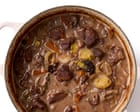
Felicity Cloake's venison casserole 05a Photograph: Robert Billington/The Guardian. Food styling: Loïc Parisot. View image in fullscreen Felicity Cloake's venison casserole 05a Photograph: Robert Billington/The Guardian. Food styling: Loïc Parisot. How to cook the perfect ... Stew How to make the perfect venison casserole – recipe Venison casserole is as autumnal as fallen leaves, a glass of red and a fire in the grate. But who makes the best version?
Felicity Cloake Sun 1 Nov 2026 14.00 CET Last modified on Sun 1 Nov 2026 14.02 CET Share Prefer the Guardian on Google B ecause I don’t eat it very often, I always forget how much I like venison. Or, rather, how much I like it in certain contexts: the natural leanness of a wild animal doesn’t naturally lend itself to soloing in juicy burgers or sausages, but, when slow-cooked, it’s fabulous – rich in flavour, and soft enough to eat with a spoon, should you so desire. It also tends to be good value both in season and frozen for the rest of the year, and, as red meat goes, a pretty climate-friendly option (though not straightforwardly so, as this piece explains ) that pairs beautifully with seasonal spuds and kales, and is even better when made ahead of time and reheated. In fact, it’s the perfect autumn and winter entertaining option, even if the only people you’re entertaining are yourselves, the dog and the cast of Celebrity Traitors.
Few recipes specify the cut, perhaps because venison is so often sold in chunks, so the assumption is that it’s going to be used for just this purpose, and rarely do the vendors elucidate further than saying the meat is for “stewing” or simply “diced”. Caroline Conran , whose recipe in her 1 978 British Cooking is attributed to nameless “ghillies” (Scottish hunting guides), suggests using leg or haunch, while Gary Rhodes is firm in his belief that “venison for stewing should come from the haunch, or you can use neck”. Meanwhile, David Eyre calls for a whole shoulder in The Eagle Cookbook , which, like the haunch, feels like a great extravagance, even though, in truth, it is my favourite – the shoulder is better marbled than either the haunch or the diced venison I buy, which, once slow-cooked, makes for a richer, stickier result. That said, you can counteract the meat’s leanness by adding other fats, of which more later, so the only cut you should steer clear of, simply because it’s too tender for such treatment, is the saddle.
View image in fullscreen John William, AKA “the deer man” of Raasay, soaks the meat overnight in “gutsy red wine”. All thumbnail images by Felicity Cloake. John William, “the deer man” of Raasay, whose recipe is included in Sue Lawrence’s A Taste of the Scottish Islands , soaks the meat overnight in “gutsy red wine”. I cannot speak for Raasay venison, and I imagine William knows what he’s talking about, but my testers and I don’t detect much difference with the wild Devon meat I use. Indeed, chemist Hervé This concluded that one would have to marinade meat for several days for the alcohol to have a noticeably tenderising effect, while the flavour penetration of any marinade is mere millimetres. By all means, marinate if you like, then, but I think you’re better off trusting in the mingling of flavours that takes place in the pot.
Rhodes tells readers of his book More Rhodes Around Britain that, “I like to cut the meat into large pieces rather than dice. It takes a little longer to cook, but the texture and taste are better.” Scept…