
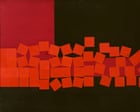
‘She’s making the moves’ … Wilhelmina Barns-Graham’s Protest, 1967. Photograph: © Wilhelmina Barns-Graham Trust View image in fullscreen ‘She’s making the moves’ … Wilhelmina Barns-Graham’s Protest, 1967. Photograph: © Wilhelmina Barns-Graham Trust Art and design Beaches, Beatles and a broken marriage: how Wilhelmina Barns-Graham became a radical art icon The artist who was inspired by Swiss glaciers, the Vietnam war and her own divorce was sidelined from St Ives’ art history – but finally has a major retrospective at Tate
Kat Lister Mon 2 Nov 2026 13.30 CET Last modified on Mon 2 Nov 2026 13.32 CET Share Prefer the Guardian on Google A t the centre of Tate St Ives’ newly opened retrospective of the British modernist Wilhelmina Barns-Graham, her monumental altar-piece Glacier (Blue Cave) pulls viewers into its frozen tendons of turquoise and white. Its mouth is agape and the blue slit of its eye casts downwards to the rest of its body. The glacier feels human: a vivisection of rock, ice and snow that brings to mind the fragmented facial features of Picasso’s Weeping Woman.
Standing in front of this glassy colossus, the exhibition’s curator, Katy Norris, talks about these “mangled” and “twisted” forms – so alive on the canvas. “Barns-Graham was so distinct in her approach,” Norris says. “There are always questions of: what am I seeing? What is in front of me really? And how does that relate to what I feel inside?”
View image in fullscreen ‘Feels human’ … Glacier (Blue Cave), 1950. Photograph: © Wilhelmina Barns-Graham Trust Glacier (Blue Cave) was painted not far from this gallery space in 1950 – only 10 years after the Scottish-born painter moved 500 miles south to the tiny fishing town of St Ives – but it goes some way to showing just how radical she was over the course of her eight-decade career. From her early 20s, Barns-Graham’s quest for connection saw the self-described “lone wolf” become a key player in the St Ives school which congregated in and around the Cornish harbour during the second world war. She continued to experiment relentlessly with colour, geometry, kineticism and repetition until her death in 2004, aged 91.
Anne Barlow, director of Tate St Ives, points out this major retrospective – the first to span Barns-Graham’s full career – is a “long-overdue celebration” of an expressive master. The art historian Virginia Button wrote that “Barns-Graham clearly felt that as a woman she had been unfairly sidelined from the history of St Ives” with its focus on Ben Nicholson, Peter Lanyon and Patrick Heron. She had a brief period of fame in the 1950s, but it waned in the 1960s as her landscape modernist work became increasingly “hard-edged” (as Rob Airey, director of the Wilhelmina Barns-Graham Trust, puts it) and more daring; less commercial and harder to categorise.
View image in fullscreen In Barns-Graham’s beloved St Ives … The Blue Studio, 1948. Photograph: © Wilhelmina Barns-Graham Trust. Courtesy of The Fleming Collection. With her “blue eyes that flashed like knives” (so her husband, the writer David Lewis, remarked) and her delight in toying with gender stereotypes (she took great pleasure in the sexual ambiguity of her preferred nickname “Willie”), Barns-Graham ploughed her own furrow from the beginning. Born into an upper-class family in the seaside town of St Andrews in 1912, Barns-Graham’s resistance was tested early when her stern father became hostile towards her plan to pursue artmaking as a profession.
N…