
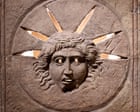
‘Brrr’ … the sun god Sol on one of the altars found under a cricket pavilion in Inveresk. Photograph: Murdo MacLeod/The Guardian View image in fullscreen ‘Brrr’ … the sun god Sol on one of the altars found under a cricket pavilion in Inveresk. Photograph: Murdo MacLeod/The Guardian Art and design What did the Romans ever give Scotland? Heated floors, flashy sandals, sun gods – and a lot of nails From steamy bathhouses to altars to Sol the sun god and leather shoes that still survive to this day, an eye-opening new exhibition chronicles Scotland under the Romans (before they fled)
Charlotte Higgins Thu 5 Nov 2026 06.00 CET Share Prefer the Guardian on Google I nveresk is a handsome village near Edinburgh that sits above a curve of the little river Esk, not far from the mighty Firth of Forth. It is full of elegant 18th-century houses and an attractive kirk, dated 1805. To the casual observer, there is absolutely nothing Roman about it.
And yet, in 2010, when the local cricket pavilion was being rebuilt, an extraordinary find was made – two altars made of local sandstone, lying on their sides, evidently deliberately buried in the Roman era, dedicated to the gods Mithras and Sol. They had been made in the 140s CE as part of a mithraeum, a temple devoted to the worship of Mithras, a cult dependent on secret ritual and complex initiation ceremonies, much beloved by the Roman military. Carved from sandstone quarried nearby, the altars were impressive in scale and finely made, although terribly fragile.
Fragments of manacles are a reminder that the Roman empire depended on enslaving its captives One of them had a frieze of four beautiful female faces carved into it: personifications of the four seasons. Spring was youthful and round-cheeked, winter was cloaked against the frost. Beneath the faces, a Roman mason had also carved the face of the sun god Sol, his rays hollowed right through the stone so that when a lamp was placed behind it, atmospheric flickers of light and shadow would have been thrown into the dark of the temple. There is also an iron hook behind the god’s mouth – archaeologist Fraser Hunter thinks for something metallic to hang there, to be set in motion and jangled by the convection of the lamp’s flame. That way, the god might seem to be murmuring.
View image in fullscreen Hot feet … Fraser Hunter with the remains of underfloor heating. Photograph: Murdo MacLeod/The Guardian The altars will be seen for the first time in public – at least if you consider that, when they were first made and used a little under 2,000 years ago, they were for the eyes of the initiated only and not for the idly curious. They will be one of the highlights of a major new exhibition at the National Museum of Scotland , curated by Hunter and his colleagues. For years, the artefacts have been undergoing an intensive conservation and stabilisation process, since the sandstone of which they were made was threatening to crumble into actual sand.
These impressive altars – once colourfully painted, traces of pigment still clinging to their surfaces – are the tip of the iceberg. Over centuries, chance finds and small-scale targeted excavations have shown that unassuming, pretty Inveresk was, argues Hunter, once the site of a huge Roman military installation. What’s more, this was perhaps the most important campaign of the 140s, when the new emperor Antoninus Pius sought to extend Roman control north of the wall ordered by his predecessor Hadrian, buildin…