
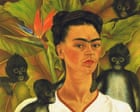
‘I am the subject I know best’ … Kahlo and her pets in Self-Portrait with Monkeys, 1943. Photograph: Archivart/Alamy View image in fullscreen ‘I am the subject I know best’ … Kahlo and her pets in Self-Portrait with Monkeys, 1943. Photograph: Archivart/Alamy Frida Kahlo ‘I call this dish Frida Kahlo Against the World. It’s hot and horny!’ My thrilling week of Fridamania in Mexico City The bar she drank at, the bed she recuperated in, the canals she daytripped to, the studio she stormed out of, the easel she painted her final masterpiece at … ahead of a major Tate show, our writer finds Kahlo’s spirit alive in her home town
Andrew Gilchrist Mon 15 Jun 2026 14.35 CEST Last modified on Mon 15 Jun 2026 16.25 CEST Share Prefer the Guardian on Google ‘T oday you’re going to eat art,” says Federico Valdez, a chef at the School of Mexican Cuisine and a man so passionate about food he has the word Queso (Cheese) tattooed on his forearm. “Today,” continues Valdez, “you’re going to eat history.” What unfolds, in a sun-filled dining room lined with Mexican flowers, books and artefacts, is a three-course feast inspired by Frida Kahlo , her life, her art and her loves, including her first lesbian affair.
The starter, inspired by her childhood fascination with revolution, is a lightly spiced Mexican take on pirozhki, the Russian favourite. The main dish – served with pulque, an agave-derived drink Kahlo loved – taps into her rebellious spirit. “It’s called Frida Against the World,” says Valdez, as we are presented with a giant stuffed chilli that sits amid a nutty, beany sauce similar to the one eaten at Kahlo’s wedding to Diego Rivera, then the most famous artist in the world, now much more in her shadow.
When she found Rivera in bed with her sister, she said: ‘I’m going to get all my furniture and leave. I hate you’ “I wanted this to be hot and horny,” says Valdez, explaining that halved figs were added to reference Kahlo’s sexuality. “Her first love, with a female teacher, happened at a time when Mexico wasn’t so open. I wanted to get in all that spicy gossip. I’m not a big fan of playing it safe.”
View image in fullscreen ‘This is going to blow your mind’ … chef Federico Valdez. Photograph: Courtesy Andrew Gilchrist I’m in Mexico City with a Tate delegation just as the huge jacaranda trees are blooming purple and violet across its parks and boulevards – to follow in Kahlo’s footsteps ahead of Frida: The Making of an Icon , a show of more than 30 of her works at Tate Modern in London that seems destined to be a summer blockbuster, adding yet more fuel to Fridamania.
One work, Self Portrait With Thorn Necklace and Hummingbird, was painted in 1940 after her painful divorce from Rivera. A spider monkey, similar to the one he gave her as a present, is pulling on her thorn necklace, drawing blood. The two soon remarried, Kahlo inscribing the clocks in their house with the years of their separation and reunion.
“The exhibition is like a movie,” says Tobias Ostrander, its curator. “Frida is the star but it’s also about her life, her people, her impact.” Charting Kahlo’s rise from unknown painter to global phenomenon, the show will also examine merch (expect a Kahlo Barbie) and gauge her influence on later artists.
On display, too, will be many of the artist’s treasured possessions, including her brilliantly patterned tehuana dresses. Graciela Iturbide’s ghostly photographs of her crutches, customised medical corsets and prosthetic leg will also feature. These were taken 50 years after Kahlo’s death, when all her belongings were finally freed from the bathroom in which Rivera had ordered them to be locked away.
View image in fullscreen Unseen for 50 years … Kahlo’s prosthetic leg, captured in Graciela Iturbide’s photograph. Photograph: Courtesy of the artist This took place at Casa Azul, the house in Coyoacán (The Place of the Coyote Owners) where Kahlo was born and spent most of her 47 years. It’s now a beautiful, beguiling museum with smooth exterior walls painted a gorgeous blue. These border shiny red concrete paths that thread through fountains and lush gardens bursting with palm, yucca, cactus and bougainvillaea. Off in a corner, seen through trees, a maroon pyramid with yellow steps displays on its ledges Rivera and Kahlo’s pre-Hispanic, Aztec and Toltec artefacts.
“We don’t know exactly where the blue came from,” says Perla Labarthe Álvarez, the museum director. “But in her diary, Frida expressed what the colour meant to her: purity, electricity and love. Because of her health – she had surgery all her life, more than 30 operations – she was at home a lot so it had to be a comfortable place where she could rest. Many of her still lifes were done in the garden. She called her home A Place Full of Places.”
It’s a perfect description. For this is a breathtakingly evocative location, even leaving aside the fact that Trotsky lived here for two years with his wife, having a brief affair with Kahlo.
View image in fullscreen …