
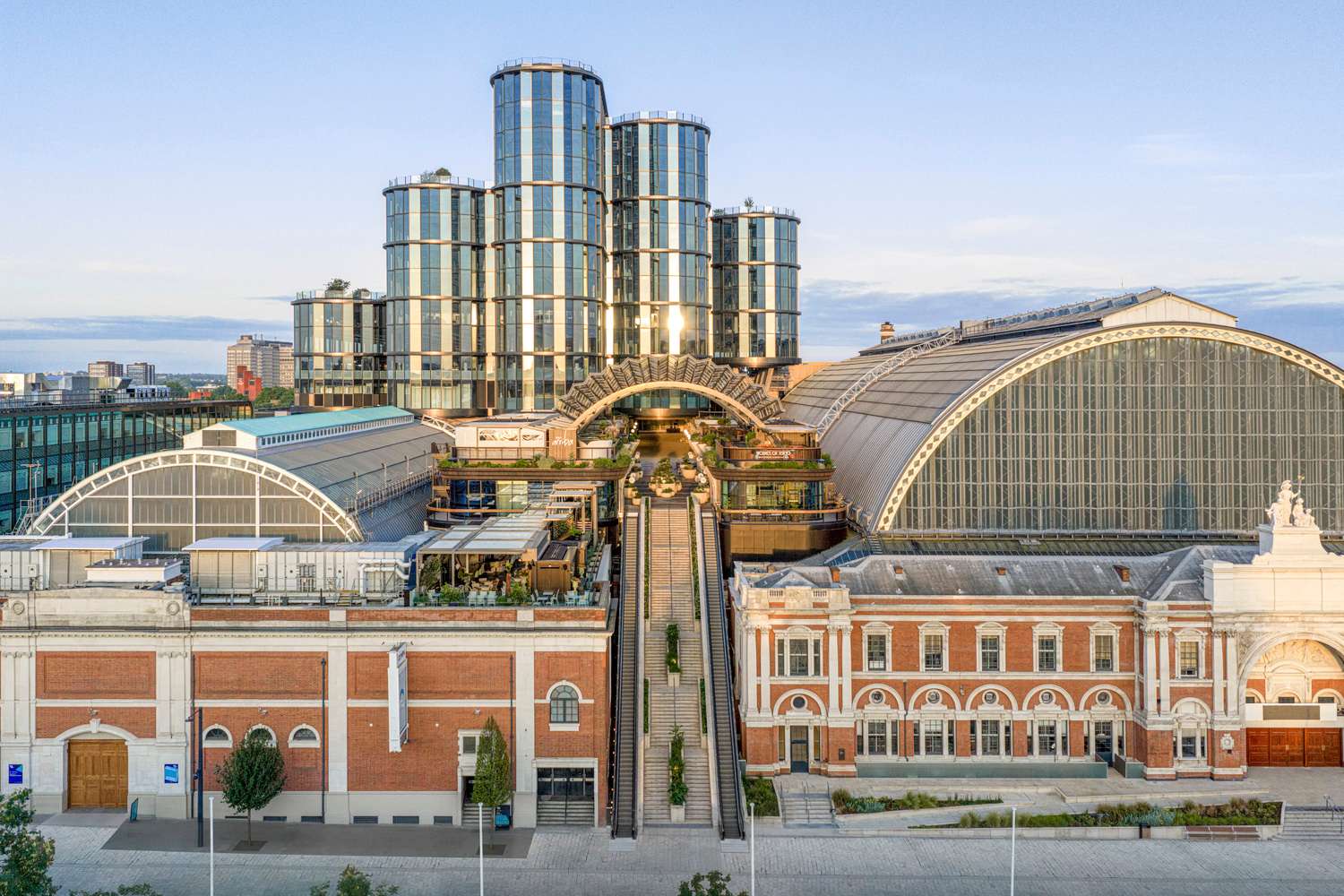
On June 16, 2026, the Folded Glass Canopy opened the first phase of the redesign of the Victorian Exhibition Centre in West London. The Victorian Exhibition Centre, spanning 14 acres, is undergoing a transformation into an open, multi-use cultural campus, replacing the site's historically closed logic with a new network of public streets, elevated walkways, and terraces. The opening move is anchored by a complete public canopy introducing a layer of movement at the second floor above the listed halls, reordering visitor flow and establishing a new threshold between the city and the campus. The broader masterplan extends through 2027, adding exhibition halls, hotels, offices, and community facilities within the existing fabric.
The centre originally opened in 1886 and operated for over a century as a self-contained destination. Visitors would enter for exhibitions and leave without interacting with the surrounding neighborhood. The development addresses this enclosure directly, opening up the masterplan to previously inaccessible areas through a network of new streets, squares, and terraces woven between and around the existing buildings.
Concurrently, the project has relocated the service and logistical infrastructure underground. This move has freed up surface-level space for public use, re-establishing kinetic links between the listed halls. The strategy treats accessibility not as an addition but as an organizing principle for the overall reconfiguration of the campus.
The first completed architectural intervention — the new public canopy — sits at the second floor level above the exhibition halls. It provides approximately 1000 square meters of public space, serving as the primary entry point to the campus. A public stair and escalators extend below, lifting visitors from ground level to the elevated circulation paths above.
Five curved steel arches, each spanning 22 meters, support the canopy structure. The void is covered by a roof made up of 520 folded glass panels. The design team developed the form and details of the canopy in dialogue with the original Victorian fabric of the centre, drawing inspiration from the architectural language of the historic main hall. At the same time, contemporary construction registers itself as a distinct intervention rather than a mimicry.
From the canopy level, visitors gain views over the historic Olympia roof of cast iron and glass. The intervention introduces a new reading of the site — a reading experienced from above, where the layered accumulation of Victorian engineering becomes visible as a connected scene of curved forms and glazed surfaces.
Alongside the canopy, the broader development introduces a dense programmatic mix across the 14-acre site. Planned additions include a 3800-person capacity live performance space and a 1575-seat theatre. Two hotels, restaurants, cafés, and approximately 550,000 square feet of office space form the commercial layer. The plan also reserves dedicated training facilities for local organizations, incorporating community use within the broader commercial campus.
The exhibition halls remain operational throughout the transformation phases. The masterplan schedules completion of the remaining phases over the years 2026 and 2027. More specifically, the phased strategy allows the centre to continue hosting events while the new architecture and public space gradually emerge around it.
The most architecturally significant decision in this first phase is placing the main public threshold at the second floor level rather than at ground level. This move flips the traditional entry sequence of a large urban complex. Instead of entering a ground floor lobby or forecourt, visitors ascend via a system of stairs and escalators before arriving at the canopy — the point at which the campus reveals itself. The canopy thus operates simultaneously as a container, a viewing platform, and a gateway. Its structural logic — five 22-meter arches supporting 520 folded glass panels — borrows the rhythmic repetition of the Victorian halls below, while affirming a different tectonic record through glass instead of cast iron. The real test of the plan comes with the subsequent phases bringing in the theatre, the performance space, and the hotels. The spatial question remains open regarding the upper canopy's ability to retain its role as the main threshold as multiple ground-level programs vie for pedestrian attention. For now, the intervention is successfully recasting a closed campus as a site of public movement and civic use.
Project team: Heatherwick Studio and SPPARC (design architects). The original Victorian centre was designed by Sir Henry Edward Coe. Location: Olympia, West London, United Kingdom.
Project notes: The first phase, including the public canopy, is completed and opened. The broader masterplan extends through 2026 and 2027. The program includes a 3800-person capacity performance space, a 1575-seat theatre, two hotels, approximately 550,000 square feet of office space, restaurants, cafés, and community training facilities. The developer and client source has not been specified.