
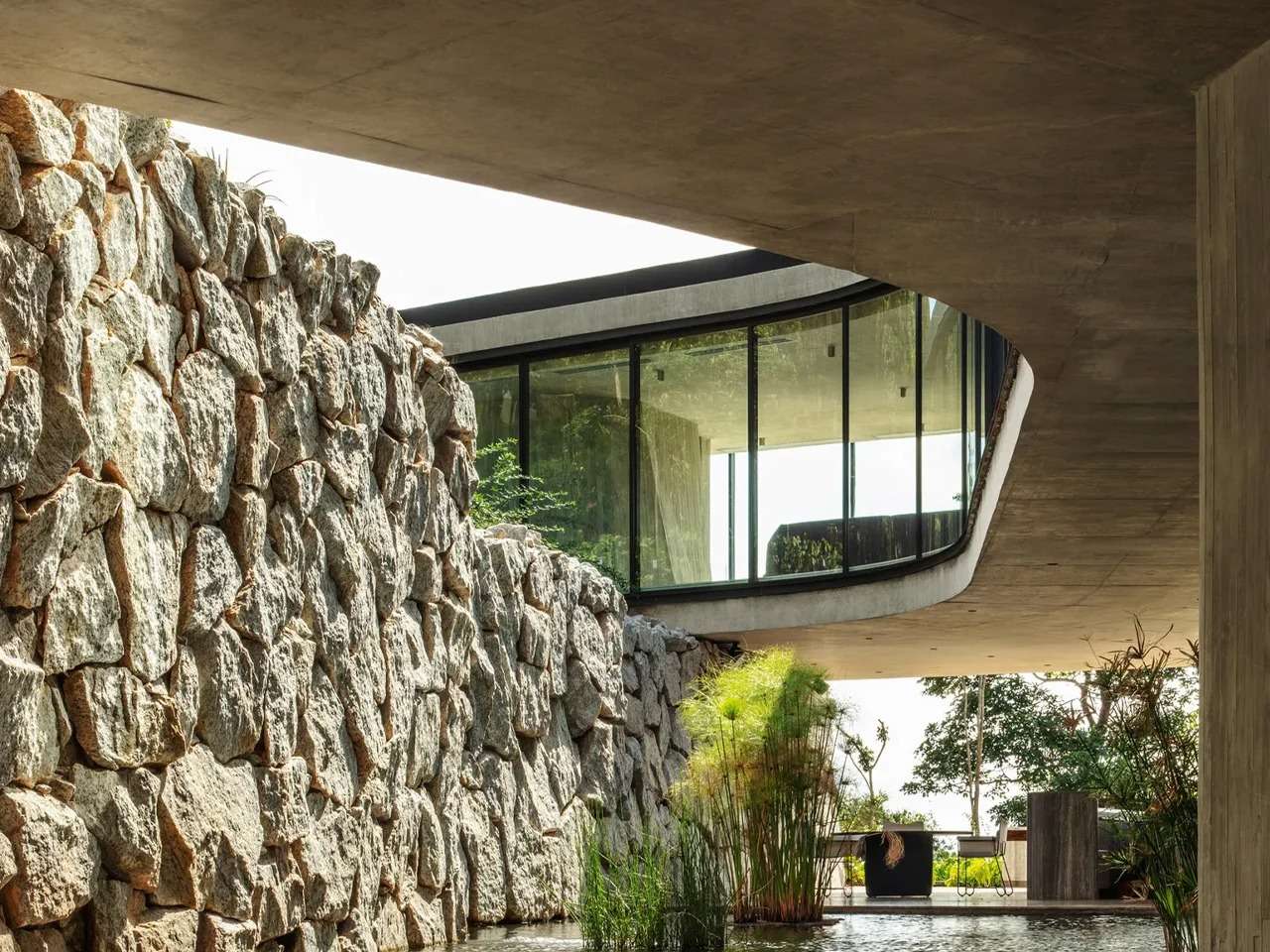
June 15, 2026 June 15, 2026 Home » Projects » Xingu House Redefines the Relationship Between Mass and Natural Terrain The mass formation and dialogue with the terrain does not treat the terrain as a blank canvas, but as an extended geological structure; where the direct response to the nature of the land is manifested in the project's imposition of the Xingu House building atop the old stone walls remaining from a previous construction. The building appears as a physical event that carves through the terrain and emerges from it, rather than merely being a prefabricated structure dropped onto the site. This mass disassembly allows the building to open up to the grassy plateaus and the expansive mountain views, containing the visual and physical pressure imposed by the local forests from the edges, thus creating a dynamic balance between the closure of the mass and its opening.
The spatial experience inside the space is formed based on a continuous material and psychological dialogue with elements of nature and history surrounding it. From the moment of entry and passage between the stone walls, the user feels the effect of time and the physicality of the place through the interplay of shadows with concrete and stone blocks, a scenographic movement that changes throughout the day in response to the path of the sun and the movement of air. This psychological and physical impact extends to connect the user's vertical movement to the core of the earth, where the path beneath these blocks leads to an underground space sculpted within a natural cave, designated in the future for wine making and cheese storage, deepening the sense of living within an integrated geological event.
The architectural perspective of the building is shaped by the idea of strict visual orientation towards the horizon, where the building rises six meters above the natural ground level to float free above the old stone walls. This structural suspension is achieved through thick concrete columns of irregular shapes emerging from below, serving a dual function of both structural support and containing service spaces such as bathrooms, stairs, and the elevator within their solid mass. This mass treatment grants the main wings an uninterrupted panoramic view of the surrounding mountains, creating a visual and material push for the user towards nature through every available angle.
The sculptural movement of the project is distributed across three distinct engineering sectors that extend outward with open arms, each pointing towards a different part of the terrain, making the building extend across the land rather than settling still upon it. The main raised volume contains the core wings, while the other two sectors extend to rest directly on the plateau shaped by the old stone walls, accommodating hospitality units. This mass elongation creates a dynamic scenographic experience for the user as they move between the sectors, where the perception of space shifts between the suspended buoyancy over the concrete columns and the direct material support on the site's historical stone structure.
The relationship between the built structure and nature takes on a more deliberate character in the spa area, where this part is designed as a fully independent volume that physically separates from the main space of the house. This small structure sneaks between the existing trees, avoiding their displacement, reflecting a design language that responds to the forest rather than a forced imposition of mass onto it. Inside, the functional program comprising the sauna, changing rooms, lounge area, and gym flows dynamically and visually through directed openings that allow the interplay of shadows and the flow of fresh air to penetrate deep, achieving a psychological effect that integrates the user of the space into a living environmental experience.
Despite the project's extensive overall area, the architectural formation succeeds in containing the structural and functional complexity and preventing it from turning into visual noise that disrupts the natural scene. This spatial calm is achieved by relying on a frugal and straightforward material language that allows the raw concrete to visually merge with the surrounding local nature. This choice of materials imparts a clear sense of function and purpose, with intricate structural details receding behind a direct and silent material dialogue between the concrete mass, the old stone walls, and the geological site elements.
The thesis frames this architectural work as a seamless geological extension, using concrete minimalism to hide highly complex structural engineering. By elevating the residential mass to adapt to the rugged terrain, the historical ruins transform into spatial pillars, highlighting an extraordinarily luxurious design strategy; where the protection of the site is reduced to a massive capital expenditure and violent material manipulation, turning the surrounding natural environment into merely a silent visual background. Nevertheless, the claim of submission to the environment remains merely an aesthetic illusion; since suspending a concrete mass inevitably requires polluting logistics and a subsoil engineering fixation, placing nature in a position of dependency on the logic of construction.