
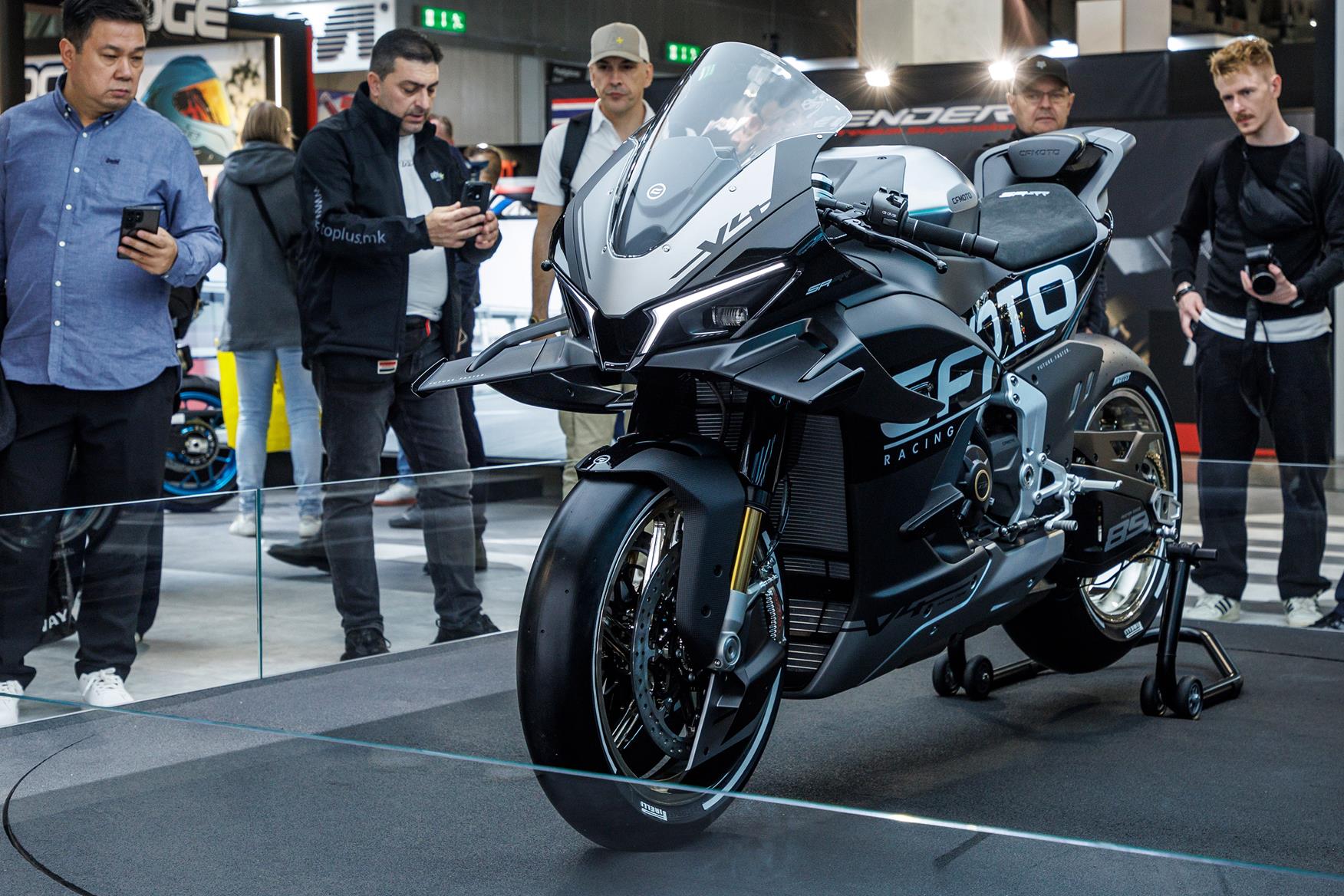
When CFMoto pulled the covers from their prototype V4 SR-RR at last November’s EICMA trade show in Milan it sent a clear statement to the established superbike competition .
Alongside claims of more than 207bhp courtesy of a 997cc V4 engine, exotic suspension and braking components, plus an impressive appearance, the prototype debuted an extreme interpretation of active aerodynamics.
Like this story? You can get more MCN in your life by clicking here and asking Google to make us a preferred source .
“Active aerodynamic wings adjust in real time, responding to speed and riding conditions to deliver exceptional stability, reduced drag, and reach a top speed of over 300kmh (186mph),” a statement claimed.
On the show stand, the bike’s huge wings waggled independently to demonstrate their range of travel. Concept bike nonsense? That doesn’t seem to be the case here.
Prototypes spotted testing on the road in China appear to have had the same wing design, complete with the distinctive pivoting system, and CFMoto have filed patents describing how its moving aero is intended to work in the real world.
The mechanical side of the system – illustrated in the documents – is relatively straightforward. While the drawings show a slightly different wing design, mounted flush on the fairing sides rather than on stubby extensions as on physical concept, the operating theory is likely to be the same.
The wing is attached via a pivoting bearing, which appears to support its weight and the forces running through it, while a connecting rod attaches to an eccentrically mounted peg on the inner side of the fairing to alter the wing’s angle.
The other end of that rod is attached to an electric servo, and by tailoring the length and shape of the connecting rod there’s freedom to mount the servo wherever there’s space inside the fairing.
On the real prototype the wing also has a second support bracket halfway along its length on the top of a vertical aerodynamic element and braced against the fairing behind the wing, to prevent it from flexing under the aerodynamic loads it will be subjected to.
On current bikes with conventional, fixed winglets, the aerodynamic surfaces’ main function is to counter the front-end lift that’s inherent at high speeds, improving stability, and to help counter the bike’s tendency to wheelie under acceleration.
But since adding downforce also means increasing drag, there’s a compromise to made: more wing angle means more downforce, but also more drag and less top speed.
CFMoto’s patent explains how its moving wing will be governed by sensors on the bike and a control unit to alter its angle as required.
In the simplest form it looks set to adopt a fairly flat position during initial acceleration – the patent says more than 0° but less than 10° – to minimise drag, increasing to an angle of between 10° and 20° at high speed to combat front-end lift and ensure stability. But that’s just its most basic operation.
The wings also look to be able to alter their positions if the bike becomes unstable, as determined by the computer, and when the Inertial Measurement Unit (IMU) senses that the bike is leaning into corner. CFMoto’s Eicma prototype demonstrated that the wings could move independently, so each could be able to adopt a different angle as the bike tilts over.
Finally, there’s braking, and this could be the biggest boon of all from the system.
Hit the anchors and the winglets flip to between 45° and 90°, not only increasing the downward pressure on the front wheel but adding drag to increase the overall amount of deceleration possible before the bike starts to pitch forward into a stoppie.
CFMoto’s patent doesn’t just deal with the theories of moving winglets, but also some of the production realities of adopting the system onto mass-made motorcycles.
For example, it makes the point that the electric servo operating each winglet is the most expensive element and ensures it’s protected from damage in three ways.
First, the wing’s overall travel is mechanically limited, so it can’t move outside its predetermined range of movement. Second, the servo drives through a self-locking worm gear, so physically trying to move the wing from outside can’t transfer movement to the motor inside the actuator.
Finally, the connecting rod attaching the servo to the wing is specifically designed to be more fragile than the motor itself. The cheap, easily replaced rod will bend or break before actuator does if someone tries to manually move the wing.
Love it or hate it, motorcycle aero looks to be with us for the foreseeable future, and this looks to be the most interesting application of the tech so far. Use cases beyond extreme superbikes will be where the tech finds its way to most of us, and there’s a potential for this kind of adaptive approach to have a wider window of effectiveness and make a difference that can be felt at road speeds.