
As the wheel of the 2026 World Cup spins, the eyes are not only drawn to tactical plans but the analysis expands to include the 'physical physics' that creates crucial differences on the green grass. This historically largest edition witnesses a sharp contrast between a generation of giants who exploit height to impose aerial dominance, and a group of shorter players who adopt agility and speed to unsettle defenses. This anthropological clash presents intriguing numerical comparisons reflecting how each coach utilizes their players' physical advantages to create superiority.
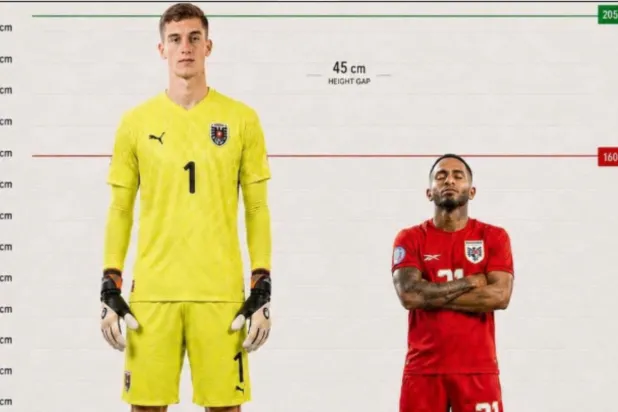
Among the most interesting phenomena this year is the huge height difference between participating players, with the tournament featuring the tallest player at 205 centimeters and the shortest player at 160 centimeters, a gap of up to 45 centimeters between them.
This variation not only reflects the physical differences between players but also confirms that modern football remains a game that embraces all talents, regardless of height or body structure.
The promising Austrian goalkeeper Florian Wiegthl sits atop the physical pyramid of the tournament, with his height of 205 centimeters providing him with an absolute advantage in aerial balls to protect his team's net at Viktoria Plzeň in the Czech league, marking his name as the tallest player to participate in the World Cup at the age of twenty-five.
Florian Wiegthl, Austria national team goalkeeper (Instagram)
Wiegthl is not alone at this upper level, as he is challenged by seasoned English defender Dan Burn, a 34-year-old Newcastle United player, who stands at 201 centimeters, forming a defensive wall that is hard to breach in aerial conflicts.
Seasoned English defender Dan Burn, Newcastle United player (Twitter)
Joining this mighty club are Colombian goalkeeper Álvaro Montero and Bosnian defender Stevan Radelić, both measuring 201 centimeters, reflecting a clear tactical trend among some football schools to rely on large physical blocks to secure their back lines and thwart set pieces.
Conversely, Panamanian star César Yanis emerges as the shortest player in the current World Cup, measuring just 160 centimeters. Despite reaching the age of thirty, the star of Chile's Club Risel compensates for the height difference with amazing agility and a quick ability to change direction that confounds tall defenders.
Following a similar path is young Curacao striker Jeremy Antonis, who stands at 164 centimeters tall and exploits his short stature to navigate tight lines, just like Canadian talent Marcelo Flores of the same height, and speedy Australian striker Nestory Erankonda, measuring 165 centimeters. These stars tactically prove that a lower center of gravity provides players with exceptional balance and higher ability to dribble, making them the ideal weapon to strike slow defensive clusters.
On a collective level, official FIFA numbers reveal that the Norway national team, bolstered by the physique of its star Erling Haaland at 195 centimeters, sits alongside Bosnia and Herzegovina at the top of the tallest teams in the tournament with an average height of 187.2 centimeters, which explains their reliance on long balls and strong physical surges to impose their style. Conversely, Central American and Caribbean teams like Panama and Curacao emerge with lower average heights approaching the 179 centimeters mark, where their technical management bets on close lines, relying on quick short passes and dynamic off-the-ball movements, compensating for the differences in physical infrastructure with tangible skill and tactical superiority on the field.
The history of football provides countless proofs that height has never been a fundamental condition for creating stars or achieving major accomplishments. The late Argentine football legend Diego Maradona led his country to the World Cup title in 1986 despite not having a massive physical structure, and his compatriot Lionel Messi followed the same path, culminating his career by leading Argentina to the World Cup title in 2022.
Lionel Messi, Argentina national team player (AFP)
Other names have also emerged, such as Spaniards Xavi Hernández and Andrés Iniesta, Frenchman N'Golo Kanté, and Croatian Luka Modrić, who created footballing glories thanks to vision, intelligence, and skill rather than relying on physical strength.
Between Wiegthl and Yanis, the 2026 World Cup encapsulates one of the most beautiful truths of the game: the huge height difference did not prevent either from reaching the biggest football event on earth.
As the spotlight shifts to the battle of the giants for the world title, these human stories serve as a reminder that football does not choose its champions based on height or weight, but on talent and the ability to make a difference when the real competition begins on the green pitch.