
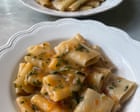
Rachel Roddy’s pasta all’arrabbiata with red onion and plums. Photograph: Rachel Roddy/The Guardian. View image in fullscreen Rachel Roddy’s pasta all’arrabbiata with red onion and plums. Photograph: Rachel Roddy/The Guardian. A kitchen in Rome Food Rachel Roddy’s recipe for pasta all’arrabbiata with red onion and plums Much like tomato, the plum has a natural acidity and sweetness that works brilliantly in a delightfully jammy pasta sauce
Rachel Roddy Thu 19 Nov 2026 07.00 CET Share Prefer the Guardian on Google S tanding on platform 2 at Baker Street station a few weeks ago, a grey creature scuttled under the raised tracks. “You’re never more than six feet away from a rat in London,” I said to my Roman son. “It’s a mouse, Mum,” was his hardboiled reply to my rehashing of an urban myth. A myth that turns out to be inaccurate, according to Dr David Cowan , whose research on the subject resulted in estimates of anything from 10ft-164ft: in other words, while it’s impossible to know for sure, in certain areas you might be very close to a rat.
The same can be said about wild plum trees all over the world. While it’s impossible to know exactly, even in dense urban areas, you might be very close to a wild plum tree or, more correctly, a cultivated plum that has gone feral. Hedgerows, field margins, woodland edges, abandoned parks and wastelands are all places in which you might find yourself close to a plum tree; its branches decorated with fruit, some the size of marbles, others lozenges or eggs, and their spectrum of colour ranging from deep purple to powdery light blue, red, pink, gold and green.
Their flavour also varies according to species and season: astringent to begin with and getting sweeter as they mature. Of course, you should never pick them unless you are absolutely certain they are edible. What is important for this week’s recipe, though, is that the plums – whether wild or cultivated – are firm but not rock-hard, so with good acidity and slight astringency, and their flesh rather like a firm tomato.
In her majestic Fruit book , Jane Grigson compares plums and tomatoes, and in particular their flesh and smooth, thin skins. Italian chef Gianluca Gorini also finds symmetry, using wild plums plus tomato water to produce a velvety sauce that he turns into a version of pasta all’arrabbiata (angry pasta) with plenty of chilli. It’s a dish Gorini serves at his restaurant in San Piero in Bagno, Emilia-Romagna, and the recipe is included in his book La Cucina Radicale (Radical Cuisine) – the title is a reference to the fact that Gorini’s cooking is both related to roots (ingredients and traditions) while at the same time embracing change. It is a brilliant book.
It’s also a brilliant recipe, and one that made me think of European cooks’ first encounters with gold and red fruit in the form of tomatoes from the Americas, eventually (in the case of Italian cooks in the early 1800s) turning them into a sweet, gently acidic sauce. My recipe is a domestic version, and I’m going to anticipate comments about it tasting like pasta with fruit jam or puree by agreeing. Yes, it does. And in much the same way that pasta with silky tomato sauce does – the sweetness met with acidity, heat and herbs.
Olive oil 1 large red onion , peeled and sliced into arcs Salt 300g firm but not rock-hard red plums , stoned and cut into slender wedges 1 ripe, fleshy tomato , roughly chopped 1 tbsp red-wine vinegar 400g pasta (penne, mezze maniche, rigatoni, fus…