
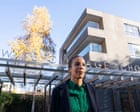
Syra Sowe, the headteacher of Swiss Cottage school, said ‘any limits we think these children have are actually limits on our own imaginations’. Photograph: Antonio Olmos/The Guardian View image in fullscreen Syra Sowe, the headteacher of Swiss Cottage school, said ‘any limits we think these children have are actually limits on our own imaginations’. Photograph: Antonio Olmos/The Guardian Special educational needs ‘We don’t produce Neets’: the London school recognised at World’s Best School awards Swiss Cottage school for children with complex needs is place where ‘every child feels they belong’, education secretary says
Prefer the Guardian on Google For Maria, the hardest part of having a child with complex needs has been the grief: mourning the life she had imagined for her son, for her family – and coming to terms with how lonely the reality of parenting him can be.
“There are wonderful days but there are very hard ones too,” she added, tears coursing down her face.
Thanks to a school dedicated to children and young people with multiple, severe and complex special needs, however, Maria is not alone any more.
Already the recipient of seven consecutive “outstanding” Ofsted ratings, the Swiss Cottage School, Development and Research Centre, operated by the local authority in Camden, has now received worldwide recognition as winner of the World’s Best School prize for community collaboration. It is the first time a school in England has won the prize.
The school has attracted the attention of those in government: the education secretary, Lucy Powell , said it was “a case in point of what we want to replicate through our Send reforms: a system where every child feels they belong and can access the support they need, close to home, without a fight”.
View image in fullscreen Maria with her son Alex, a Swiss Cottage student who has Sotos syndrome. Maria says the school has given Alex ‘back his childhood’. Photograph: Antonio Olmos/The Guardian On paper, the Swiss Cottage school is just one of more than 1,000 state-funded special schools in England, catering for the country’s 10,000-plus children with profound developmental and learning difficulties.
But in reality, “Swiss”, as its families fondly call it, is run very differently. “Swiss has become our second family,” said Maria. “Support for children with complex needs is split across education, healthcare and social services. But Swiss does it all for us.”
“You have no idea,” she added, breathing out a great sigh of relief, “how much stress and weight that removes from parents’ shoulders.”
Instead of focusing solely on teaching their own pupils, Swiss is also different in that it operates an integrated research and training hub, leads teacher training programmes and conducts educational research.
It shares its best practices with hundreds of mainstream and special schools across the UK and internationally: over the last year alone, it has had delegations from South America, Uzbekistan, Saudi Arabia and Sweden.
Syra Sowe, head of the school, is reluctant to name names, but several UK schools have changed their teacher training, curriculums and planning, she said, after Swiss’s input. “Just to be clear, we don’t just use these partnerships to disseminate best practice,” she added. “We also learn from others.”
Until Maria found Swiss, her family were stuck in a nightmare. Her 18-year-old son, Alex, has Sotos syndrome, a rare genetic condition that has left him struggling with epilep…