
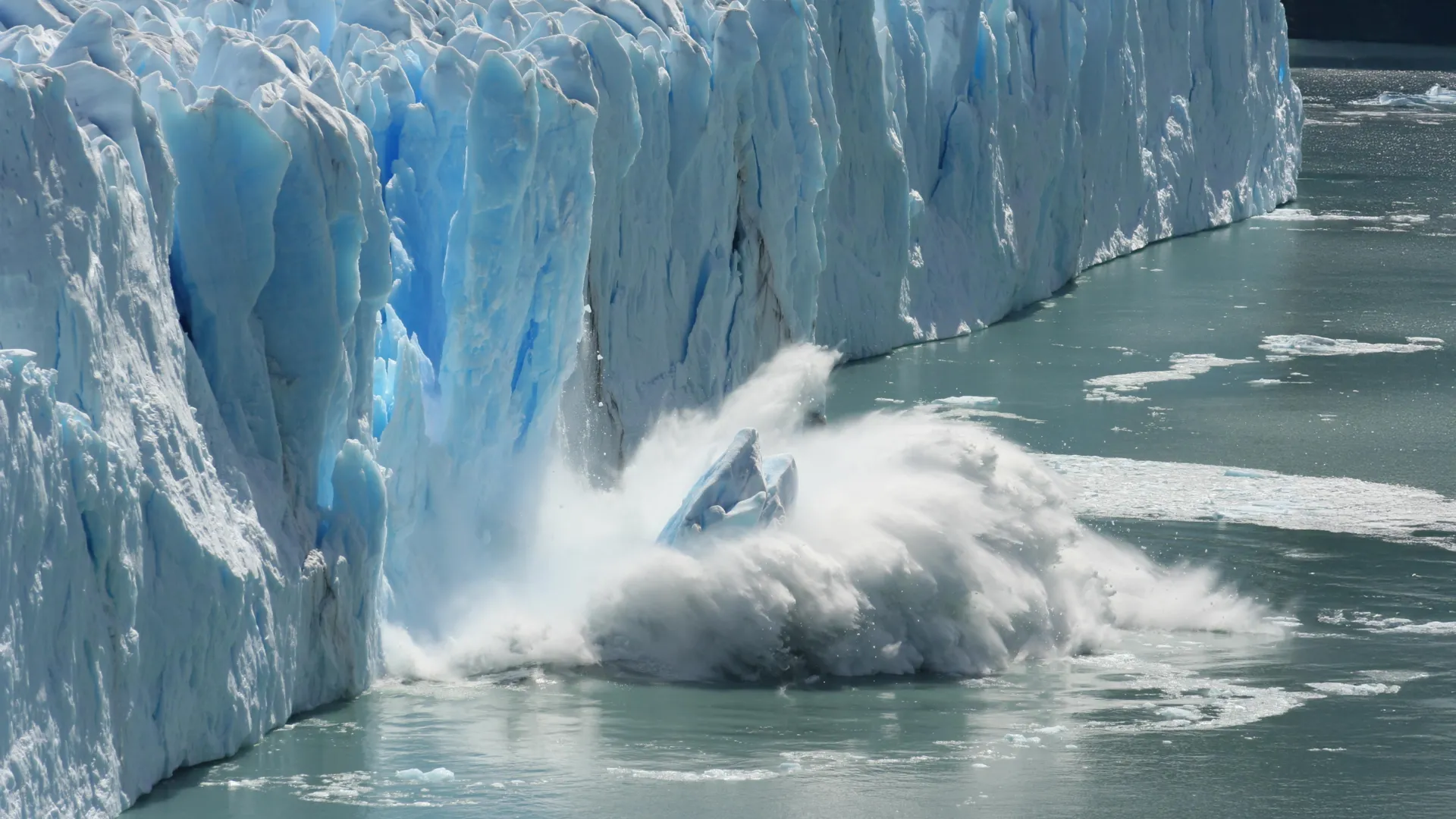
As temperatures rise, the floating ice shelves that help hold Antarctica's massive ice sheet in place are melting and breaking apart at record rates. As these protective barriers disappear, they expose towering walls of solid ice. Whether these cliffs remain standing or collapse could play a major role in Antarctica's future ice loss and its contribution to rising sea levels worldwide.
For years, scientists have believed that ice cliffs become unstable once they exceed 100 meters in height, roughly as tall as the Statue of Liberty. According to this theory, a cliff that grows too tall will collapse under its own weight, exposing an even taller wall of ice farther inland. That new cliff would then collapse, potentially setting off a chain reaction that causes the ice sheet to retreat rapidly.
But new research from MIT and the Woods Hole Oceanographic Institution (WHOI) challenges this long-standing assumption. The findings suggest that the fate of an Antarctic ice cliff depends on much more than its height, and that even dramatic collapses do not necessarily lead to an unstoppable retreat.
Published in the journal Science , the study examined satellite observations of more than 15,000 Antarctic ice cliffs collected over four years. Researchers discovered a surprising pattern: When the cliffs collapsed, they sometimes retreated much faster than existing models predicted. Yet rather than continuing to disintegrate, the affected glaciers soon stabilized.
"We found that when the cliffs were retreating, they were doing so faster than what has been modeled, which would mean more ice loss and higher contributions of sea level rise," says study author Caroline Needell, a graduate student in the MIT-WHOI Joint Program. "But because we found that the retreat was short-lived, and all the glaciers eventually stabilized, that would suggest that things won't be so bad. We don't see this runaway effect."
The study's co-authors are Catherine Walker, an assistant scientist at WHOI, and Jeremy Bassis, an associate professor at the University of Michigan.
Why Scientists Expected Antarctica's Ice Cliffs to Collapse
The possibility of runaway ice cliff collapse is described by a theory called marine ice cliff instability (MICI). It proposes that when an exposed ice wall reaches a critical height, its own weight makes it structurally unstable. If the cliff falls and reveals an even taller wall behind it, the process could repeat, progressively eating away at the Antarctic ice sheet.
Earlier research investigated this possibility primarily through computer models. Scientists used the physical properties of ice to estimate how enormous frozen cliffs should behave, then compared those calculations with a limited number of observations from Antarctica. These studies suggested that cliffs taller than approximately 100 meters were particularly vulnerable to collapse.
"Predictive ice-sheet models that have been used so far to represent ice cliff instability just take into account cliff height," Needell notes. "That's the only variable that matters. And once the cliff height reaches the critical threshold, usually 100 meters, it should initiate this runaway effect of ice sheet retreat."
Needell and her colleagues wanted to test those predictions against a much larger collection of real-world measurements. They sought to determine how tall Antarctica's ice cliffs actually become and whether their collapse consistently triggers the destructive chain reactions…